If you searched for “Droven.io AI Automation in USA,” you may have expected to find an AI software product, an automation platform, or a SaaS company offering business automation services.
That assumption is understandable. Droven.io publishes extensively about Artificial Intelligence, AI tools, automation, RPA, machine learning, digital transformation, and business technology. Its website also has an “AI Automation for Work” category, which can make the name sound like a software product rather than an information resource.
There is an important distinction, though. Droven.io currently presents itself as an editorial technology platform, not as a standalone automation application that businesses log into to run workflows. Its homepage describes the site as a guide to AI, emerging technology, startups, and business strategies.
That difference matters if you’re trying to answer questions such as “What is Droven.io?”, “Is Droven.io an AI tool?”, or “Can I use Droven.io for business automation?”
This 2026 guide separates those questions from the much larger topic of AI automation in the USA. It also explains how genuine AI-powered automation works, where businesses use it, what technologies sit underneath it, and what you should check before adopting an automation system.
What Is Droven.io?
Droven.io is best understood as an AI and technology editorial platform. Its public website covers topics including artificial intelligence, AI tools, machine learning, generative AI, robotics, software development, automation, digital transformation, and emerging technology.
That positioning makes Droven.io useful as an informational resource. A business owner can research an unfamiliar technology, learn how an automation concept works, and then investigate actual software products separately.
In other words, Droven.io sits closer to a technology knowledge hub than a traditional SaaS automation platform.
What the Droven.io Website Actually Represents
The site’s own description is fairly direct. Droven.io says it publishes content at the intersection of Artificial Intelligence, emerging technology, and modern business. It also organizes its material into areas such as AI tools, machine learning, generative AI, automation, software development, and future technology.
Its content includes practical explainers about AI applications and automation. For example, the site has published material covering AI agent assist, where AI can help customer support employees draft replies, summarize tickets, suggest knowledge articles, and identify coaching signals.
That kind of article explains an AI technology or business use case. It doesn’t necessarily mean Droven.io itself supplies the underlying software.
What Droven.io Says About AI and Automation
The strongest evidence comes from the site’s own content structure. Droven.io maintains dedicated areas for AI Automation for Work, Automation & RPA, AI in business processes, machine learning, and other technology topics.
That explains why the website can appear in searches related to Droven.io automation tools, Droven.io AI technology, or Droven.io AI systems. The site discusses these subjects directly.
However, there’s a big difference between covering AI automation and selling AI automation software. A technology publication can explain CRM automation without operating a CRM. It can explain RPA without providing an RPA bot. The same principle applies here.
Is Droven.io an AI Automation Software Tool?
Based on its current public positioning, Droven.io is not presented as a standalone AI automation software product.
The homepage identifies Droven.io as an editorial platform, while its navigation points readers toward technology information and articles rather than a workflow builder, automation dashboard, or software application.
That’s an important answer for anyone searching “Is Droven.io an AI tool?” or “Is Droven.io an automation platform?” The site discusses AI tools and automation, but that doesn’t make the website itself an AI automation platform.
A genuine automation product normally provides some combination of workflow configuration, triggers, actions, integrations, user accounts, execution controls, monitoring, and technical documentation. Those are the features that allow software to actually perform automated business processes.
Why People Search for “Droven.io AI Automation in USA”
The phrase “Droven.io AI Automation in USA” combines a specific website name with a broad technology category and a geographic modifier.
That creates a classic case of search intent confusion. Someone may be trying to find information about Droven.io. Another person may be looking for AI automation software available to American businesses. A third person may simply want to understand how Droven.io relates to automation.
Those are different questions even though the search terms overlap.
The Difference Between a Search Term and a Product Category
Search engines don’t require a phrase to describe a formal product category.
People search in shorthand. They combine brand names, technologies, locations, and problems into one query. A phrase such as “Droven.io AI automation tools” can therefore describe someone’s research process rather than the name of an actual product.
This is why search behavior shouldn’t be treated as product documentation.
The safest approach is to separate the target keyword from the underlying fact. “Droven.io AI Automation” may be a useful search phrase, but the question remains: What does Droven.io actually provide?
Why Search Intent Around Droven.io Can Be Confusing
Droven.io publishes content about AI automation, RPA, AI tools, and digital transformation. Its AI category also includes articles about AI tools, generative AI, business applications, and automation-related subjects.
Naturally, readers can associate the site with the technologies it covers.
That association doesn’t establish that Droven.io runs those systems. It simply tells you what the site’s content focuses on.
What “In USA” Means for Businesses
The AI automation USA market includes everything from simple no-code workflows to large enterprise AI systems.
For a U.S. company, choosing an automation solution involves more than asking whether the software has AI. Data handling, access controls, vendor practices, integration requirements, compliance obligations, and human oversight can all matter.
The National Institute of Standards and Technology recommends a structured approach to managing AI risks through its AI Risk Management Framework, which organizations can use when designing, deploying, and evaluating AI systems. NIST’s generative AI profile also addresses risks and recommended actions specific to generative AI.
So, “in the USA” isn’t simply a location tag. It can change the practical questions a business should ask before putting customer, employee, financial, or operational data into an AI system.
What AI Automation Actually Means in 2026
AI automation combines artificial intelligence with automated workflows so systems can interpret information, make predictions or recommendations, and trigger actions with limited human intervention.
Traditional automation usually follows predictable instructions. For example:
If a customer submits a form, create a CRM record and send an email.
AI automation can handle messier inputs. It might read the customer’s message, determine the request type, extract relevant details, check a knowledge base, draft a response, and then route the case to the right employee.
IBM describes an AI workflow as a process in which AI-powered technologies automate or streamline organizational activities. Those systems can operate autonomously or work alongside people.
AI Automation vs Traditional Automation
Traditional workflow automation works particularly well when the rules are clear.
For instance, a business could automatically send an invoice reminder seven days after an invoice becomes overdue. No machine learning is necessary. The trigger and action are already known.
AI becomes more useful when the input requires interpretation.
A support system may need to distinguish between a refund request, technical complaint, billing question, and urgent escalation. That’s where Natural Language Processing, machine learning, or a language model can add value.
AI Agents vs AI Automation
The terms AI agents, AI automation, and intelligent automation are often mixed together, but they aren’t identical.
An automated workflow may have a fixed sequence of actions. An AI agent can have more flexibility in deciding which tools or steps to use to achieve a goal.
That doesn’t mean every AI agent should operate without supervision. For sensitive tasks, a human approval step can be the smartest design.
Human-in-the-Loop Automation
The best business automation isn’t always the most autonomous system.
Imagine a financial-services workflow that receives a suspicious transaction alert. AI might identify unusual behavior and assign a risk score. An employee can then review the evidence before any consequential action occurs.
This model creates human-AI collaboration rather than pretending that software never makes mistakes.
For many organizations, that’s a more practical route toward intelligent automation. The machine handles volume and pattern recognition. The person handles judgment, exceptions, and accountability.
How AI Automation Works Behind the Scenes
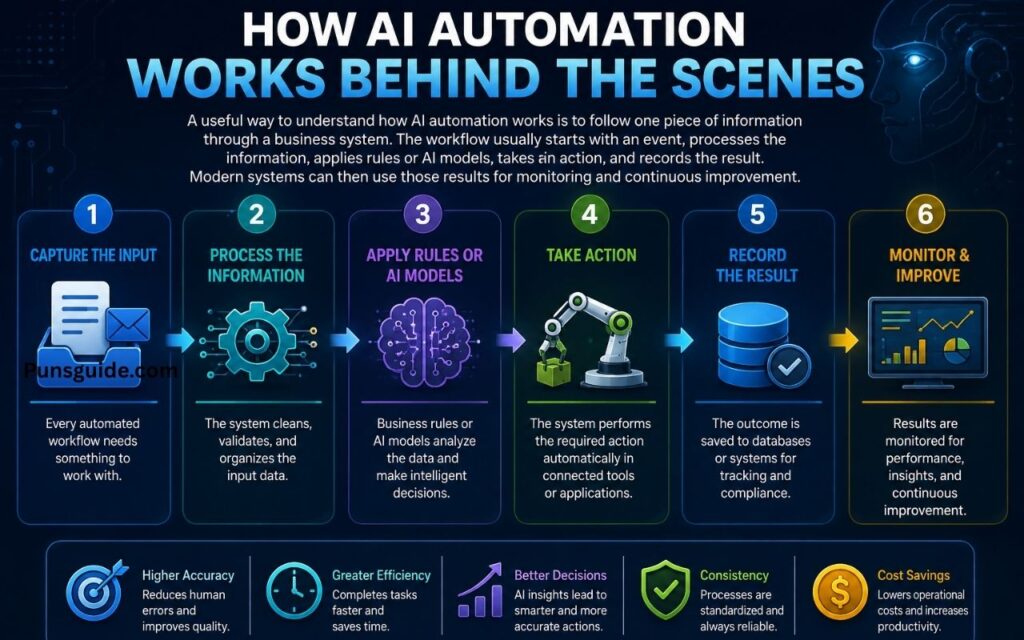
A useful way to understand how AI automation works is to follow one piece of information through a business system.
The workflow usually starts with an event, processes the information, applies rules or AI models, takes an action, and records the result. Modern systems can then use those results for monitoring and continuous improvement.
Step 1 — Capture the Input
Every automated workflow needs something to work with.
The input might come from an email, website form, customer message, document, CRM record, API request, sensor, transaction, or internal database.
For example, an eCommerce company might receive thousands of customer messages about orders. The automation system first needs access to those messages and their relevant order information.
Step 2 — Understand the Information
This is where AI can make the workflow more flexible.
Natural Language Processing can classify a message, identify names or order numbers, summarize a complaint, or detect intent. A machine-learning model might classify a transaction as normal or suspicious.
Generative AI can also produce text, summarize documents, or draft responses. The exact technology depends on the task.
Step 3 — Apply Business Logic
AI output shouldn’t automatically become business policy.
A system can combine an AI prediction with deterministic rules. For example, an AI model might classify a customer request as a cancellation, while a business rule checks whether the order has already shipped.
This combination of AI decision systems and traditional workflow logic is often more reliable than relying on an AI model alone.
Step 4 — Trigger an Action
Once the system has enough information, it can perform an action.
That could mean updating a CRM record, creating a support ticket, sending a personalized email, assigning a lead to a salesperson, generating a report, or requesting human review.
This is where AI moves beyond simple conversation and becomes part of business process automation.
Step 5 — Validate the Result
A mature automation system checks its work.
Confidence thresholds, validation rules, approval queues, exception handling, and audit logs can prevent small AI errors from becoming expensive business mistakes.
If the system isn’t confident enough, it can send the task to a person instead of forcing an answer.
Step 6 — Monitor and Improve the Workflow
Automation isn’t a “set it and forget it” project.
Businesses should monitor error rates, processing time, escalation rates, customer outcomes, and other performance indicators. When problems appear, teams can adjust the workflow, improve the data, change business rules, or refine the AI component.
That’s workflow optimization in practice.
Technologies That Power Modern AI Automation
Behind most modern AI automation tools sits a collection of technologies rather than one magical AI engine.
Some systems rely heavily on large language models. Others use machine learning, RPA, predictive analytics, APIs, databases, or a combination of several technologies.
Large Language Models and Generative AI
Large language models can process and generate natural language at scale.
Businesses can use them for document summarization, customer-message classification, content drafting, information extraction, internal knowledge queries, and other language-heavy tasks.
The model itself isn’t the entire automation system, though. A language model needs surrounding workflow logic, data access, permissions, integrations, and safeguards before it can reliably perform business work.
Machine Learning
Machine Learning allows systems to identify patterns in data and produce predictions or classifications.
Common applications include lead scoring, fraud detection, demand prediction, customer behavior prediction, recommendation engines, and anomaly detection.
A retailer, for example, might analyze historical purchasing behavior to estimate future demand. That prediction can then feed into an inventory workflow.
Natural Language Processing
Natural Language Processing helps software work with human language.
It can support intent detection, sentiment analysis, entity extraction, document classification, summarization, translation, and conversational interfaces.
Customer support is a particularly clear example. Instead of forcing customers to select from rigid menus, an AI system can interpret what someone actually wrote and route the request accordingly.
Robotic Process Automation
Robotic Process Automation, or RPA, focuses on automating repetitive digital actions.
RPA bots can interact with software interfaces and perform structured tasks such as copying information between systems, updating records, processing documents, or generating routine reports. IBM notes that RPA is designed to automate robotic processes and can support administrative workflows.
AI and RPA can work together. AI can interpret an unstructured document while RPA handles the predictable steps required to move that information between legacy systems.
APIs and Business Integrations
An automation system becomes far more useful when it can communicate with other applications.
CRM integration, APIs, webhooks, databases, email systems, help desks, payment platforms, and business applications allow information to move between systems.
This creates a connected automation ecosystem instead of a collection of isolated AI tools.
Data Pipelines and Knowledge Bases
AI systems are only as useful as the information they can access.
A customer-support workflow might need product documentation, account information, policies, previous conversations, and order data. A sales system might need CRM records and buying-intent signals.
Good data integration therefore matters just as much as the AI model.
A Real-World AI Automation Workflow
Consider a U.S. online retailer receiving hundreds of customer-support messages every day.
A customer writes, “My package says delivered, but I don’t have it.”
The workflow can classify the request, identify the order, check shipping information, retrieve the company’s missing-package policy, and prepare an appropriate response.
The process could look like this:
Customer message → AI classification → Order lookup → Policy retrieval → Response draft → Confidence check → Human review if needed → CRM update → Customer response
The important part isn’t the flashy AI layer. It’s the connection between every stage.
What Happens When AI Gets It Wrong?
AI systems can misinterpret ambiguous language, work with incomplete information, or generate an answer that sounds convincing but isn’t correct.
That’s why production-grade automated workflows need exception paths.
If an order number is missing, the system can ask for it. If the customer’s request doesn’t fit a known category, the workflow can escalate it. If the AI confidence score falls below a threshold, a human can take over.
A good automation system knows when not to automate.
Measuring Whether the Automation Works
Businesses shouldn’t measure success simply by counting automated tasks.
A better measurement framework includes:
| Metric | Why It Matters |
|---|---|
| Processing time | Shows whether workflows actually move faster |
| Error rate | Reveals whether automation creates costly mistakes |
| Escalation rate | Shows how often humans need to intervene |
| Cost per task | Helps estimate financial impact |
| Resolution rate | Measures whether customers get useful outcomes |
| Customer satisfaction | Captures the experience beyond speed |
| Employee time saved | Shows operational impact |
| ROI | Connects automation to business value |
That shift from “How much did we automate?” to “What improved?” separates useful business automation from technology theater.
Where U.S. Businesses Use AI Automation
AI automation has applications across industries, but the strongest opportunities usually involve repetitive work, large data volumes, predictable decisions, or language-heavy processes.
Customer Service
Support teams can use AI assistants for business, ticket classification, conversation summaries, knowledge suggestions, response drafting, and routing.
Droven.io itself has published an AI agent-assist guide that describes features such as reply drafting, knowledge suggestions, ticket summaries, macro recommendations, and coaching signals.
These examples illustrate an important principle: AI doesn’t have to replace the support employee to create value.
Sales and Marketing
Sales teams can automate lead enrichment, lead scoring, CRM updates, meeting summaries, personalized emails, and follow-up workflows.
Marketing teams can also use AI for content production, customer segmentation, campaign analysis, and personalized communication.
The goal isn’t to automate every creative decision. It’s to remove repetitive administrative work so employees can spend more time on strategy and customer relationships.
Finance and Accounting
Finance teams can automate invoice extraction, expense categorization, document processing, reconciliation support, and anomaly detection.
Financial fraud detection is another important application. Machine-learning systems can analyze transaction patterns and flag activity that deserves closer inspection.
Because financial workflows can carry serious consequences, human review and strong controls remain important.
Healthcare
AI automation in healthcare can support administrative work, document processing, scheduling, patient communication, and data analysis.
AI-assisted systems can also contribute to areas such as patient data analysis or clinical decision support. However, healthcare automation requires careful attention to privacy, security, validation, and professional oversight.
A high-stakes environment isn’t the place for blind automation.
Retail and eCommerce
Retailers can use retail automation and eCommerce automation for customer support, product data processing, demand forecasting, personalized recommendations, abandoned-cart workflows, and inventory management.
A recommendation engine can analyze customer behavior and suggest products. A demand-prediction model can help estimate future inventory requirements.
The technology becomes valuable when predictions connect directly to operational workflows.
Logistics
Logistics automation can support shipment processing, route optimization, delivery forecasting, document handling, and exception management.
For example, an AI system might identify a shipment likely to experience a delay. An automated workflow could notify an operations team before the delay becomes a customer complaint.
That’s a practical example of real-time business optimization.
Real Estate
Real estate businesses can apply AI to lead scoring, inquiry classification, listing workflows, customer follow-up, and market analysis.
Real estate lead scoring can help sales teams prioritize prospects based on available signals rather than treating every inquiry identically.
Again, AI provides the prediction. The business still decides how that prediction should influence action.
Droven.io AI Automation vs a Real Automation Platform
The cleanest comparison isn’t “Which one is better?”
They serve different purposes.
| Capability | Droven.io | Typical AI Automation Platform |
| Educational technology content | Yes | Usually secondary |
| AI explainers | Yes | Sometimes |
| Workflow execution | Not presented as its core function | Core function |
| Automated triggers | Not presented as a product feature | Common |
| App integrations | Not presented as a core product feature | Common |
| Workflow builder | Not presented as a core product feature | Common |
| AI-powered actions | Discussed through content | Often available |
| Business process execution | Not its stated role | Core purpose |
| Technical automation controls | Not its primary positioning | Common |
Droven.io’s own homepage positions the site as an editorial platform covering AI and technology.
So if you’re looking for AI automation software for business, the right next step is to evaluate actual software products based on their capabilities rather than assuming that an educational website is an automation engine.
How to Implement AI Automation in a U.S. Business
The biggest mistake businesses make is starting with the technology.
Start with the process instead.
Start With One Repetitive Workflow
Find a task employees perform repeatedly.
Customer-ticket classification is a good example. So is extracting information from invoices, summarizing meetings, updating CRM records, or routing incoming leads.
A narrow workflow gives you something measurable. It also keeps the first implementation from becoming a sprawling technology project.
Map the Existing Process
Write the process down:
Trigger → Input → Decision → Action → Review → Outcome
Then look for bottlenecks.
Which steps consume the most employee time? Which tasks require judgment? Which actions follow consistent rules? Where do mistakes happen?
Those answers reveal where intelligent automation could actually help.
Choose the Right Architecture
Not every problem needs AI.
Use straightforward workflow automation when the rules are predictable. Consider RPA when software must interact with older interfaces. Use machine learning for prediction or classification. Use generative AI for language-heavy tasks.
Sometimes the strongest solution is a hybrid.
Connect Business Systems
Automation becomes much more valuable when systems can exchange information.
A useful setup might connect a CRM, email platform, help desk, knowledge base, analytics system, and internal database.
That’s where APIs and system integration become critical.
Build Guardrails Before Going Live
Before deployment, define what the automation can and cannot do.
Use permission controls, validation rules, approval steps, logging, confidence thresholds, and escalation paths where appropriate.
NIST’s AI Risk Management Framework is designed to help organizations incorporate trustworthiness considerations into the design, development, use, and evaluation of AI systems.
Test Realistic Edge Cases
Don’t test only the easy examples.
Try incomplete data, contradictory information, unusual customer requests, duplicate records, unexpected wording, failed integrations, and low-confidence AI outputs.
Real business data is messy. Your automation should be tested against that mess before customers encounter it.
AI Automation Costs in the USA
There isn’t one standard price for AI automation USA projects.
A simple workflow using a no-code tool may cost relatively little. A custom enterprise system involving multiple applications, large data volumes, security requirements, custom models, and ongoing monitoring can cost dramatically more.
The main cost drivers include AI usage, workflow complexity, integrations, implementation time, data preparation, security requirements, maintenance, and human review.
Subscription Tools vs Custom Automation
No-code automation tools can make it easier for small teams to build workflows without extensive programming.
Custom development makes more sense when a company needs specialized logic, deep integrations, unusual data requirements, or tighter control over the entire system.
Neither approach wins automatically. The right choice depends on the business problem.
Hidden Costs Businesses Should Budget For
The software subscription is rarely the entire cost.
Businesses should also consider integration work, data cleanup, testing, employee training, monitoring, workflow maintenance, security reviews, and future changes.
A cheap automation that fails every third task can become expensive surprisingly quickly.
Security, Privacy, and Compliance Considerations
The moment an AI system touches business data, security becomes part of the automation project.
That includes customer information, employee records, financial data, proprietary documents, internal communications, and credentials.
What Happens to Business Data?
Before adopting an AI platform, understand how it handles your information.
Check data retention, storage, processing, access controls, third-party providers, and contractual terms. Don’t assume that every AI service treats business data in the same way.
Access Control and Permissions
An automation system should have only the access it needs.
If a workflow only needs to read customer orders, it shouldn’t automatically receive permission to modify financial records.
Least-privilege access reduces the potential damage caused by errors, compromised credentials, or poorly designed workflows.
Audit Trails and Accountability
Businesses need to know what happened when an automated process produces an important result.
Logs can record inputs, actions, approvals, errors, and system responses. That information makes troubleshooting easier and provides accountability.
For high-impact AI applications, governance isn’t bureaucracy for its own sake. It becomes part of responsible system design.
Industry-Specific Requirements
Different industries face different requirements.
A healthcare workflow may involve sensitive patient information. A financial workflow may influence transactions or risk decisions. A government workflow may involve additional security and procurement requirements.
The same automation architecture shouldn’t be copied blindly across every industry.
Common AI Automation Mistakes to Avoid
AI automation can save enormous amounts of time, but poor implementation can create a faster version of a bad process.
The technology deserves less hype and more process discipline.
Automating a Broken Process
If five unnecessary approvals exist in a workflow, automating all five doesn’t solve the underlying problem.
First simplify the process. Then automate the useful parts.
Giving AI Too Much Authority
An AI model can classify an email. That doesn’t mean it should automatically issue refunds, delete accounts, approve payments, or make other irreversible decisions.
Use approval gates when the consequences justify them.
Ignoring Data Quality
Poor data produces poor automation.
Outdated customer records, duplicate entries, inconsistent product information, and missing fields can undermine even sophisticated AI systems.
Before investing heavily in AI, examine the data feeding the workflow.
Treating AI Output as Guaranteed Truth
AI systems can be remarkably useful without being infallible.
Generated text, predictions, classifications, and summaries should have appropriate verification mechanisms. The more consequential the decision, the stronger those controls should become.
Measuring Activity Instead of Results
A workflow that processes 100,000 records isn’t necessarily successful.
If it creates thousands of errors, frustrates employees, or produces no measurable business benefit, the automation failed despite its impressive activity count.
Focus on operational efficiency, business efficiency, accuracy, customer experience, cost reduction, and measurable outcomes.
How to Verify AI Automation Claims About Any Website
The internet is full of technology terminology. Words such as AI, automation, intelligent systems, and digital transformation can appear on pages that don’t provide any actual software.
That makes verification essential.
Check the Official Product Pages
Look for concrete capabilities.
A real automation platform should be able to explain what users can actually do with it. Look for workflows, triggers, actions, integrations, user controls, pricing, limits, and product documentation.
Read the Documentation
Documentation tells you far more than marketing slogans.
Look for API references, integration guides, workflow examples, authentication requirements, deployment information, and technical limitations.
If a supposed automation platform has no meaningful explanation of how its product works, that’s worth investigating.
Look for Demonstrable Features
Screenshots, demos, workflow builders, product tours, integration directories, and technical examples can help establish whether a claimed product actually exists in usable form.
The more specific the evidence, the better.
Check Company and Legal Information
Review the privacy policy, terms of service, company information, support details, and data-processing information.
For U.S. businesses, these details can matter before sensitive information enters an external system.
Don’t Confuse SEO Pages With Product Documentation
This point deserves emphasis.
A page optimized around terms such as “Droven.io AI automation,” “AI automation tools,” or “business automation” can rank for those phrases without proving that the website sells an automation product.
Search visibility and product capability are separate things.
Droven.io AI Automation: What Readers Should Know in 2026
The most defensible conclusion is straightforward: Droven.io is an editorial technology platform that publishes information about AI, automation, and related technologies rather than presenting itself as a standalone AI workflow product.
That distinction doesn’t make the site irrelevant to AI automation. Quite the opposite. Its categories and articles cover the concepts businesses need to understand before selecting technology, including AI tools, machine learning, automation, RPA, and digital transformation.
The mistake would be turning that educational connection into an unsupported software claim.
What Can Be Confirmed
Droven.io publicly presents itself as a technology and AI editorial platform.
Its content covers Artificial Intelligence, AI tools, machine learning, generative AI, robotics, software development, automation, digital transformation, and future technology.
It also publishes practical articles discussing AI automation concepts, including customer-support workflows and agent-assist systems.
What Shouldn’t Be Assumed
Don’t assume that because Droven.io discusses automation, it runs automation workflows for customers.
Don’t assume that because a page mentions AI agents, the website provides an AI-agent product.
And don’t assume that the phrase “Droven.io AI Automation in USA” describes an official product name.
The public evidence supports a much simpler explanation: Droven.io is a technology information platform that covers the AI and automation ecosystem.
What Businesses Should Look For Instead
If your goal is to purchase AI automation software, evaluate the actual capabilities you need.
Look for workflow execution, integrations, security controls, data policies, human-approval features, monitoring, documentation, support, pricing, and measurable business outcomes.
A useful automation platform should solve a specific operational problem. Fancy terminology comes second.
Frequently Asked Questions About Droven.io and AI Automation
What is Droven.io?
Droven.io is a technology and AI editorial platform. Its public website focuses on artificial intelligence, emerging technology, software, digital transformation, automation, and related subjects.
It is better understood as an information resource than as a standalone business automation application.
Is Droven.io an AI tool?
No evidence on its current public positioning indicates that Droven.io itself is a conventional AI software tool.
The website publishes information about AI tools and applications, but discussing a technology is different from providing the software that operates it.
Is Droven.io an automation platform?
Droven.io is not publicly positioned as a conventional automation platform that lets customers build and execute business workflows.
Its content does cover AI Automation for Work and Automation & RPA, which helps explain why people associate the site with automation.
What is AI automation?
AI automation combines AI capabilities with automated workflows to interpret information, make predictions or recommendations, and trigger business actions.
A simple example is an AI system that reads customer messages, identifies the request type, retrieves relevant information, drafts a response, and sends the case to a human when confidence is low.
How does AI automation work?
Most systems follow a sequence such as:
Input → AI processing → Business rules → Action → Validation → Monitoring
The exact architecture varies by application, but the principle remains the same: AI handles tasks requiring interpretation or prediction while automation connects those capabilities to business processes.
What’s the difference between AI automation and RPA?
RPA focuses primarily on automating structured digital actions.
AI can add interpretation, prediction, classification, language understanding, or generation. When the two technologies work together, AI can handle messy information while RPA performs predictable actions across existing applications.
Is AI automation useful for small U.S. businesses?
Yes, when the workflow justifies it.
Small businesses can start with focused applications such as lead routing, customer support, appointment communication, document processing, CRM updates, or email automation.
The best starting point is usually a repetitive process with measurable costs rather than a vague goal such as “use more AI.”
How much does AI automation cost in the USA?
Costs vary widely.
A simple no-code workflow may require little development, while a custom enterprise system can involve significant expenses for integrations, AI usage, security, data preparation, monitoring, and maintenance.
The right question isn’t simply “How much does AI automation cost?” It’s “How much value will this particular workflow create?”
Is AI automation safe for business data?
It can be, but safety depends on how the system is designed and operated.
Businesses should evaluate data handling, permissions, encryption, retention, third-party access, monitoring, model behavior, and human oversight. NIST’s AI Risk Management Framework provides a useful foundation for thinking about trustworthy AI practices.
Final Verdict: Understanding Droven.io and AI Automation
The phrase “Droven.io AI Automation in USA” sounds like the name of an automation product. The public evidence points somewhere more nuanced.
Droven.io presents itself as an editorial technology platform covering AI, automation, machine learning, software, digital transformation, and emerging technology. It publishes material that explains automation concepts and AI applications, including AI agent assist and other business-focused topics.
That makes Droven.io relevant to the AI automation ecosystem, but it shouldn’t automatically be described as an AI automation SaaS product.
For businesses in the United States, the larger lesson is useful. AI automation isn’t a single tool. It’s an approach to connecting artificial intelligence with real business processes. The strongest implementations combine good data, sensible workflows, appropriate AI models, reliable integrations, security controls, and human judgment.
If you’re evaluating an AI automation platform, start with the problem rather than the buzzword. Find one repetitive process. Measure its current cost and performance. Then determine whether workflow automation, RPA, machine learning, generative AI, or a combination of technologies can improve it.
That approach is far more valuable than chasing whatever happens to be the newest AI phrase in the search results.

Jhon AJS, the creative mind behind Puns Guide, is an experienced blogger with a knack for wordplay and witty humor. Passionate about blending laughter with language, he crafts engaging pun filled content that entertains and inspires readers. With years of blogging expertise, Jhon continues to share clever insights, making every visit to Puns Guide a fun and refreshing experience.