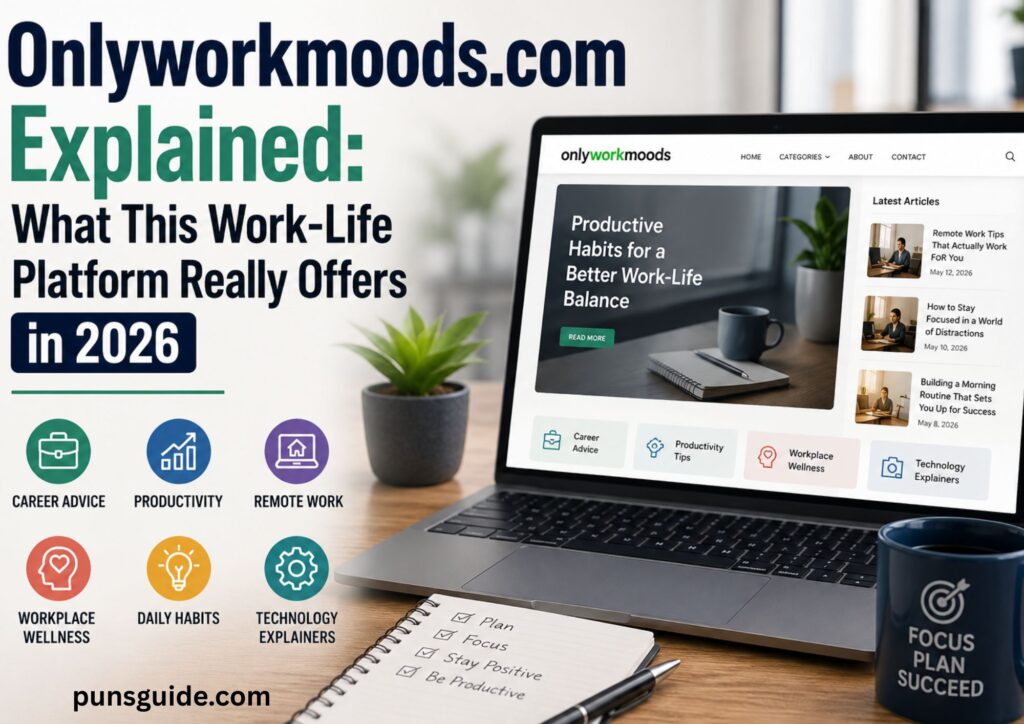
If you discovered Onlyworkmoods.com through a search result, the name probably created a very specific expectation. It sounds like a work-mood platform, productivity application, employee wellness service, or even a mood-tracking tool.
That impression doesn’t quite match what the publicly available evidence shows.
Onlyworkmoods.com is better understood as a content publishing website than as a software platform. Its publicly indexed material points toward articles covering work, careers, productivity, money, technology, lifestyle, and other general-interest subjects. Independent reviews published in 2026 have reached a similar conclusion.
That distinction matters. If you’re looking for a dashboard that tracks your mood or manages your workload, this isn’t the same category as a dedicated productivity app. If you’re looking for quick explanations, workplace ideas, lifestyle information, or general advice, the site fits that use case much better.
The bigger question is whether the content deserves your trust.
That answer requires a little nuance.
A website can be perfectly real while still offering information that deserves verification. Legitimacy, usefulness, expertise, and editorial authority aren’t interchangeable concepts. A site can pass a basic safety check while remaining a secondary source for important decisions.
This guide takes a closer look at what Onlyworkmoods.com actually offers, how its content works, why people search for it, where it can help, and where you should slow down before acting on its advice.
What Is Onlyworkmoods.com, Actually?
At its core, Onlyworkmoods.com appears to operate as an article-based content website rather than an interactive work-life software product.
Publicly indexed descriptions and independent examinations characterize it as a broad publishing site. Its material touches work, careers, productivity, lifestyle, technology, finance, business, and other subjects.
The name creates some confusion because “work moods” sounds like a very specific product category.
You might reasonably expect features such as:
- Daily mood logging
- Employee mood surveys
- Workplace sentiment reports
- Productivity dashboards
- Habit tracking
- Journaling prompts
- Task management
- Personalized productivity recommendations
- Team analytics
- Automated reminders
Those aren’t the core function presented by the publicly indexed site.
Instead, the basic experience resembles a digital magazine or general-interest blog. You find an article, read it, follow related links, and move on to another topic.
That’s a much simpler proposition.
What the Site Is Not
Understanding what Onlyworkmoods.com doesn’t offer prevents the biggest source of confusion.
It doesn’t appear to be a dedicated:
- Mood-tracking app
- Productivity SaaS platform
- Workplace management dashboard
- Employee engagement system
- Task-management application
- Project collaboration tool
- Career counseling service
- Job-search platform in the traditional software sense
Several independent 2026 reviews specifically describe the domain as a content site rather than a mood tracker or productivity application.
Think of the difference this way:
A productivity app helps you do the work. A content site helps you learn about the work.
That distinction sounds small. It isn’t.
Someone searching for a tool to record daily emotions needs functionality. Someone searching for an explanation of workplace motivation needs information. Those are completely different user intents.
What You’ll Actually Find on Onlyworkmoods.com
The site’s content model is broader than its domain name suggests.
Public descriptions indicate coverage across work, careers, business, money, technology, education, lifestyle, and related subjects.
That gives the platform a multi-niche character.
Instead of building its identity around one narrow topic, it appears to publish material designed to answer different types of search queries. One article might discuss productivity while another explores technology or a broader lifestyle question.
This approach has an obvious advantage: topic variety.
You don’t have to stay inside one tiny editorial box.
However, breadth also creates a challenge. A website discussing workplace psychology, finance, technology, travel, and lifestyle simultaneously has a harder time demonstrating deep expertise in every field.
That’s especially important when the subject becomes consequential.
Content Format
Onlyworkmoods.com follows the basic mechanics of an online publishing site.
Readers encounter articles, explanations, guides, and informational pieces rather than software interfaces. Publicly indexed reviews describe the material as generally simple and accessible, with a structure suited to casual reading and quick information gathering.
That makes the site potentially useful for early-stage research.
For example, you might encounter an article that introduces:
- A productivity method
- A workplace concept
- A technology trend
- A career question
- A lifestyle idea
- A money-related topic
- A modern work habit
The article can then serve as a jumping-off point for deeper research.
That role is underrated.
Not every website needs to be a definitive academic authority to be useful. Sometimes you simply need a clear explanation that helps you understand what question to ask next.
Topic Range
The site’s topic range appears considerably wider than the word “work” implies.
Available analyses describe content involving areas such as:
| Topic area | What readers may find useful |
| Work and careers | Workplace habits, career ideas, professional development |
| Productivity | Focus, routines, time management, motivation |
| Lifestyle | Everyday decisions, habits, personal interests |
| Technology | General explainers and digital trends |
| Business | Basic business and professional topics |
| Finance | General money-related information |
| Education | Explanatory and informational subjects |
| Remote work | Work-from-home and modern workplace themes |
The exact mix can change as a publishing site adds or removes material. That’s another reason to judge individual pages rather than assuming every article has the same editorial quality.
Who’s Behind It?
This is where readers should become more analytical.
Third-party examinations have pointed to limited transparency around ownership and author expertise. Scamadviser reports that the domain’s WHOIS information is hidden while also listing a registration date of March 18, 2023. It also reports valid SSL infrastructure and a renewal date extending to 2034.
Those facts tell you something about the domain’s technical and registration history.
They don’t establish editorial authority.
A domain existing for several years doesn’t automatically make every article accurate. Likewise, a hidden WHOIS record doesn’t automatically make a website malicious.
The useful question is more specific:
Can you identify who wrote the article, what qualifies that person to discuss the subject, and where the important claims came from?
That’s the editorial test that matters.
Why Are People Searching for “Onlyworkmoods.com”?
The search behavior makes more sense once you understand the name.
Someone seeing Onlyworkmoods.com for the first time may wonder whether it’s:
- A workplace wellness platform
- A mood-tracking application
- A productivity tool
- A career website
- A work-life blog
- A general content site
- Something entirely different
That uncertainty naturally produces navigational searches.
People often search a website name because they want to answer a simple question:
“What is this thing?”
There can also be a credibility check hiding underneath that search.
You may have encountered the domain in a search result or through a link and decided to investigate before clicking deeper. That’s sensible behavior in today’s web environment.
Search engines are full of unfamiliar publishers. A quick brand search can reveal whether a site has a consistent identity, recognizable authors, external references, or a history worth examining.
The domain’s unusual name adds another layer.
Curiosity creates clicks. Expectation creates searches. Confusion creates verification.
Those three forces can work together.
How Onlyworkmoods.com Is Structured
The publicly available descriptions indicate a conventional article-and-category structure rather than a software interface.
That means the site experience revolves around discovering and reading content.
A typical content journey looks something like this:
Search query
↓
Onlyworkmoods.com article
↓
Topic/category exploration
↓
Related article
↓
External source verification
↓
Deeper research
That’s fundamentally different from a productivity application.
A SaaS product might take you from registration to dashboard to personalized workflow. A content website takes you from search result to article to another piece of content.
The distinction becomes important when judging usability.
Is It Easy to Find Useful Information?
A broad site can make discovery both easier and harder.
It’s easier because you have many subjects under one roof. You can move from a workplace question to a technology explanation without leaving the site.
It’s harder because a multi-niche structure can dilute topical focus.
If someone searches for workplace psychology, for instance, they may expect a specialist publication. A general content hub may provide a useful introduction, yet still lack the research depth found in specialist sources.
This is where search intent matters.
A reader seeking a quick explanation and a reader making a high-stakes decision don’t need the same source.
Is Onlyworkmoods.com Actually Useful?
Yes, it can be useful.
However, its usefulness depends heavily on what you’re asking it to do.
For casual research, topic discovery, and general reading, an accessible content site can save time. You may find an explanation that gives you enough context to understand a subject.
The limitations appear when you need specialist expertise, original research, or personalized guidance.
What It Does Reasonably Well
The platform’s broad publishing model gives it several practical strengths.
First, accessibility matters. Simple explanations can help readers who don’t want to decode academic terminology before understanding a basic concept.
Second, topic variety creates discovery opportunities. Someone researching workplace productivity might also discover material about remote work, technology, career strategy, or daily habits.
Third, article-based content works well for search-driven questions. You can arrive with a specific query and potentially find an answer without creating an account or learning a complicated interface.
Other potential strengths include:
- Broad subject coverage
- Beginner-friendly presentation
- Quick informational reads
- Easy topic discovery
- General productivity ideas
- Work-life-related material
- Search-friendly article structures
- Publicly accessible reading
Those strengths are meaningful.
They simply shouldn’t be confused with expert-level authority.
Where It Falls Short
The biggest limitation is editorial depth and transparency.
Independent reviews have described the site as broad and somewhat uneven. Some analyses also point to limited author information and a lack of strong evidence that every topic receives specialist treatment.
That creates several potential weaknesses.
Broad coverage can dilute expertise
Writing about many subjects isn’t automatically bad. But expertise becomes harder to establish when a single publisher covers unrelated fields.
A specialist publication can spend years developing authority around one subject.
A multi-niche blog has a steeper hill to climb.
General advice can become surface-level
Advice such as “take breaks,” “stay organized,” or “set goals” isn’t necessarily wrong.
The problem is that it doesn’t always tell you how, when, why, or under what conditions a method works.
Good advice has context.
For example, “work from home more effectively” becomes far more useful when an article explains workspace separation, meeting overload, notification control, work boundaries, and the difference between focus time and collaborative time.
Important claims need stronger sourcing
Health, finance, employment law, and serious career decisions require more than a confident paragraph.
They need reliable evidence.
For important subjects, look for:
- Primary sources
- Government publications
- Professional organizations
- Research papers
- Recognized experts
- Transparent citations
- Current publication dates
A general blog can introduce the topic. It shouldn’t necessarily be your final stop.
How to Evaluate Information From Onlyworkmoods.com
The smartest approach isn’t “trust everything” or “trust nothing.”
Use an article-level credibility test.
Ask these questions before relying on an important claim:
| Check | What to look for |
| Author | Is a real author identified? |
| Credentials | Does the author have relevant expertise? |
| Date | Is the information recent enough for the topic? |
| Sources | Does the article cite credible evidence? |
| Primary material | Can important claims be traced to original sources? |
| Specificity | Does the article explain how and why something works? |
| Balance | Does it acknowledge limits or exceptions? |
| Consistency | Do other reliable sources agree? |
This method works well far beyond Onlyworkmoods.com.
It’s simply good digital literacy.
Why Author Credentials Matter
A productivity writer doesn’t automatically qualify as a psychologist.
A technology blogger doesn’t automatically qualify as a cybersecurity professional.
A general finance writer doesn’t automatically qualify as a financial adviser.
That distinction becomes especially important when an article discusses mental health at work, financial decisions, employment rights, or other consequential subjects.
The presence of an author byline is useful. Relevant credentials are better. Transparent sourcing is better still.
The Biggest Mistake Visitors Make
The biggest mistake is assuming the domain name tells you what the website actually is.
Onlyworkmoods.com sounds like a specialized work-mood service.
But available evidence points toward a broad publishing model.
That mismatch can lead visitors to expect features that simply aren’t the main offering.
A second mistake is more serious:
Treating general information as personalized advice.
An article about quiet quitting doesn’t know your employer.
A general piece about career strategy doesn’t know your industry.
A productivity guide doesn’t know your sleep schedule, workload, responsibilities, or workplace culture.
Context changes everything.
Consider a simple example.
An article might recommend working from home to improve focus. That could work beautifully for a software developer with flexible hours. It may be useless for a nurse, teacher, warehouse supervisor, or employee whose job depends on physical collaboration.
The advice isn’t necessarily wrong.
It’s simply incomplete without context.
How to Get Real Value From Onlyworkmoods.com
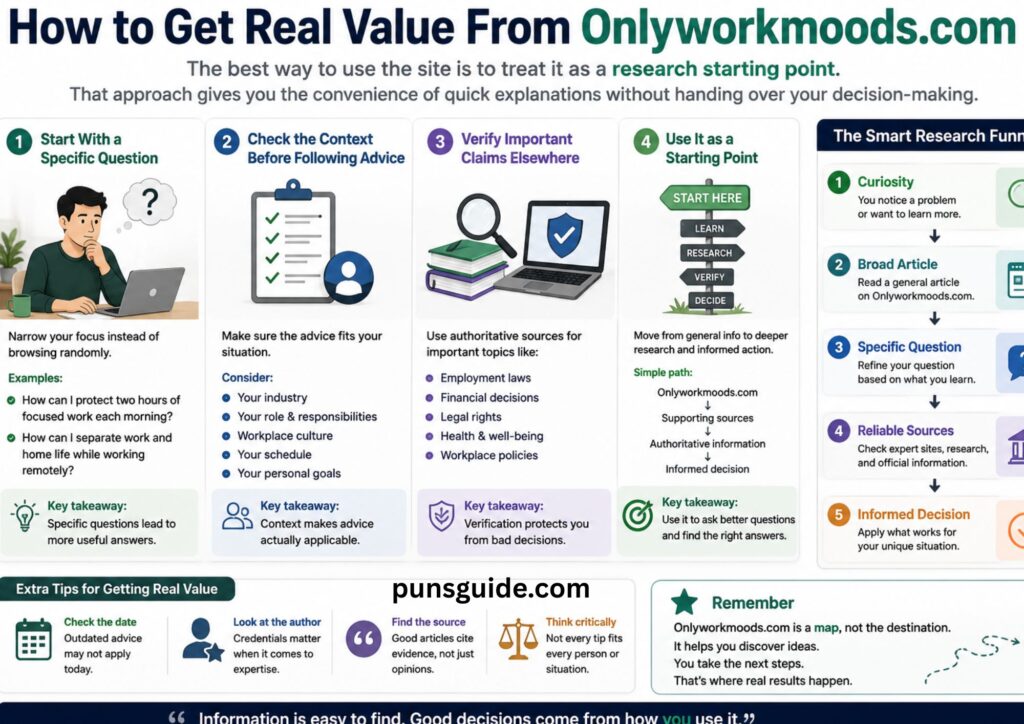
The best way to use the site is to treat it as a research starting point.
That approach gives you the convenience of quick explanations without handing over your decision-making.
Start With a Specific Question
Don’t begin with an enormous question like:
“How can I improve my work life?”
That’s too broad.
Instead, narrow it down:
- How can I protect two hours of focused work each morning?
- How can I separate work and home life while working remotely?
- What is job crafting?
- What does quiet quitting actually mean?
- Which productivity method fits project-based work?
- How can I build a better morning routine before work?
Specific questions produce better research.
They also make it easier to recognize when an article actually answers your problem.
Check the Context Before Following Advice
Advice becomes valuable when it matches the situation.
Before adopting a recommendation, consider:
- Your industry
- Your job responsibilities
- Your experience level
- Your location
- Your workplace culture
- Your schedule
- Your financial circumstances
- Your personal goals
This matters particularly for remote work and hybrid work culture.
A strategy designed for a solo freelancer may not work inside a large company with fixed meetings and team dependencies.
Verify Important Claims Elsewhere
For low-risk ideas, a general article may be enough to get started.
For consequential claims, verification is essential.
Use authoritative sources for subjects such as:
- Employment regulations
- Tax rules
- Financial products
- Medical information
- Mental health
- Legal rights
- Workplace compliance
- Professional licensing
For workplace and management research, established publications such as Harvard Business Review and SHRM can provide more specialized material.
For psychological or health-related questions, look for recognized psychology and medical organizations or peer-reviewed research.
The principle is simple:
Use broad content for orientation and authoritative sources for confirmation.
Use It as a Starting Point
Think of the research process as a funnel.
At the top, you have curiosity.
Then you narrow the subject.
Then you verify the important details.
Curiosity
↓
Broad article
↓
Specific question
↓
Reliable sources
↓
Expert evidence
↓
Informed decision
That is a much safer workflow than treating the first search result as the final authority.
A Realistic Example of Using Onlyworkmoods.com
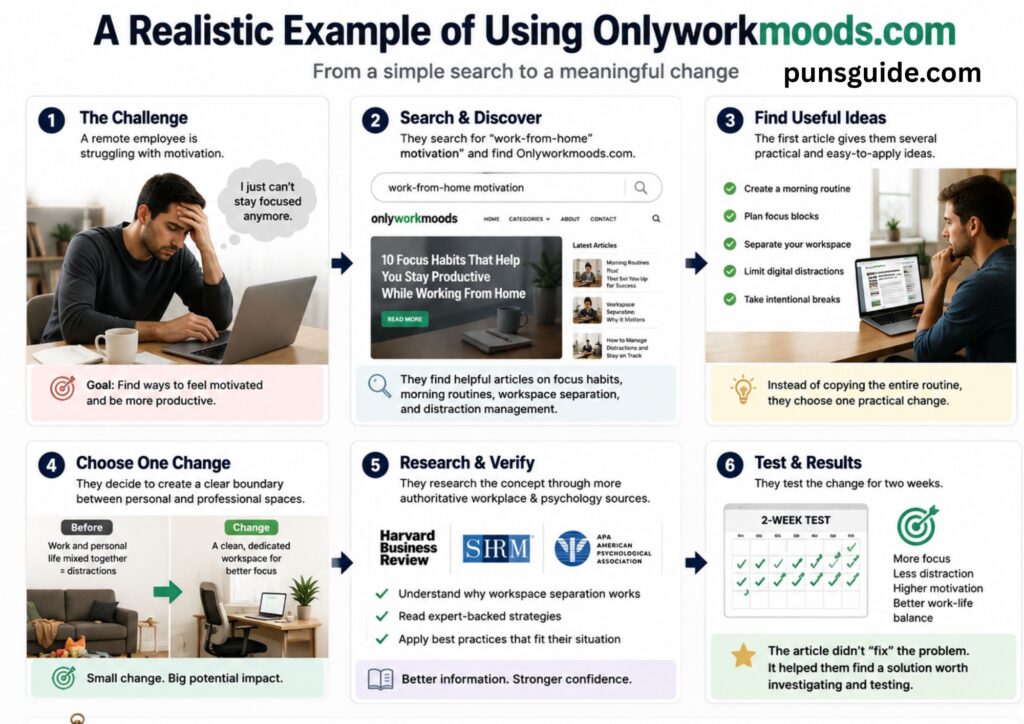
Imagine a remote employee has started struggling with motivation.
They search for work-from-home motivation and find general articles discussing focus habits, morning routines, workspace separation, and distraction management.
The first article gives them several useful ideas.
Instead of copying the entire routine, they identify one practical change: creating a clear boundary between their personal and professional spaces.
They then research the concept through more authoritative workplace and psychology sources.
Finally, they test the change for two weeks.
The result isn’t “Onlyworkmoods.com fixed the problem.”
That’s the wrong way to think about an information website.
The useful outcome is that the article helped the reader identify a possible solution worth investigating.
That’s a legitimate role for general content.
It acts like a map.
It isn’t the destination.
Onlyworkmoods.com vs. Specialized Sources
Different questions require different sources.
| Your goal | Better starting point |
| General productivity ideas | General work-life content |
| Workplace research | Established business publications |
| Employment law | Government agencies |
| Career qualifications | Professional organizations |
| Academic evidence | Peer-reviewed research |
| Financial decisions | Regulators and qualified professionals |
| Medical questions | Medical institutions and qualified clinicians |
| Productivity software | Dedicated software providers |
| Mood tracking | Dedicated mood-tracking applications |
This distinction prevents a common research error: choosing a source because it appeared first rather than because it fits the question.
A blog can explain what job crafting means.
A specialist source may be better for understanding the research behind job crafting.
A blog can explain what quiet quitting means.
A workplace research organization may be better for understanding its prevalence and implications.
A blog can introduce a productivity method.
Your actual workflow determines whether that method will work.
Is Onlyworkmoods.com Safe and Legit?
Available third-party technical checks provide some useful signals.
Scamadviser reports a valid SSL certificate, a domain registration date of March 18, 2023, and a domain renewal date of March 18, 2034. It also notes that WHOIS ownership information is hidden.
Those details suggest that the domain is an established website rather than a newly created one-day domain.
However, domain age doesn’t prove editorial accuracy.
Likewise, HTTPS protects the connection between a browser and website. It doesn’t guarantee that every article contains correct information.
So the most accurate conclusion is measured:
There is no clear evidence in the reviewed sources that Onlyworkmoods.com is an obvious scam. But technical legitimacy should not be confused with editorial credibility.
For ordinary browsing, use normal internet safety practices. Don’t provide unnecessary sensitive information. Don’t download unknown files. Don’t follow financial or employment instructions without checking the relevant authority.
What About the Site’s SEO and Content Strategy?
The site’s broad structure also makes sense when viewed through the lens of modern search behavior.
A publisher covering multiple categories can target many search queries.
For example, instead of competing only for workplace-related terms, a multi-niche content strategy can target searches involving:
- Productivity
- Technology
- Finance
- Careers
- Lifestyle
- Business
- Remote work
- General information
This creates a larger potential pool of search terms.
However, search volume alone doesn’t guarantee useful content.
A page can attract a curiosity click and still fail to satisfy the reader.
That’s where search-intent mismatch becomes important.
Someone searching “Onlyworkmoods.com” wants to know what the site is.
If the resulting article spends hundreds of words discussing generic productivity tips before explaining the website, it misses the point.
Likewise, someone searching for a legal employment question needs precise, current information rather than broad lifestyle commentary.
Strong content should match the question first.
Traffic comes second.
Why Generic Advice Can Be a Problem
Generic advice isn’t always useless.
Sometimes simple advice works because the problem itself is simple.
The issue appears when generic recommendations pretend to be comprehensive.
Consider these two statements:
“Take regular breaks to stay productive.”
That’s reasonable but shallow.
Now compare it with a more useful explanation:
“If your work requires sustained concentration, planned breaks can help you avoid long periods of declining attention. Test a schedule that separates focused work from communication tasks rather than interrupting deep work every few minutes.”
The second version gives you a mechanism and a practical application.
That’s the difference between surface-level tips and actionable guidance.
When reading Onlyworkmoods.com or any similar publishing site, look for that distinction.
Who Is Onlyworkmoods.com Best Suited For?
The platform appears best suited to readers who want accessible, general information.
That may include:
- Beginners exploring productivity
- Employees looking for workplace ideas
- Remote workers searching for general tips
- Readers researching unfamiliar concepts
- People browsing lifestyle topics
- Users looking for quick explanations
- Readers trying to discover related subjects
It is less suitable as the sole source for someone who needs specialist evidence or personalized professional guidance.
That’s not a criticism of the entire website.
It’s simply a matter of matching the tool to the job.
You wouldn’t use a pocket calculator to conduct a laboratory experiment. You also wouldn’t use a general blog as the only authority for a complex legal decision.
Is Onlyworkmoods.com Worth Your Time?
For casual reading and early-stage research, it can be.
For expert-level decision-making, caution is warranted.
A useful way to judge the site is with five questions:
- Does the article directly answer the question?
- Does it provide specific information rather than vague tips?
- Does it identify credible sources?
- Does the author demonstrate relevant expertise?
- Can important claims be confirmed elsewhere?
If the answer is yes across the board, an article becomes much more useful.
If several answers are no, treat the page as a starting point rather than a reliable final source.
Quick Facts About Onlyworkmoods.com
| Fact | What the available evidence indicates |
| Website type | Content publishing website |
| Primary experience | Reading articles and browsing topics |
| Dedicated mood tracker | No clear evidence of one |
| Productivity dashboard | No clear evidence of one |
| Topic range | Work, careers, productivity, technology, lifestyle, money, business, and other subjects |
| Domain registration | March 18, 2023, according to Scamadviser |
| WHOIS ownership | Hidden according to Scamadviser |
| SSL | Valid certificate reported by Scamadviser |
| Best use | General information and topic discovery |
| Main caution | Verify important claims independently |
The technical details above come from third-party checks and can change over time.
Bottom Line: What Does Onlyworkmoods.com Really Offer?
Onlyworkmoods.com is best understood as a broad content website, not a mood-tracking or productivity software platform.
Its name creates a more specialized impression than its apparent publishing model supports.
The site’s real value lies in its articles and topic coverage. Readers can encounter information about work, careers, productivity, lifestyle, technology, business, money, and related subjects. Independent reviews consistently describe it as a multi-topic publishing site rather than a dedicated workplace tool.
That makes the platform useful for certain jobs.
Use it for discovery.
Use it for general explanations.
Use it to generate better questions.
But don’t automatically treat every recommendation as expert-backed guidance.
The most important distinction is between information and authority.
A readable article can introduce an idea. A primary source can verify a fact. An expert can provide specialized judgment. Those roles overlap sometimes, but they aren’t identical.
Ultimately, Onlyworkmoods.com makes the most sense when you approach it with reasonable expectations. It’s a content destination rather than a personal productivity dashboard.
And that’s perfectly fine.
The internet doesn’t need every website to be an app.
It does, however, benefit from readers who know the difference between a useful starting point and a source they should trust without question.
Frequently Asked Questions About Onlyworkmoods.com
What is Onlyworkmoods.com?
Onlyworkmoods.com appears to be a multi-topic content publishing website. Its publicly described coverage includes work, careers, productivity, lifestyle, technology, business, money, and other general-interest subjects.
Is Onlyworkmoods.com a productivity app?
No clear evidence indicates that it operates as a dedicated productivity application.
It doesn’t appear to function like a task manager, productivity dashboard, or workplace software product. Available reviews instead describe it as an article-based website.
Is Onlyworkmoods.com a mood-tracking app?
The publicly available evidence does not show a dedicated mood-tracking system behind the domain.
The name may suggest mood logging or workplace sentiment tracking, but the site’s apparent function centers on published content.
What topics does Onlyworkmoods.com cover?
Its coverage appears broad. Topics described across public analyses include work, careers, productivity, business, finance, technology, education, lifestyle, and other general-interest subjects.
Is Onlyworkmoods.com legitimate?
The domain appears to be a functioning, established website. Scamadviser reports a valid SSL certificate and a registration date of March 18, 2023.
However, legitimacy doesn’t mean every article deserves unquestioned trust. Evaluate individual pages based on authorship, evidence, sourcing, and relevance.
Is Onlyworkmoods.com safe to browse?
There is no clear evidence in the reviewed material that the site is an obvious malicious or phishing operation. Scamadviser reports valid SSL infrastructure and describes the domain as likely safe.
Still, standard internet precautions remain sensible. Don’t enter sensitive information unnecessarily, and don’t download unfamiliar files.
Does Onlyworkmoods.com provide professional advice?
It should primarily be treated as a source of general informational content.
For legal, financial, medical, employment, or other high-stakes decisions, verify claims through authoritative sources or qualified professionals.
Who should use Onlyworkmoods.com?
The site is most appropriate for readers looking for quick explanations, general work-life ideas, productivity concepts, and broader lifestyle information.
It may be less suitable for readers who need specialist research or personalized professional guidance.
Can Onlyworkmoods.com replace a productivity tool?
No.
If you need task management, habit tracking, mood logging, reminders, analytics, or personalized workflows, you need a dedicated application designed for those functions.
A content website and a productivity tool solve different problems.
How should you evaluate an article on Onlyworkmoods.com?
Check the author, credentials, publication date, citations, evidence, specificity, and consistency with reliable external sources.
The more consequential the subject, the more important those checks become.
What is the best way to use Onlyworkmoods.com?
Use it as a starting point for information and research.
Find the article that addresses your question. Extract the useful concepts. Then verify important claims through authoritative or primary sources before making a consequential decision.
Does the site’s broad topic range matter?
Yes.
A multi-niche publishing strategy can expose readers to many subjects. However, breadth can also make it harder for a single website to demonstrate deep expertise across every field.
That’s why article-level evaluation matters more than judging the entire domain with one simple label.
Final Takeaway
Onlyworkmoods.com is not what its name initially suggests. It appears to be a broad content website built around articles rather than a dedicated work-mood application or productivity platform.
That doesn’t make it useless.
It simply defines how it should be used.
For quick information, topic discovery, and general work-life reading, the site can have practical value. For decisions involving money, health, law, employment rights, or specialized career strategy, stronger sources should enter the picture.
In the end, good online research isn’t about finding one website that answers everything.
It’s about finding the right source for the question you’re asking.
Also Read: Glossywise Com Review 2026: Is It Worth It? An Honest Look at the Website, Content, and Credibility

Jhon AJS, the creative mind behind Puns Guide, is an experienced blogger with a knack for wordplay and witty humor. Passionate about blending laughter with language, he crafts engaging pun filled content that entertains and inspires readers. With years of blogging expertise, Jhon continues to share clever insights, making every visit to Puns Guide a fun and refreshing experience.