
Your mind can feel crowded even when your desk looks perfectly clean.
A deadline sits in the back of your head. A half-finished idea keeps resurfacing. You remember an email while making breakfast, then forget it again by lunchtime. Meanwhile, tomorrow’s appointment, this week’s errands, and a dozen tiny decisions compete for attention.
That mental traffic can make ordinary days feel surprisingly heavy.
JournalWord Com approaches this problem through journaling, organization, reflection, and practical productivity systems. The platform describes itself as a resource focused on mental clarity, mindful organization, bullet journaling, focus, habit building, and intentional living.
The bigger idea is simple: instead of forcing your brain to hold everything at once, put some of it somewhere you can see.
That doesn’t mean writing three pages about your feelings every morning. It might mean capturing five tasks, recording one idea, reviewing an unfinished project, or spending five quiet minutes deciding what actually matters.
This guide explores JournalWord Com, the Bullet Journal method, digital and paper journaling, mental clutter, thought offloading, and practical ways to build a journaling routine that doesn’t become another chore.
What Is JournalWord Com?
JournalWord Com is a journaling and productivity-focused platform that brings together practical journaling techniques, organization methods, reflection, and personal productivity ideas. Its stated focus includes mental clarity, mindful organization, bullet journaling, focus improvement, habit building, and intentional living.
Rather than presenting journaling as nothing more than keeping a diary, JournalWord frames it as a broader system for organizing your thoughts and daily life.
That distinction matters.
A traditional diary might focus heavily on what happened during your day. A productivity journal might focus on what needs to happen next. A reflective journal might explore why something happened and how you felt about it.
A flexible system can combine all three.
JournalWord’s content covers areas such as:
- Daily journaling
- Bullet Journaling
- Gratitude journaling
- Reflection
- Habit tracking
- Productivity
- Focus
- Goal organization
- Mindful organization
- Intentional living
The platform’s core message is that productivity doesn’t have to mean squeezing more tasks into every available minute. Instead, its approach emphasizes clarity, focus, organization, and sustainable systems.
That makes the concept useful for people who don’t necessarily need another complicated productivity app.
Sometimes you don’t need more features.
You need fewer loose ends.
What JournalWord Com Is Not
It’s equally important to understand what the platform shouldn’t be mistaken for.
JournalWord Com isn’t a substitute for professional mental-health care. Journaling can support reflection and organization, but it shouldn’t be treated as a universal treatment for anxiety, depression, trauma, or other health conditions.
It’s also important not to assume that every journaling feature belongs to JournalWord itself. A resource site can explain techniques without functioning as a full-featured journaling application.
Before entering sensitive personal information into any online service, check its current privacy policy, storage practices, account requirements, and export options.
Why Your Mind Can Feel So Crowded
Mental clutter doesn’t always come from having too much to do.
Sometimes it comes from having too many things to remember.
Your brain may keep rehearsing unfinished tasks because you haven’t decided what happens next. You might repeatedly think, “I need to call them,” because the task has no clear place, deadline, or next action.
Research on unfinished goals offers an interesting explanation. Studies have found that unfulfilled goals can continue occupying mental processes and interfere with tasks requiring executive functions.
More recent research adds another piece to the puzzle. A 2026 meta-analysis covering 17 between-person studies with 2,473 participants and 14 within-person studies with 12,129 participants found that unfinished work tasks were associated with increased work-related thoughts during off-job time.
That doesn’t mean every unfinished grocery list creates psychological distress.
It means open loops can have a real cognitive and emotional footprint.
Cognitive Load and Working Memory
Your working memory is the mental workspace you use to hold and manipulate information temporarily.
Think of it as a small desk.
If you place a meeting time, grocery list, password, unfinished email, project idea, appointment, and weekend plan on that desk, something eventually gets buried.
A journal can act as an external memory system.
Instead of repeatedly thinking:
“Don’t forget to email Sarah.”
You can write:
Email Sarah — Monday morning
Now the information has somewhere to live outside your immediate attention.
Writing it down doesn’t magically complete the task. What it can do is create a reliable cue for later action.
The Zeigarnik Effect and Unfinished Tasks
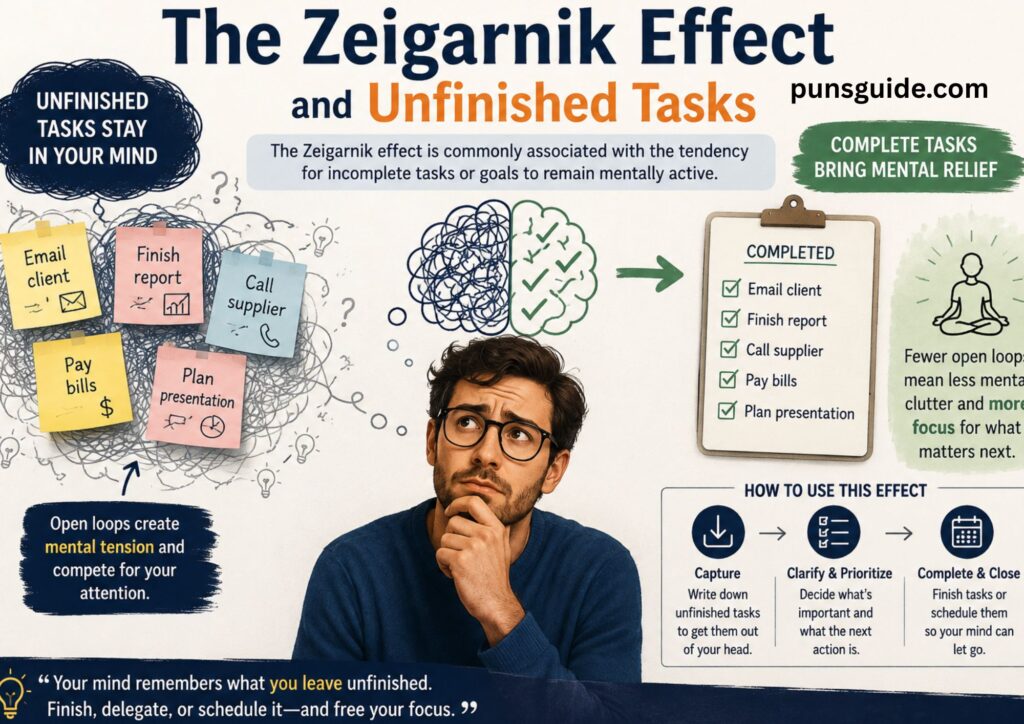
The Zeigarnik effect is commonly associated with the tendency for incomplete tasks or goals to remain mentally active.
The modern evidence is more nuanced than the popular version suggests. Research doesn’t justify saying that every unfinished task automatically hijacks your brain. However, unfinished work does appear related to work-related thoughts and rumination in real-world settings.
That’s where journaling becomes practical.
A task such as:
“Finish presentation.”
is vague.
A better entry might say:
“Finish slides 8–12 before 3 p.m.”
Better still:
“Open presentation → finish slides 8–12 → send draft.”
The second version gives your brain a clearer path forward.
Thought Offloading
Thought offloading means placing information into the environment rather than keeping it entirely in your head.
A notebook can become that external storage layer.
You can offload:
- Tasks
- Appointments
- Ideas
- Questions
- Reminders
- Project notes
- Personal reflections
- Decisions
- Habits
- Goals
The trick is not to record absolutely everything.
The trick is to create a system you trust.
What JournalWord Com Actually Covers
JournalWord presents journaling as a practical tool for clarity, organization, productivity, focus, and personal growth. Its material includes beginner journaling guidance, Bullet Journal systems, habit tracking, reflection, and productivity concepts.
That combination gives the topic more depth than conventional diary writing.
You can use a journal to look backward, manage the present, or prepare for what comes next.
Journaling Guides for Beginners
Starting a journal sounds easy until you face the blank page.
Then the questions arrive:
- What should I write?
- How much should I write?
- Should I write every day?
- Do I need prompts?
- Should I track my habits?
- What if I miss a week?
The answer is surprisingly forgiving.
There is no requirement to write a certain number of words.
A useful journal entry might take two minutes.
It could look like this:
Today: Finish the client draft.
Concern: I’m trying to solve too many things at once.
Priority: Finish the introduction before lunch.
Reflection: The project feels easier when I define the next action.
That’s journaling.
It doesn’t need a leather notebook, fountain pen, or Instagram-worthy spread.
Bullet Journal Systems and Templates
The Bullet Journal method takes this idea further by giving different kinds of information simple visual structures.
You can use it for:
- Tasks
- Events
- Notes
- Future plans
- Projects
- Habits
- Reflections
- Collections
JournalWord’s Bullet Journal guidance emphasizes practical organization and minimalist layouts rather than making artistic decoration the central goal.
That distinction can save beginners a lot of frustration.
Your journal doesn’t need to look like a tiny art exhibition.
It needs to work.
Productivity and Focus Systems
JournalWord also connects journaling with productivity and focus.
That connection makes sense when you treat productivity as attention management, not merely task completion.
Doing 20 trivial tasks while avoiding the one important task doesn’t create meaningful progress.
A simple journal can help you ask:
- What matters today?
- What’s urgent?
- What’s important?
- What can wait?
- What can I remove?
- What’s the next physical action?
- What keeps distracting me?
Those questions turn an amorphous workload into something more concrete.
The Bullet Journal Method Without the Instagram Version
The Bullet Journal method was developed by Ryder Carroll as a flexible system for capturing and organizing information. The official Bullet Journal site describes rapid logging as the heart of the method.
The system combines planning, note-taking, task management, reflection, and review.
You don’t need artistic talent.
You don’t need a special notebook.
And you certainly don’t need to spend 45 minutes drawing a weekly spread before writing your first task.
Where the Bullet Journal Method Came From
Ryder Carroll developed the Bullet Journal method through years of experimentation with ways to capture information and manage daily life. The method evolved around rapid logging, collections, migration, and reflection.
The original idea is much more utilitarian than the decorative Bullet Journal culture that later became popular online.
At its core, the system asks you to capture information quickly and give it enough structure to remain useful.
The Core Building Blocks
The major elements include:
| Component | Purpose |
| Rapid logging | Capture information quickly |
| Tasks | Record actionable items |
| Events | Record date-related information |
| Notes | Capture useful information |
| Signifiers | Add context to entries |
| Daily Log | Manage day-to-day information |
| Monthly Log | Organize the current month |
| Future Log | Store future commitments |
| Collections | Group related information |
| Migration | Reconsider unfinished items |
This structure turns a notebook into a lightweight task management system.
Rapid Logging
Rapid logging is designed to make writing fast.
Instead of creating a long narrative, you capture the essential information.
For example:
• Email project proposal
O Dentist appointment at 2 p.m.
– Idea for newsletter
• Buy printer paper
The symbols tell you what kind of information you’re looking at.
The official Bullet Journal guidance identifies tasks, events, and notes as core categories within rapid logging.
This approach also reduces the pressure to write a conventional journal entry every day.
Signifiers
Signifiers add meaning to your bullets.
A simple system might use:
- • Task
- X Completed task
- > Migrated task
- O Event
- – Note
- * Important item
The exact system can vary.
The point is recognition.
You should be able to glance at a page and understand what requires attention.
Daily Log
The Daily Log is where day-to-day information goes.
You don’t need to create a perfect page.
Write the date, then capture what matters.
For example:
August 15
• Finish article introduction
• Call supplier
O 4:00 p.m. team meeting
– New headline idea
X Pay electricity bill
The daily log becomes a compact record of what happened and what still needs attention.
Weekly Review
A weekly review prevents your journal from becoming a graveyard of forgotten tasks.
Once a week, look back.
Ask:
- What did I finish?
- What remains unfinished?
- Which tasks no longer matter?
- Which commitments need scheduling?
- What problems kept appearing?
- What deserves attention next week?
This is where journaling becomes more than note-taking.
You’re reviewing your behavior.
You’re noticing patterns.
You’re deciding what deserves another week of your attention.
Migration
Migration is one of the most useful parts of the Bullet Journal method.
An unfinished task doesn’t automatically deserve another place on tomorrow’s list.
First ask whether it still matters.
The official Bullet Journal guidance describes migration as deliberately reviewing unresolved tasks and moving relevant ones forward while eliminating tasks that no longer deserve attention.
That creates an important friction point.
If you repeatedly write:
• Organize old files
and repeatedly move it forward, eventually you have to confront the question:
Do I actually need to do this?
That’s the beauty of migration.
It turns repetition into a decision.
How to Start JournalWord-Style Journaling in Five Minutes
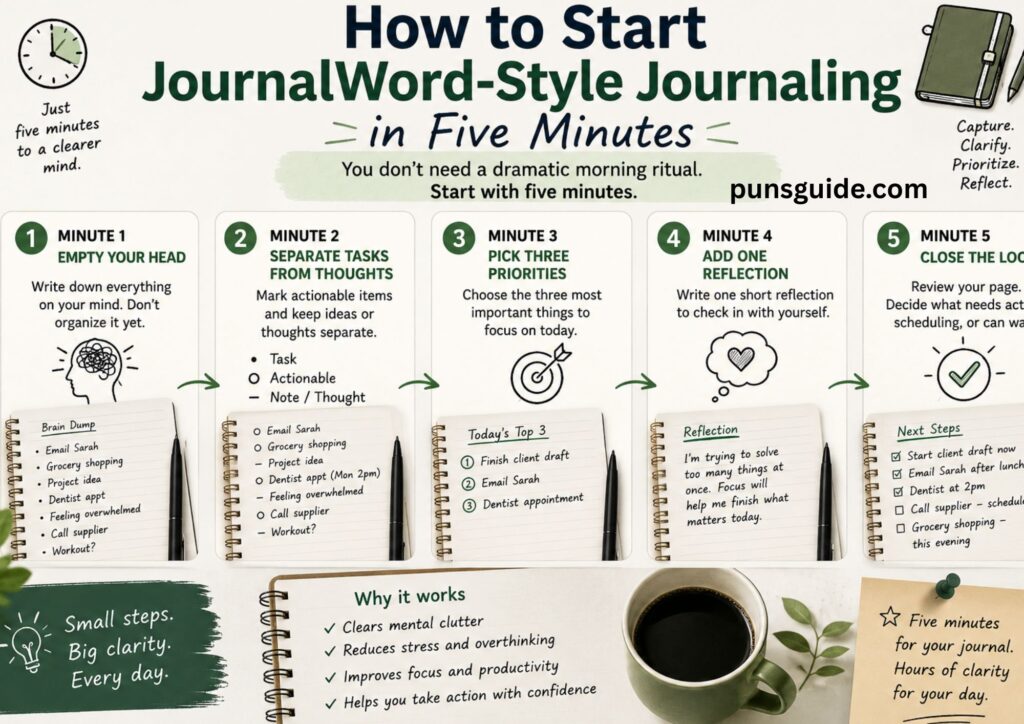
You don’t need a dramatic morning ritual.
Start with five minutes.
Minute One: Empty Your Head
Write down whatever is currently competing for attention.
Don’t organize it yet.
Capture:
- Tasks
- Worries
- Ideas
- Reminders
- Appointments
- Questions
Think of this as thought dumping.
The objective isn’t literary quality.
It’s mental inventory.
Minute Two: Separate Tasks From Thoughts
Now distinguish actionable items from general thoughts.
For example:
| Raw thought | Useful entry |
| “I need to deal with the website.” | Email developer about homepage issue |
| “I’m behind on everything.” | Finish invoice batch before noon |
| “Don’t forget Mom’s birthday.” | Buy birthday card Saturday |
| “Need to think about vacation.” | Compare two hotel options tonight |
Specificity makes the information easier to act on.
Minute Three: Choose Three Priorities
Pick three meaningful tasks.
Not fifteen.
Three.
If everything is a priority, nothing is.
A short list also gives you a better chance of seeing real progress instead of spending the day rearranging tasks.
Minute Four: Add One Reflection
Write one sentence about your current state.
Try:
- “I’m distracted because the project has no clear next step.”
- “The morning went smoothly because I avoided notifications.”
- “I keep postponing this task because it feels vague.”
That sentence can reveal more than another checkbox.
Minute Five: Close the Loop
Look at the page.
Decide:
- What happens today?
- What gets scheduled?
- What gets deleted?
- What needs more thought?
Then close the notebook.
The goal isn’t to journal forever.
The goal is to know what you’re doing next.
Paper Journaling vs. Digital Journaling
The paper vs. digital journaling debate doesn’t have one universal winner.
Each medium changes the experience.
| Factor | Paper journaling | Digital journaling |
| Writing feel | Tactile and deliberate | Fast and editable |
| Search | Manual | Usually excellent |
| Organization | Physical | Tags, folders, search |
| Distraction | Usually low | Potentially high |
| Backup | Physical protection needed | Digital backup possible |
| Portability | Depends on notebook | Usually strong |
| Privacy | Physical access matters | Account and security matter |
| Sync | None unless manually copied | Often available |
| Customization | Handwriting and layouts | Formatting and templates |
What You Gain With Digital Journaling
Digital journaling offers obvious conveniences.
You can search thousands of words in seconds. You can edit an entry without crossing out half the page. You can potentially access the same journal across several devices.
Depending on the software, you may also have:
- Cloud sync
- Local storage
- Tags
- Search
- Reminders
- Templates
- Attachments
- Data export
- Automatic backups
For people who already live inside digital note-taking systems, that convenience can be compelling.
What You Give Up
Digital journaling can introduce friction of its own.
Your phone isn’t only a notebook.
It’s also a notification machine.
You open the journal to write one thought and suddenly you’re checking messages, headlines, social media, and weather.
Twenty minutes later, the original thought has vanished into the Bermuda Triangle of notifications.
Paper has an advantage here.
There is nothing to update.
Nothing to sync.
Nothing to ping you.
Handwriting and Memory
There is also evidence suggesting that handwriting can encourage deeper processing during note-taking.
A 2014 study by Mueller and Oppenheimer found that students taking notes longhand performed better on conceptual questions than students taking notes on laptops in their experiments. The researchers linked the difference partly to the tendency of laptop users to transcribe information rather than process it in their own words.
That doesn’t prove handwriting is always better for journaling.
A journal isn’t a lecture.
Still, it offers a useful principle: the slower medium can sometimes encourage more deliberate thinking.
Digital Journaling Privacy: What You Should Check
A private journal contains unusually personal information.
It may include your relationships, finances, work concerns, health details, passwords, plans, and private reflections.
Don’t treat digital journaling privacy as an afterthought.
Before trusting an online journaling service, check:
- Where your data is stored
- Whether data is encrypted
- Whether end-to-end encryption exists
- Who can access your entries
- Whether employees can access content
- Whether the service sells or shares data
- Whether you can export your journal
- Whether you can delete your account and data
- How account recovery works
- Whether cloud synchronization is optional
Terms such as “encrypted” can be misleading if you don’t know where encryption occurs.
For highly sensitive writing, understand the difference between encryption during transmission, encryption while stored, and true end-to-end encryption.
Backup Basics
Cloud sync isn’t necessarily the same thing as backup.
Synchronization can replicate a deletion across devices. A genuine backup gives you another recoverable copy.
The U.S. Cybersecurity and Infrastructure Security Agency has recommended the 3-2-1 backup rule for important data:
- 3 copies of important data
- 2 different media types
- 1 copy stored off-site
For a digital journal, that could mean keeping your primary journal plus two separate backup copies where practical.
You don’t need a server room in your basement.
Even a simple export routine can be better than trusting one device forever.
Journaling for Different Types of Users
A good journaling system changes depending on what you need.
For Students
A student can use journaling for:
- Assignment tracking
- Exam planning
- Study reflections
- Reading notes
- Deadlines
- Habit tracking
- Weekly planning
A simple daily log can prevent assignments from floating around as vague mental obligations.
For Professionals
A professional might use a journal to capture:
- Meeting notes
- Follow-up tasks
- Project decisions
- Daily priorities
- Ideas
- End-of-day reflections
This creates a personal information organization layer around work.
It doesn’t replace a formal project management system.
Instead, it catches the loose ends that often fall between systems.
For Creators
Creators frequently need somewhere to catch ideas before they disappear.
A journal can become a reservoir for:
- Headlines
- Story ideas
- Product concepts
- Questions
- Observations
- Research leads
- Content experiments
Not every idea deserves a project.
But every useful idea deserves somewhere to land.
For People Dealing With Mental Clutter
If your biggest problem is mental clutter, start with capture.
Don’t immediately build a complicated productivity system.
Write down what’s taking up space.
Then sort it.
The sequence matters:
Capture → clarify → prioritize → act → review.
That simple loop can be more useful than collecting another dozen productivity techniques.
How Journaling and Productivity Fit Together
Journaling and productivity may seem like different worlds.
One sounds reflective.
The other sounds operational.
In practice, they overlap.
A productivity system answers:
What needs to happen?
Journaling can add:
Why does it matter? What keeps getting in the way? Is it still worth doing?
That second layer is where self-reflection becomes useful.
Journaling for Better Priorities
Suppose your list contains these tasks:
- Answer email
- Finish proposal
- Clean desk
- Check analytics
- Buy groceries
- Update spreadsheet
- Research new software
A journal can help you ask what actually matters today.
Maybe the proposal has a deadline tomorrow.
Suddenly the seven-item list becomes:
Primary: Finish proposal.
Secondary: Answer urgent email.
Later: Everything else.
The journal didn’t create more time.
It helped you allocate attention.
Journaling for Habit Formation
Habit formation works better when you observe behavior rather than merely declaring intentions.
A habit tracker can show:
| Habit | Mon | Tue | Wed | Thu | Fri |
| Read 10 minutes | ✓ | ✓ | — | ✓ | ✓ |
| Walk | ✓ | — | ✓ | ✓ | — |
| Journal | ✓ | ✓ | ✓ | — | ✓ |
The dashes matter.
They prevent the illusion of perfection.
Missing one day doesn’t erase a habit. It gives you information about where your routine breaks.
Journaling for Decision-Making
When a decision feels murky, write it down.
Use four simple sections:
Decision: What am I deciding?
Options: What choices exist?
Trade-offs: What does each choice cost or provide?
Next step: What information do I still need?
This method turns a foggy question into a tangible problem.
That’s cognitive processing, not merely diary writing.
JournalWord Com, GTD, and Other Productivity Methods
JournalWord’s approach sits near several established productivity traditions, but they aren’t identical.
Bullet Journal vs. Regular Journaling
| Feature | Bullet Journal | Regular journaling |
| Main purpose | Organization and reflection | Reflection and expression |
| Structure | Highly structured | Usually flexible |
| Tasks | Central | Optional |
| Events | Central | Optional |
| Notes | Structured | Free-form |
| Review | Built into method | Depends on user |
| Migration | Core feature | Usually absent |
| Emotional writing | Optional | Often central |
Neither is inherently better.
They solve different problems.
Bullet Journal vs. GTD
Getting Things Done (GTD) is a broader productivity methodology built around capturing commitments, clarifying them, organizing them, reviewing them, and engaging with the appropriate next action.
A Bullet Journal can perform some similar functions through rapid logging, collections, logs, and migration.
The difference is that Bullet Journal is designed as a flexible notebook-based method, while GTD provides a broader workflow for managing commitments and projects.
You can even borrow useful ideas from both.
For example:
Capture everything in your journal → clarify the next action → schedule important work → review the list weekly.
That’s a perfectly reasonable hybrid.
Bullet Journal vs. Morning Pages
Morning Pages generally refers to a stream-of-consciousness writing practice associated with Julia Cameron’s The Artist’s Way.
The basic philosophy differs from rapid logging.
Rapid logging tries to be concise and structured.
Stream-of-consciousness writing encourages uncensored flow.
One says:
• Finish proposal
– Feeling distracted
– Need information from Alex
The other might become several paragraphs about why the proposal feels difficult.
Both have their place.
If you need organization, structured journaling may work better.
If you need to explore thoughts, free-form writing may feel more natural.
What JournalWord Com Can and Can’t Solve
A good article shouldn’t turn journaling into a cure-all.
Journaling can help create structure.
It can help you capture information, review priorities, notice patterns, and make decisions more deliberately.
But a notebook cannot solve every source of overwhelm.
What Journaling Can Help With
- Mental clutter
- Task organization
- Daily planning
- Weekly planning
- Idea capture
- Habit tracking
- Self-reflection
- Personal productivity
- Attention management
- Information organization
- Decision-making
What Journaling Can’t Magically Fix
- An impossible workload
- Constant interruptions
- Poor sleep
- Unrealistic deadlines
- A chaotic work environment
- Serious mental-health conditions
- Broken boundaries
- A lack of support
That’s an important distinction.
A journal is a tool, not a magic eraser.
If the problem comes from having 14 hours of work assigned to an eight-hour day, writing a prettier task list won’t change the arithmetic.
Can Journaling Reduce Overthinking?
This question deserves a careful answer.
Journaling can give repetitive thoughts a place to go. It can also turn vague concerns into specific statements and next actions.
However, more writing isn’t automatically better.
If you repeatedly rehearse the same fear without moving toward understanding or action, journaling can become another form of rumination.
That’s why structured journaling can be useful.
Instead of writing:
“Everything is going wrong.”
Try:
Concern: The project deadline feels unrealistic.
Fact: Three sections remain unfinished.
Action: Ask for revised priorities tomorrow.
Unknown: Whether the deadline can move.
Now you’re separating facts, emotions, actions, and uncertainty.
That is far more useful than endlessly circling the same thought.
Research on expressive writing also cautions against making sweeping health claims. A 2018 meta-analysis of 39 randomized controlled trials found that brief self-directed expressive writing did not produce significant long-term reductions in depressive symptoms among physically healthy adults, although effects varied with factors such as session number and writing specificity.
So journaling may support reflection and organization, but it shouldn’t be marketed as a universal mental-health intervention.
A Simple JournalWord-Inspired Daily Routine
A sustainable routine should be almost boring.
That’s a compliment.
If your system requires 17 steps, color-coded pens, six apps, and a motivational soundtrack, you probably won’t keep it going.
Morning
Spend about five minutes:
- Empty your head.
- Review commitments.
- Choose three priorities.
- Check the calendar.
- Write one intention.
During the Day
Capture information quickly.
Use:
- Short task entries
- Event notes
- Ideas
- Questions
- Follow-ups
Don’t rewrite your entire journal every time something changes.
Evening
Spend a few minutes reviewing:
- What got finished?
- What remains?
- What no longer matters?
- What needs scheduling?
- What did you learn?
Then close the book.
The day is done.
Weekly
Your weekly review should be more thoughtful.
Look for:
- Repeated unfinished tasks
- Recurring distractions
- Habit patterns
- Important upcoming events
- Projects lacking next actions
- Commitments that no longer deserve attention
This is where a personal productivity system becomes adaptive instead of rigid.
Is JournalWord Com Worth Your Time?
The answer depends on what you’re looking for.
If you want a resource focused on journaling, Bullet Journaling, mental clarity, productivity, habits, reflection, and intentional organization, JournalWord’s stated scope lines up well with those interests.
It may be especially useful if you’re new to structured journaling and don’t know where to begin.
The bigger value, however, comes from the methods themselves.
You don’t need to become a devoted Bullet Journal user.
You don’t need to maintain a perfect streak.
You don’t even need to write every day.
The useful question is simpler:
Does this system make your life easier to manage?
If yes, keep it.
If it creates more work than clarity, simplify it.
It May Be Worth Trying If You Want
- A simple journaling starting point
- Better thought organization
- A practical Bullet Journal introduction
- Daily planning
- Weekly reflection
- Habit tracking
- More deliberate task management
- A low-effort productivity system
You May Want Something Else If You Need
- Advanced project management
- Team collaboration
- Automated workflows
- Complex reminders
- Enterprise-level information management
- Clinical mental-health support
Different tools exist for different jobs.
A notebook isn’t supposed to replace an entire software ecosystem.
JournalWord Com FAQs
What is JournalWord Com, specifically?
JournalWord Com is presented as a journaling and productivity platform focused on mental clarity, mindful organization, Bullet Journaling, focus, habit building, and intentional living. It combines journaling techniques with productivity, reflection, and organization strategies.
Is JournalWord Com a journaling app?
Not necessarily in the sense of a full-featured dedicated journaling application.
Its current public presentation describes JournalWord primarily as a journaling and productivity resource. Specific app features, account functions, synchronization, encryption, or storage capabilities shouldn’t be assumed without current documentation.
Is JournalWord Com free to use?
Publicly accessible JournalWord content can be viewed through its website. However, that doesn’t automatically establish that every potential feature or future service is free.
For current pricing or paid offerings, check the site’s latest information directly.
Do I need a dot-grid notebook for a Bullet Journal?
No.
The official Bullet Journal guidance says you can use your favorite notebook. A dot-grid notebook can make layouts easier, but it’s not a requirement.
A plain notebook works.
So does lined paper.
Even a cheap school notebook can become a useful Bullet Journal.
How long should a daily journal entry take?
There’s no universal time requirement.
A five-minute session can work well for a simple daily log and priority review.
Longer sessions make sense when you want deeper reflection, creative writing, or emotional processing.
The best duration is the one you can sustain without turning journaling into another obligation.
Can I keep a Bullet Journal digitally?
Yes.
The method’s underlying ideas can be adapted to digital note-taking systems.
You can create digital versions of:
- Daily logs
- Monthly logs
- Collections
- Habit trackers
- Task lists
- Future plans
- Weekly reviews
Digital systems also offer searchability and synchronization.
Paper offers tactile simplicity and fewer distractions.
Choose based on how you actually work.
Does a digital Bullet Journal still count?
There’s no official requirement that your journal must exist on paper.
The important part is the method, not the medium.
If a digital system helps you capture, organize, review, and act on information, it can serve the same broad purpose.
What’s the difference between Bullet Journaling and regular journaling?
Regular journaling often emphasizes reflection, memory, personal experiences, or emotional expression.
Bullet Journaling combines those possibilities with structured task management and information organization.
A regular journal might contain:
“Today felt exhausting because I had too many meetings.”
A Bullet Journal might contain:
• Finish proposal
O Team meeting
– Felt distracted after lunch
You can also combine both styles.
What is rapid logging?
Rapid logging is the concise notation system at the heart of the Bullet Journal method.
It uses short entries and symbols to distinguish tasks, events, and notes.
The objective is speed and clarity.
You aren’t trying to write beautiful prose.
You’re trying to capture useful information before it disappears.
What are Bullet Journal signifiers?
Signifiers are symbols that provide additional context about an entry.
For example, you might use an asterisk to mark something important or a question mark to flag an item that needs clarification.
The exact symbols can be customized.
Their purpose is to make information easier to interpret at a glance.
What is Bullet Journal migration?
Migration means reviewing unfinished tasks and deciding what should happen to them.
You can move an important task forward, schedule it for a future date, or remove it if it no longer matters.
The official method treats migration as a deliberate filtering process rather than mindless copying.
That’s a powerful distinction.
An unfinished task should earn its place on your next list.
Can journaling improve memory?
Writing can help you process and organize information, but the effect depends on what you’re writing and how you’re writing it.
Research comparing handwritten and laptop note-taking found an advantage for longhand note-taking on conceptual questions in several experiments.
That doesn’t mean handwriting automatically produces superior memory in every situation.
It suggests that how you process information may matter as much as how much you record.
Is journaling useful for stress?
Journaling may help some people organize thoughts and reflect on stressful experiences.
However, research on expressive writing doesn’t support blanket claims that a few minutes of writing will reliably improve every psychological or physical health outcome. Meta-analyses have found mixed and context-dependent results.
Use journaling as a practical reflection tool rather than a guaranteed treatment.
Should I use paper or a journaling app?
Choose the medium that removes more friction.
Choose paper if you want:
- Fewer distractions
- Handwriting
- Tactile interaction
- Simple organization
- Offline access
Choose digital if you want:
- Search
- Cloud sync
- Easy editing
- Cross-device access
- Digital exports
- Large archives
There’s no prize for choosing the fashionable option.
The best system is the one you actually use.
Final Verdict: A Less Crowded Mind Starts With Fewer Open Loops
Your brain wasn’t designed to function like an endless task manager.
Yet modern life constantly asks it to remember appointments, deadlines, passwords, ideas, errands, conversations, projects, and unfinished decisions.
That’s a lot of tabs open in one mental browser.
JournalWord Com offers a practical way into journaling by connecting mental clarity with organization, reflection, productivity, Bullet Journaling, habit building, and intentional living.
The most useful lesson isn’t that you need another complicated system.
It’s almost the opposite.
Start small.
Write down what’s occupying your attention. Turn vague concerns into specific actions. Review unfinished tasks. Remove commitments that no longer matter. Keep what works and discard what doesn’t.
A five-minute daily journal can be enough.
A simple Bullet Journal can be enough.
A plain notebook can be enough.
The goal isn’t to create the perfect journal.
The goal is to build an external system that helps you think, choose, and act with less mental noise.
And sometimes, that’s all a crowded mind needs: somewhere trustworthy to put the clutter.
Also Read: Host Gimkit: Easy Steps to Launch Your First Game in 2026

Jhon AJS, the creative mind behind Puns Guide, is an experienced blogger with a knack for wordplay and witty humor. Passionate about blending laughter with language, he crafts engaging pun filled content that entertains and inspires readers. With years of blogging expertise, Jhon continues to share clever insights, making every visit to Puns Guide a fun and refreshing experience.