
Searching for the best duck à l’orange near me sounds easy until you actually start checking menus. Plenty of French restaurants serve duck. Far fewer serve the classic dish people have in mind: tender roasted duck paired with a bright, balanced orange sauce that cuts through the meat’s richness.
That distinction matters. A menu might advertise duck with orange sauce, a citrus-glazed duck breast, or a modern orange reduction. Those dishes can be delicious. They aren’t necessarily classic duck à l’orange. The traditional preparation has a recognizable French culinary lineage and a sauce built around the sweet-tart character of bigarade, or bitter orange.
So, if you’re wondering where to find duck à l’orange, the smartest approach isn’t simply to search for a French restaurant near me. You need to know what the dish should look like, what names it may appear under, how to verify current availability, and what signs separate a carefully prepared plate from an overly sweet imitation.
What Is Duck à l’Orange, Exactly?
At its heart, duck à l’orange is roasted duck served with an orange-based sauce traditionally associated with sauce bigarade. The French name is canard à l’orange, while older culinary references also use canard à la bigarade. The dish combines rich duck with citrus, sweetness, acidity, and savory stock.
The contrast makes the dish work. Duck carries plenty of natural richness, particularly when the skin renders its fat during roasting. Orange brings brightness. Vinegar or another acidic element prevents the sauce from becoming syrupy. A properly reduced stock gives the finished duck à l’orange sauce enough savory depth to stand up to the meat.
Duck, Orange, and Sauce Bigarade
Traditional bigarade sauce starts with a gastrique, a mixture built from caramelized sugar and vinegar. Orange juice and zest then bring the citrus character, while stock or cooking juices add body. The result should land somewhere between sweet, tart, bitter, and savory rather than tasting like ordinary orange syrup.
That balance is the giveaway. When you taste a good duck with orange sauce, the first impression shouldn’t be “orange candy.” You should get the richness of duck followed by fresh citrus and a gentle acidic lift. A glossy sauce can be luxurious without becoming heavy.
Why Bitter Oranges Matter
The word bigarade refers to the bitter orange, historically associated with Seville oranges. French culinary tradition used these oranges because their bitterness and acidity gave the sauce more character than sweet orange juice alone. The French Academy still defines bigarade as the bitter orange used for preparations such as sauce à la bigarade and canard sauvage à la bigarade.
Modern restaurants don’t always use Seville oranges. They’re seasonal and harder to source than ordinary sweet oranges. That’s perfectly reasonable. A skilled chef can create a convincing orange gastrique with available citrus while maintaining the essential sweet-sour balance.
Why Duck à l’Orange Can Be Hard to Find
Here’s the frustrating part: searching for duck à l’orange near me doesn’t guarantee that you’ll find the dish itself. Many French restaurants specialize in steak frites, mussels, coq au vin, escargots, or other staples. Duck may appear only as magret de canard, duck confit, or a rotating chef’s special.
The dish also takes more work than its simple name suggests. A traditional preparation can involve roasting the duck, rendering the skin, preparing stock, handling citrus zest, building a gastrique, reducing the sauce, and finishing the plate carefully. That’s a lot of kitchen attention for one entrée. Classic recipes reflect that complexity.
For that reason, duck à l’orange availability often changes with the restaurant’s menu, chef, season, and ingredient supply. A review from two years ago isn’t enough evidence that a restaurant still serves it today.
How to Find the Best Duck à l’Orange Near Me
The most effective search starts with the dish rather than the restaurant category. Try “duck à l’orange near me,” “canard à l’orange near me,” “duck bigarade,” and “French restaurant serving duck.” Searching the French terminology can uncover menus that don’t use the English spelling.
Then check the restaurant’s current menu. Look for canard à l’orange, duck à l’orange, duck with orange sauce, duck bigarade, or a clearly described orange gastrique. If a restaurant only mentions “duck” without describing the preparation, don’t assume you’ve found the classic dish.
A quick phone call can save you an unnecessary trip. Ask, “Do you currently serve duck à l’orange or duck with a traditional orange gastrique?” That question gives the kitchen enough detail to distinguish the classic preparation from an unrelated citrus glaze.
Search the Dish Name, Not Just “French Restaurant”
Searching French bistro near me or French restaurants near me can produce useful results, but those searches are broad. A French brasserie may serve excellent food while never putting duck à l’orange on the menu.
Try several variations instead:
- duck à l’orange near me
- canard à l’orange near me
- duck bigarade near me
- duck with orange sauce near me
- duck à l’orange menu near me
- French restaurant serving duck
- restaurants with duck on the menu
This approach works because restaurants don’t always use the same terminology. One chef may write canard à l’orange. Another may simply list “roasted duck, orange gastrique.” Both could point toward the dish you’re after.
Check the Current Menu Before You Go
A current menu is much more useful than a restaurant’s old social post. Check the restaurant’s official website first, then compare that information with Google Maps, Yelp, OpenTable, or Resy if appropriate.
Pay attention to dates. If the dish appears only in a photograph or an old review, treat it as a clue rather than proof. Menus change. Seasonal specials disappear. Chefs move on. Even popular restaurants serving duck à l’orange may offer it only on certain nights.
Ask One Specific Question
When the menu leaves you guessing, make the question simple:
“Is your duck currently served à l’orange, with a traditional orange gastrique?”
You can also ask what cut the kitchen uses. Some restaurants serve a whole roasted duck presentation. Others serve duck breast, particularly magret de canard. Neither format automatically makes the dish more authentic, but knowing what you’re ordering helps set expectations.
What Makes the Best Duck à l’Orange Near Me?
The best duck à l’orange isn’t necessarily the most expensive version. It comes down to technique and balance. Duck should taste like duck. Orange should brighten it. The sauce should tie everything together rather than dominate the plate.
Look first at the duck itself. Skin-on duck should show signs of proper rendering, ideally with crispy duck skin or a crisp golden surface when the preparation calls for it. The meat should remain juicy and tender. If the kitchen serves duck breast, you’ll often see a pink center depending on the restaurant’s preparation and food-safety standards.
Properly Cooked Duck
Duck contains a generous layer of fat beneath its skin. Good cooking renders that fat gradually while developing color and texture on the outside. The result can be wonderfully crisp without turning the meat dry.
Restaurants may use a whole duck, duck halves, duck legs, or duck breast. A classic whole-duck preparation carries more theatrical appeal. A carefully pan-roasted duck breast can deliver excellent results with less kitchen time. What matters most is whether the chef controls the heat instead of simply cooking the meat until it’s tough.
A Balanced Orange Sauce
The sauce deserves just as much attention as the duck. A strong orange reduction sauce should have noticeable citrus, but it should also have acidity and savory depth.
If the sauce tastes overwhelmingly sugary, something has gone sideways. Traditional duck à l’orange sauce gets its personality from the interaction of sugar, vinegar, citrus, and stock. Historical recipes and modern interpretations both demonstrate that the sauce isn’t supposed to taste like bottled orange syrup.
Real Citrus Flavor
Fresh orange zest gives the sauce an aromatic quality that plain juice can’t reproduce. The zest contains concentrated citrus oils, so a little can make the entire plate smell brighter.
You may also notice lemon, bitter orange, orange liqueur, or another citrus element. Some versions incorporate Grand Marnier or Cointreau, while others keep the sauce simpler. These additions can work beautifully when the chef uses them to deepen the sauce rather than turn it into a sweet cocktail.
A Sauce With Depth
A restaurant-quality sauce usually needs more than citrus. Stock, fond, roasting juices, or a carefully reduced base can give it the savory foundation that makes the duck taste richer rather than merely sweeter.
This is where classical French technique becomes obvious. A good reduction concentrates flavor. It doesn’t simply make a sauce thicker. The difference is subtle at first, but you’ll notice it after a few bites. One sauce tastes layered. The other tastes flat.
Restaurant-Style Duck à l’Orange vs. Traditional Preparation
Don’t expect every duck à l’orange restaurant to present the dish the same way. Traditional versions can involve a whole roasted duck, while contemporary restaurants often use individual duck breasts for easier portioning and faster service.
A classic presentation can be quite elaborate. Historical descriptions include presenting the roast duck before carving the breast and continuing the cooking of the legs. Modern restaurants generally streamline that process.
| Style | What You’ll Usually Get | What to Look For |
|---|---|---|
| Whole roasted duck | Carved duck with orange sauce | Crisp skin, tender meat, balanced sauce |
| Duck breast | Individual skin-on breast | Rendered fat and juicy meat |
| Duck leg | Rich, slow-cooked portion | Tender texture and concentrated flavor |
| Bigarade preparation | Traditional orange gastrique | Sweet-tart, savory, lightly bitter character |
| Modern interpretation | Chef-specific presentation | Good technique and restrained citrus |
A modern interpretation isn’t automatically inferior. In fact, a beautifully cooked seared duck breast with a thoughtful orange gastrique can be more enjoyable than a poorly executed attempt at historical authenticity.
Signs You’ve Found a Great Duck à l’Orange
A good plate announces itself through balance rather than spectacle. The crispy duck skin should provide texture. The meat should remain moist. The sauce should cling lightly to the duck without burying it.
Most importantly, the citrus should wake up your palate. You should notice fresh orange juice, zest, acidity, and savory notes working together. If all you taste is sugar, you’re probably eating a modern orange glaze rather than a well-made classic duck à l’orange.
Another useful clue comes from the sauce’s texture. A glossy sauce can indicate a carefully reduced preparation, although appearance alone doesn’t prove quality. Taste matters more. The best sauce has enough concentration to coat the duck while still feeling lively.
What to Order With Duck à l’Orange
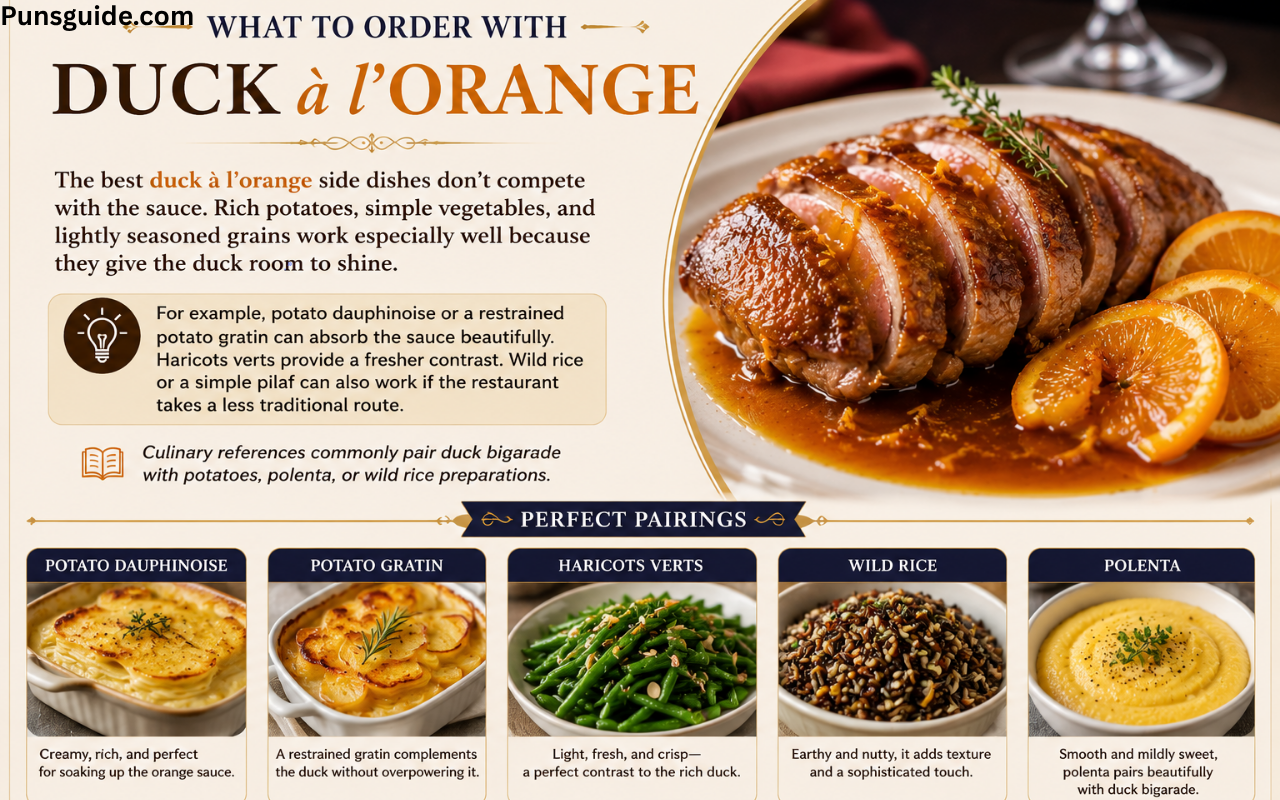
The best duck à l’orange side dishes don’t compete with the sauce. Rich potatoes, simple vegetables, and lightly seasoned grains work especially well because they give the duck room to shine.
For example, potato dauphinoise or a restrained potato gratin can absorb the sauce beautifully. Haricots verts provide a fresher contrast. Wild rice or a simple pilaf can also work if the restaurant takes a less traditional route. Culinary references commonly pair duck bigarade with potatoes, polenta, or wild rice preparations.
Potatoes and Duck
Potatoes make sense for a practical reason: they’re excellent at carrying sauce. A crisp roasted potato gives you textural contrast, while potato dauphinoise brings creamy richness.
There’s a limit, though. If both the potatoes and sauce feel excessively rich, the plate can become exhausting. That’s why a French bistro often benefits from keeping at least one element simple.
Green Vegetables
Haricots verts, asparagus, or simply prepared seasonal greens can cut through the richness of duck. Their freshness gives each bite a little breathing room.
You don’t need a complicated vegetable preparation. In fact, the more restrained the side, the more clearly you’ll taste the duck and citrus sauce.
Dessert After Duck à l’Orange
If you’re finishing a rich French meal, keep dessert in mind before ordering something enormous. A modest crème brûlée can work well, although its caramel sweetness may feel heavy after a sweet sauce.
Dark chocolate can also pair nicely with duck’s richness. If the meal already leans rich, however, fruit-based desserts or a lighter citrus dessert may leave you feeling better at the end.
Duck à l’Orange Wine Pairing
The right duck à l’orange wine pairing needs enough acidity to refresh the palate while still having the structure to stand beside duck. Pinot Noir is a natural option, particularly when the sauce leans savory rather than sugary.
A Red Burgundy with duck follows that same logic. The wine’s acidity and earthy character can complement the meat without overpowering the citrus.
White wine can work, too. A moderately rich Riesling or another aromatic white can handle the sweet-tart character of the sauce. Modern duck bigarade recipes also suggest fuller whites such as Viognier, Roussanne, or oaked Chardonnay.
The key isn’t memorizing one “correct” bottle. Think about balance. If the sauce tastes bright and acidic, a fresh, aromatic wine can be lovely. If the preparation is richer and more savory, Pinot Noir may be the better call.
How Much Should Duck à l’Orange Cost?
There isn’t one meaningful national price for duck à l’orange. A neighborhood bistro, hotel restaurant, and French fine-dining restaurant operate with very different costs.
Price can also reflect the preparation itself. Whole-duck service, house-made stock, long sauce reductions, premium duck, and tableside carving require more labor than a quick pan-seared breast with a simple orange glaze.
Rather than judging the dish by price alone, compare what you’re actually getting. A higher price can make sense when the restaurant uses a French-trained chef, makes its sauce in-house, cooks the duck to order, and provides a carefully composed plate. A high price doesn’t excuse dry meat or a sugary sauce, though.
Where to Look for Duck à l’Orange
If you’re searching for restaurants with duck à l’orange, start with restaurants that have a strong French identity and a menu that demonstrates classical technique. A classic French bistro, traditional French restaurant, French brasserie, or French fine-dining restaurant gives you a logical starting point.
However, don’t stop there. A chef-driven restaurant may offer an excellent seasonal version even if it doesn’t market itself as an old-school French restaurant. What matters is the menu and kitchen rather than the sign above the door.
Classic French Bistros
A neighborhood French bistro can be one of the best places to investigate. These restaurants often focus on recognizable dishes and may rotate preparations according to season.
Still, don’t assume every French bistro near me serves duck à l’orange. Check the actual menu. Look for duck preparations that demonstrate a serious approach to sauces and roasting.
French Brasseries
A French brasserie often offers a broader menu than a small bistro. That can make it a useful place to search for duck, especially if the restaurant maintains a substantial poultry section.
Brasseries also tend to attract diners looking for familiar French dishes. If duck à l’orange appears as a special, the restaurant may have enough demand to bring it back periodically.
Fine-Dining French Restaurants
A fine dining French restaurant may offer a more technical interpretation. Expect smaller portions, carefully reduced sauces, precise cooking, and a presentation designed around the entire plate.
The downside? Menus can change quickly. A restaurant may serve an exceptional duck dish one month and replace it with another seasonal preparation the next.
Seasonal Menus
Seasonality can work in your favor. Restaurants may feature seasonal duck à l’orange when the kitchen has especially good citrus or wants to bring a classic preparation back for a limited run.
That’s why checking the restaurant’s menu shortly before dinner matters. If you’re hoping for duck à l’orange tonight, don’t rely on a cached menu from an old search result.
How to Verify a Restaurant Before You Go
Before driving across town for duck à l’orange near you, spend a few minutes verifying the details. Start with the restaurant’s official menu. Then use recent customer reviews to see whether diners have actually ordered the dish.
A useful five-point check looks like this:
| Check | What You Want to See |
|---|---|
| Current menu | Duck à l’orange or a clearly related preparation |
| Description | Orange gastrique, bigarade, orange reduction, or similar |
| Recent reviews | Diners specifically mention the duck |
| Availability | Restaurant confirms it’s currently served |
| Price | Current menu price matches what you’re expecting |
This simple process prevents one of the most common local-search mistakes: confusing a restaurant that once served duck with one that serves it now.
If the restaurant lists a “duck special,” call and ask exactly what it is. You may discover a wonderful French duck entrée, but you won’t mistake duck confit with orange sauce for the traditional dish you’re trying to find.
Common Duck à l’Orange Mistakes to Watch For
The biggest problem is excessive sweetness. The classic dish has sweet elements, but the sauce needs acidity and savory depth. A plate that tastes like orange marmalade poured over duck has missed the point.
Another warning sign is poor duck technique. Properly rendered duck skin should have appealing texture, while the meat should remain tender. If the kitchen overcooks the breast until it’s dry, even a brilliant sauce won’t rescue the plate.
Finally, watch for terminology that sounds traditional but describes something else. Orange chicken isn’t duck à l’orange. A Chinese-style orange duck isn’t automatically French. A duck breast with bottled orange glaze isn’t the same thing either.
Is Orange Duck the Same as Duck à l’Orange?
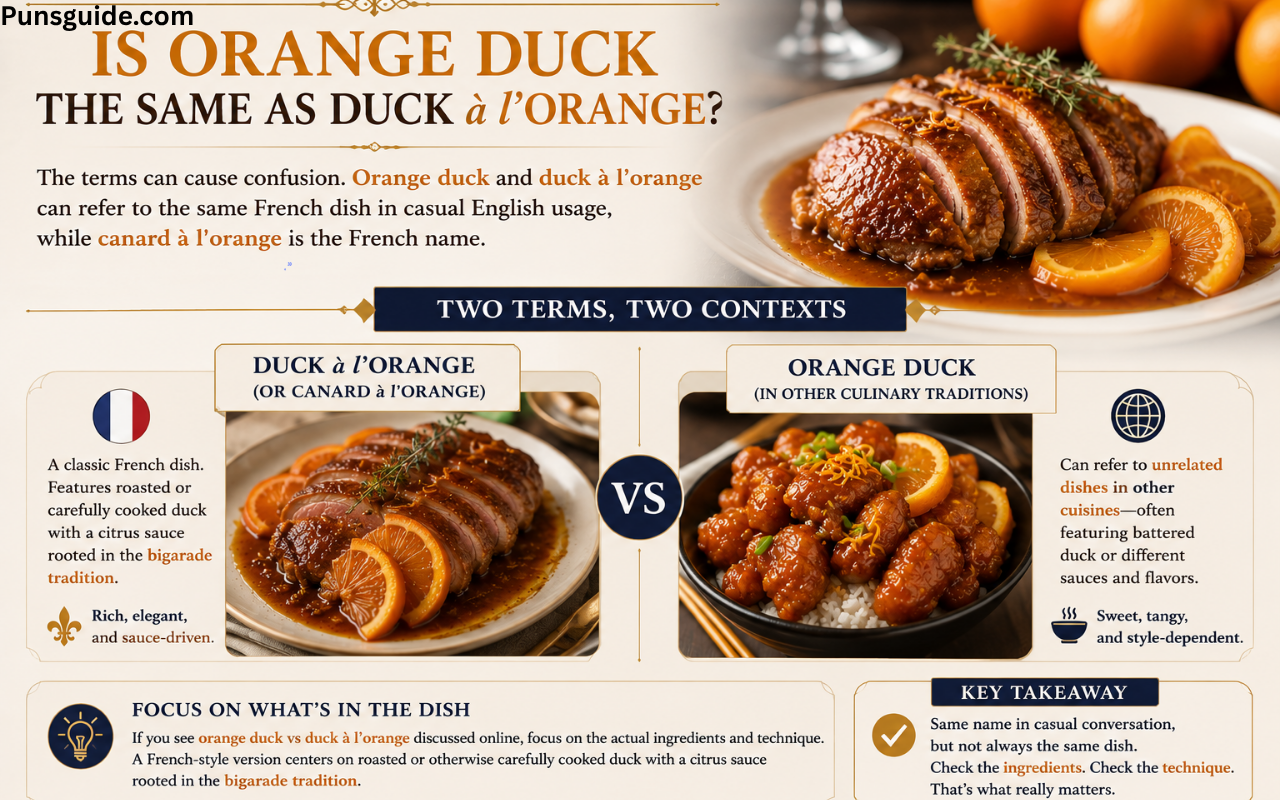
The terms can cause confusion. Orange duck and duck à l’orange can refer to the same French dish in casual English usage, while canard à l’orange is the French name.
However, “orange duck” can also describe unrelated dishes in other culinary traditions. That’s why the sauce and preparation matter more than the label.
If you see orange duck vs duck à l’orange discussed online, focus on the actual ingredients and technique. A French-style version centers on roasted or otherwise carefully cooked duck with a citrus sauce rooted in the bigarade tradition.
Duck à l’Orange vs. Duck Confit
Duck confit and duck à l’orange both belong to the broader world of French duck preparations, but they showcase very different techniques.
Confit traditionally cooks duck legs slowly in duck fat until the meat becomes exceptionally tender. Duck à l’orange focuses more heavily on the relationship between roasted duck and citrus sauce. The rich meat remains important, but the sauce supplies the dish’s signature character.
So, if a restaurant doesn’t have classic duck à l’orange, duck confit can be an excellent alternative. Just don’t order it expecting orange sauce.
Duck à l’Orange vs. Peking Duck
Peking duck also pairs duck with a strikingly crisp skin, but the culinary tradition is Chinese rather than French. The preparation, seasoning, cooking method, and service are entirely different.
French duck à l’orange emphasizes the marriage of duck with citrus and a reduced sauce. Peking duck emphasizes crisp skin, sliced meat, thin wrappers, and accompaniments such as scallions and sauce.
Both dishes can be spectacular. They’re simply spectacular in different ways.
Duck à l’Orange History: From Bigarade to a French Classic
The history of duck à l’orange is more complicated than the familiar Catherine de’ Medici story suggests. Some accounts connect the dish to Florentine cooking and Catherine de’ Medici’s move to France. Others point to earlier European preparations involving duck and citrus. Historians don’t agree on one neat origin story.
What we can document more confidently is the development of the dish within French cooking. A published recipe for ducklings à la bigarade appeared in Louis Eustache Ude’s The French Cook in the early 19th century, while Auguste Escoffier later codified versions of the preparation in Le Guide Culinaire.
The dish eventually became especially prominent in American food culture during the mid-20th century. Julia Child helped bring classical French cooking techniques into American home kitchens, and duck à l’orange became one of the era’s recognizable French dinner-party dishes.
Its reputation later became a little complicated. The sauce sometimes drifted toward excessive sweetness, giving the dish a dated reputation. Yet the underlying combination remains sound. Modern chefs can make the preparation feel remarkably fresh simply by restoring the balance of citrus, acidity, stock, and duck.
How Duck à l’Orange Is Made
A traditional duck à l’orange recipe involves more than roasting a bird and squeezing an orange over it. The sauce typically requires its own preparation, often beginning with orange zest and a sugar-and-vinegar reduction.
Classical recipes may blanch strips of orange peel, prepare a stock, roast the duck, deglaze the roasting pan, and combine those concentrated flavors with orange juice and the gastrique. Some versions finish with butter or orange liqueur.
The exact duck à l’orange cooking method varies. A chef might roast a whole duck, pan-sear a duck breast, or combine roasting and sauce reduction techniques. The important point is that the sauce should taste integrated with the duck rather than added as an afterthought.
What Should Duck à l’Orange Taste Like?
The first bite should give you richness, followed by brightness. Tender duck meat and rendered fat create the foundation. Then orange zest, juice, acidity, and sauce reduction pull the flavor in a sharper direction.
A good savory-sweet sauce never feels confused. Sweetness rounds out the duck. Acid keeps the palate awake. Citrus adds fragrance. Stock provides depth. When those elements line up, the dish tastes elegant without needing elaborate decoration.
That’s also why a great version can change your opinion of an old-fashioned dish. The problem was never really duck and orange. The problem was imbalance.
How to Tell if Duck à l’Orange Is Good
Start with texture. Look for crisp golden skin when the restaurant’s preparation includes skin-on duck. The meat should feel tender rather than fibrous or dry.
Then taste the sauce by itself. Does it have layers? Can you detect citrus, acidity, sweetness, and savory flavor? A balanced gastrique should make you want another bite rather than make you reach immediately for water.
Finally, try the duck and sauce together. That’s the real test. The sauce should enhance the meat while leaving enough duck flavor intact. If the orange completely overwhelms everything else, the kitchen has lost the central balance of the dish.
What If Duck à l’Orange Isn’t on the Menu?
Don’t give up on the restaurant immediately. Look for magret de canard, roasted duck, duck confit, or another classical preparation. A kitchen that handles duck well may offer an excellent alternative even when its current menu doesn’t include orange sauce.
You can also ask whether the chef has a seasonal duck special. Restaurants sometimes prepare dishes that never appear on the permanent menu. Just remember that a seasonal duck dish isn’t automatically traditional duck à l’orange.
If you’re specifically craving the classic sauce, though, keep searching. The right duck à l’orange restaurant is worth finding because the combination is difficult to fake convincingly.
Duck à l’Orange in Major U.S. Food Cities
Search behavior changes by city, but the same verification rule applies everywhere. Someone searching duck à l’orange NYC, duck à l’orange New York City, duck à l’orange Washington DC, duck à l’orange Chicago, duck à l’orange Los Angeles, or duck à l’orange New Orleans should verify the current menu rather than assume every French restaurant serves it.
In New York, for example, a search for French restaurants New York City produces a huge range of bistros, brasseries, and fine-dining restaurants. The same applies to French restaurants Washington DC or French restaurants Chicago. A broad restaurant search helps you discover candidates. It doesn’t prove dish availability.
New Orleans deserves special attention because a search for French Quarter duck à l’orange can mix genuinely French restaurants with restaurants influenced by broader Creole and European traditions. In Los Angeles, searches such as West Hollywood French restaurant can similarly surface modern French menus where duck preparations change frequently.
The practical lesson remains the same whether you’re looking for a Midtown French restaurant, a Cleveland Park French restaurant, a River West French restaurant, or a neighborhood bistro elsewhere: check the current menu and call ahead when necessary.
Frequently Asked Questions About Duck à l’Orange Near Me
What Is Duck à l’Orange Called in French?
The most familiar French name is canard à l’orange. You’ll also encounter canard à la bigarade, which refers to the classic bitter-orange sauce tradition.
If you’re searching restaurant menus, try both phrases. You may find a restaurant that doesn’t use the English term but still serves the dish.
Is Duck à l’Orange French?
Yes. Duck à l’orange is recognized as a classic French dish, although its deeper history involves older European culinary traditions and competing theories about its origins. The French culinary tradition developed and codified the dish as canard à la bigarade and canard à l’orange.
That’s why calling it a French duck dish is accurate even though the origin story isn’t as tidy as a single-country invention.
What Is Canard à l’Orange?
Canard à l’orange simply means duck with orange in French culinary terminology. In restaurant use, it generally refers to duck served with an orange-based sauce.
The phrase is especially useful when searching French menus because some restaurants prefer the French name.
Is Duck à l’Orange Supposed to Be Sweet?
Yes, but only partly. A good version has sweetness balanced by vinegar, citrus acidity, bitterness, and savory stock.
Think of the sauce as a four-way conversation rather than a sugar rush. Orange provides fruitiness. Vinegar supplies tension. Stock adds depth. Sugar rounds everything out.
Does Duck à l’Orange Use a Whole Duck?
Traditional preparations often use a whole duck or duckling, but modern restaurants frequently serve duck breast. Both approaches can produce excellent food.
The format matters less than execution. A beautifully roasted whole duck isn’t automatically better than a perfectly cooked pan-seared breast.
What Is Orange Gastrique?
An orange gastrique combines caramelized sugar and vinegar with citrus and other sauce ingredients. In classic bigarade-style preparations, orange juice and zest contribute the defining citrus flavor.
That sweet-acidic structure keeps duck from tasting overwhelmingly rich. It’s one of the reasons the pairing works so well.
Does Duck à l’Orange Contain Grand Marnier or Cointreau?
It can, but neither liqueur is mandatory. Some classic and modern recipes use Grand Marnier, Cointreau, or another orange liqueur to deepen the citrus flavor.
A restaurant can make excellent duck à l’orange without alcohol in the sauce. What matters is balance and technique rather than checking one ingredient off a list.
What Wine Goes With Duck à l’Orange?
Pinot Noir is one of the easiest choices because its acidity and moderate body work well with duck. Red Burgundy can be especially appealing when the preparation has earthy, savory depth.
Aromatic whites such as Riesling can also work, particularly when the orange sauce has pronounced sweetness and acidity. The goal is always the same: choose a wine that refreshes the palate rather than adding more heaviness.
What Should I Eat With Duck à l’Orange?
For what to eat with duck à l’orange, look for simple sides. Potato gratin, potato dauphinoise, haricots verts, roasted potatoes, wild rice, or a light pilaf can all work.
Avoid piling several rich components onto the plate. Duck already brings plenty of richness, while the sauce supplies intensity.
Is Duck à l’Orange the Same as Orange Chicken?
No. Orange chicken is a Chinese-American dish with its own cooking method, sauce, and flavor profile. It typically uses fried or battered chicken with a sweet citrus sauce.
Duck à l’orange belongs to the French culinary tradition and relies on roasted or carefully cooked duck with a citrus sauce rooted in bigarade-style technique.
How Do I Find Duck à l’Orange Tonight?
Search duck à l’orange near me, canard à l’orange, and duck with orange sauce, then check current menus. If the restaurant doesn’t clearly list the dish, call before leaving home.
For a limited-time special, this step matters even more. Duck à l’orange currently available can change from one service to the next.
Final Takeaway: Finding Great Duck à l’Orange Near You
Finding the best duck à l’orange near me takes a little more detective work than finding a generic French restaurant. That’s actually good news. Once you know what to look for, you can filter out outdated listings and misleading menu descriptions quickly.
Search using both English and French names. Check the current duck à l’orange menu. Read recent reviews. Ask about availability. Then, when the plate arrives, judge the essentials: properly rendered duck skin, tender meat, fresh citrus, and a sauce that balances sweetness with acidity and savory depth.
The greatest version may come from an old-school French bistro. It might come from a chef-driven restaurant with a seasonal menu. It could even arrive as a modern duck breast preparation that borrows the best ideas from the classical recipe.
What matters is the result. When rich duck meets a carefully reduced orange gastrique, the combination still has plenty of life left in it. That’s the magic of a true classic: strip away the gimmicks and the dish still works.
Also Read: Host Gimkit: Easy Steps to Launch Your First Game in 2026

Jhon AJS, the creative mind behind Puns Guide, is an experienced blogger with a knack for wordplay and witty humor. Passionate about blending laughter with language, he crafts engaging pun filled content that entertains and inspires readers. With years of blogging expertise, Jhon continues to share clever insights, making every visit to Puns Guide a fun and refreshing experience.