If you found Brumeblog.com through a search result and paused before clicking, that’s understandable. The internet has plenty of unfamiliar blogs, fake websites, phishing pages, and questionable content platforms. A clean-looking homepage alone doesn’t tell you whether a website deserves your trust.
So, is Brumeblog.com safe? Is Brumeblog.com legit or a scam? And can you trust Brumeblog.com for the information it publishes?
Those questions need different answers.
Brumeblog.com presents itself as a multi-topic informational blog covering subjects such as business, education, finance, health, lifestyle, technology, travel, pets, real estate, gaming, and more. The current site also shows active publishing, named authors, category navigation, an About section, and public contact information.
From a basic website security perspective, there is no clear evidence in the information reviewed that Brumeblog.com operates as a classic scam, phishing site, or malware-distribution website. A June 2026 third-party review also reported no Google Safe Browsing warnings at the time of its check. However, that isn’t a permanent guarantee. Website security can change.
The more interesting question is credibility.
Brumeblog.com appears to be a functioning publishing website, but its broad subject coverage and limited visible author information mean you shouldn’t automatically treat every article as expert-level material. That’s especially important when reading medical information, financial information, legal information, or other high-stakes content.
Here’s the full Brumeblog.com review, covering its security, privacy, legitimacy, content quality, usability, and overall trustworthiness.
Quick Verdict: Is Brumeblog.com Safe?
Is Brumeblog.com Safe to Visit?
Brumeblog.com appears reasonably safe for ordinary browsing based on the available evidence. The site operates over HTTPS, serves normal editorial pages, and doesn’t appear to require an account simply to read its articles. Its homepage currently shows active publishing activity with posts dated into 2026.
A separate June 2026 review reported that the domain returned no Google Safe Browsing warnings for malware or phishing at the time of its check. That’s a useful website safety signal, although it shouldn’t be treated as a lifetime security guarantee.
Is Brumeblog.com Legit?
The available evidence points toward Brumeblog.com being a legitimate informational website rather than an obvious scam website.
It has working content categories, named contributors, an About section, recent publishing activity, and contact information. The site identifies Devin Haney in its About section and describes the operation as self-produced, multi-niche blogs.
Still, legitimacy and authority aren’t the same thing. A website can be legitimate without being the best source for every subject it covers.
Is Brumeblog.com Trustworthy?
That’s a more nuanced question.
For casual reading and general information, Brumeblog.com can be useful. For important decisions, however, its content should be checked against authoritative resources, primary sources, government documentation, academic research, or qualified professionals.
| Area | Assessment |
|---|---|
| Basic browsing safety | Reasonably safe |
| HTTPS security | Present |
| Scam indicators | No clear evidence of classic scam behavior |
| Registration requirement | Not apparent for ordinary reading |
| Author attribution | Present |
| Editorial transparency | Limited |
| Topic expertise | Mixed |
| Content authority | Moderate to limited |
| Best use | General reading and research starting points |
| High-stakes information | Verify independently |
What Is Brumeblog.com?
Brumeblog.com is a multi-topic blog rather than a narrowly focused specialist publication.
Its current navigation includes categories such as Business, Education, Finance, Health, Lifestyle, Technology, Travel, Fashion, Crypto, Pets, Real Estate, and online gaming content. The homepage also provides search, recent posts, featured posts, and category navigation.
That makes Brumeblog more like a general informational website or digital magazine than a specialist authority. You might visit for a travel article one day and encounter business, health, technology, or gaming content the next.
Why People Search for Brumeblog.com
Searches such as “is Brumeblog.com safe,” “Brumeblog.com legit,” “Brumeblog.com scam,” and “can you trust Brumeblog.com” usually come from one simple concern: the reader doesn’t recognize the publisher.
That doesn’t automatically indicate a problem.
An unfamiliar website may simply be a small publisher that hasn’t built a major online reputation yet. The better approach is to examine its website safety, legitimacy indicators, privacy practices, authorship, and content quality rather than judging it by name recognition alone.
Brumeblog.com Security: Is the Website Technically Safe?
A proper Brumeblog website safety check starts with technical security.
Several factors deserve attention, including HTTPS encryption, browser warnings, malware reports, phishing behavior, suspicious redirects, forced downloads, and unusual requests for personal information.
No single test tells the whole story. Think of website security like checking a house. A locked front door is useful, but you still want to know what’s happening inside.
Brumeblog HTTPS and SSL Certificate
Brumeblog.com currently operates through HTTPS, which means the connection between your browser and the website uses encrypted communication.
That’s an important baseline for modern secure browsing.
However, HTTPS doesn’t prove that a website is honest. An SSL/TLS certificate establishes encrypted communication. It doesn’t verify the accuracy of an article, the identity of the publisher, or the quality of its editorial process.
In simple terms, Brumeblog HTTPS is a positive technical signal, not a complete trust signal.
Malware and Phishing Risk
The available 2026 evidence doesn’t show strong signs that Brumeblog.com functions as a malware website or phishing website.
A June 2026 third-party review reported that its Google Safe Browsing check returned no malware, phishing, or unsafe-content warnings at the time of testing.
That’s reassuring. Still, security scanners provide a snapshot rather than a permanent verdict. Websites change. Advertising networks change. External links change.
For that reason, safe browsing habits still matter.
Red Flags Users Should Watch For
Whether you’re visiting Brumeblog.com or another unfamiliar website, stop and think if you encounter:
- Fake antivirus alerts claiming your device is infected
- Forced downloads
- Unexpected browser extensions
- Fake giveaways
- Aggressive notification requests
- Repeated suspicious redirects
- Login pages pretending to belong to major brands
- Requests for unnecessary financial or identity information
These are genuine website red flags.
A normal article page doesn’t need your banking password, government ID, or remote-access software.
Brumeblog.com Privacy and Data Collection
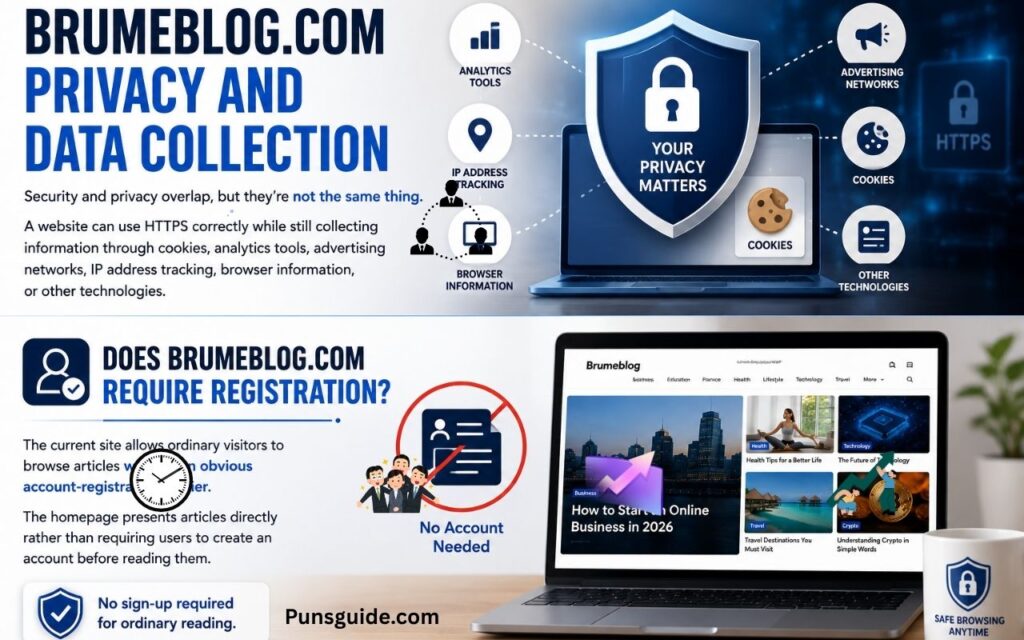
Security and privacy overlap, but they’re not the same thing.
A website can use HTTPS correctly while still collecting information through cookies, analytics tools, advertising networks, IP address tracking, browser information, or other technologies.
Does Brumeblog.com Require Registration?
The current site allows ordinary visitors to browse articles without an obvious account-registration barrier. The homepage presents articles directly rather than requiring users to create an account before reading them.
That’s convenient because casual readers don’t have to provide an email address simply to access an article.
However, no registration doesn’t mean zero data collection. Websites can still receive technical information as part of normal web traffic.
What Information Can a Blog Collect?
Depending on its technical setup and third-party services, a website may process information such as:
- IP address
- Browser type
- Device information
- Operating system
- Referring page
- Session data
- Cookies
- Approximate location
- User behavior data
- Advertising interaction metrics
The exact information collected depends on the site’s implementation and third-party services.
That’s why it’s inaccurate to say that a website collects “nothing” simply because it doesn’t require registration.
Brumeblog Privacy Policy
A proper Brumeblog privacy review should examine the current privacy policy directly.
Available third-party reporting claims that a privacy policy exists and discusses cookies and analytics. However, that claim should be treated separately from what can be independently confirmed on the current site.
The current homepage clearly exposes an About section and contact information. A privacy-policy link wasn’t clearly exposed in the material reviewed.
The sensible conclusion isn’t that Brumeblog has no privacy policy. Instead, its current privacy documentation should be checked directly before making a definitive claim about its privacy practices, data usage, cookies, or third-party tracking.
Brumeblog.com Legitimacy: Scam or Legitimate Website?
The phrase “Brumeblog.com scam” deserves careful treatment because calling a real website fraudulent without evidence can mislead readers.
A scam website normally has a deceptive objective. It may steal credentials, collect payments for nonexistent products, distribute malware, impersonate a trusted company, or manipulate visitors into surrendering sensitive information.
The evidence reviewed here doesn’t establish that kind of behavior on Brumeblog.com.
What Makes a Website Look Legitimate?
Brumeblog.com has several ordinary operational signals.
Its homepage functions as a publishing platform. Articles have publication dates and author names. The site maintains categories and publishes new material. It also provides an About section describing its publishing operation and a public contact address.
Those aren’t guarantees of quality. They are simply useful website legitimacy indicators.
What Doesn’t Prove Legitimacy?
A polished design doesn’t prove anything by itself.
Neither does HTTPS.
Neither does having dozens of articles.
Neither does appearing in Google search results.
A fraudulent website can imitate the appearance of a respected publication. A legitimate small blog can look basic and still be perfectly harmless.
That’s why a proper Brumeblog scam check should consider several independent signals instead of relying on one.
Brumeblog.com Editorial Transparency and Authority
This is where the review becomes more nuanced.
The website identifies authors. Current posts are attributed to writers including Devin Haney, Shivi Hyde, and Aditya Jain.
The About section also identifies Devin Haney and says the publisher researches trends and news and reviews content before publication.
That’s better than completely anonymous publishing.
Author Credentials Matter
A byline tells you who supposedly wrote an article. It doesn’t automatically tell you whether that person has the expertise needed for the subject.
That matters enormously when a site covers such a wide range of topics.
Someone may write a perfectly useful lifestyle article without holding a professional credential. Health, finance, legal, and technical subjects can demand a much higher level of author expertise.
For those topics, readers should look for:
- Relevant professional qualifications
- Industry experience
- Expert review
- Original research
- Strong source citations
- Clear editorial standards
Brumeblog’s visible author information is a positive starting point, but it doesn’t establish specialist authority across every category.
Brumeblog.com Content Quality Review
How Deep Is Brumeblog Content?
The site covers a remarkably wide range of subjects. That’s useful for readers who want one place to explore different topics. It also creates a credibility challenge.
A specialist technology publication can spend its editorial resources on technology. A medical publication can build a team around healthcare. A general blog has a much broader field to cover.
Brumeblog’s current homepage illustrates that range. Recent posts include an Iceland road-trip article, business advice, casino-related gaming content, employment topics, health content, pet information, and data visualization.
That breadth doesn’t make the website unreliable. It does mean topical authority varies by subject.
Content Readability
One clear strength is accessibility.
The website uses short article summaries, category labels, named authors, reading-time indicators, and familiar navigation. The structure makes the site easy to scan before choosing an article.
For a beginner-friendly website, that’s valuable. Readers shouldn’t need a map and compass to find the next article.
Yet readability shouldn’t be confused with research quality.
Simple writing can explain complicated ideas beautifully. It can also make weak information sound convincing.
Source Citations and Verification
Source citations are one of the strongest ways a reader can assess an informational article.
When an article makes a factual claim, readers should be able to trace important information back to reliable sources such as government resources, academic studies, industry reports, original datasets, or recognized experts.
The visible Brumeblog structure provides author attribution and article organization. However, the site’s broad publishing model doesn’t establish that every article follows the same level of source verification.
That’s why individual articles deserve individual scrutiny.
Is Brumeblog.com AI-Generated?
This question has become almost unavoidable in modern online publishing.
People often look at a polished article and wonder whether it came from a human writer, AI writing software, or some combination of the two.
The problem is that you can’t reliably establish authorship simply by reading a paragraph and deciding, “That sounds like AI.”
What Matters More Than AI Detection
Even if an article uses AI-assisted publishing, the more useful questions are:
- Are the facts accurate?
- Does the article provide evidence?
- Are sources relevant?
- Has a human editor reviewed it?
- Does the writer understand the subject?
- Does the article offer original value?
- Can important claims be independently verified?
AI can help with drafting. Human writers can produce shallow content too.
The real issue is content reliability, not the presence of artificial intelligence itself.
Possible Signs of Automated Writing
Readers can watch for repetitive phrasing, generic introductions, vague claims, excessive summaries, and paragraphs that say a lot without adding much information.
Still, those characteristics don’t prove AI authorship.
A better test is simple: Can you verify the important claims?
If an article tells you that a medical treatment works, a cryptocurrency is safe, or a legal rule applies in your state, check the claim against authoritative sources.
Brumeblog.com Trust Signals: What Looks Good?
The site has several positive Brumeblog trust signals.
First, it is actively maintained. The current homepage lists posts dated into June and July 2026.
Second, it doesn’t hide behind a completely anonymous interface. Author names and an About section are visible. A contact email is also published on the site.
Third, the site has a coherent publishing structure with categories, recent posts, featured content, and search functionality.
Those signals suggest an operating online content platform, not a one-page scam landing page.
Where Brumeblog.com Could Build More Trust
The biggest weaknesses aren’t obvious security problems. They’re authority and transparency issues.
Brumeblog’s category list spans everything from health and finance to technology, real estate, crypto, and online gaming. That’s a lot of ground for a small editorial operation to cover deeply.
Detailed author credentials would also help readers understand who has genuine expertise in specialized areas.
Likewise, a clearly documented editorial policy, fact-checking process, corrections policy, and stronger source documentation would make the site’s credibility easier to evaluate.
These aren’t accusations of wrongdoing. They’re simply areas where an informational publisher can build stronger website credibility.
Brumeblog.com Usability and User Experience
A safety review shouldn’t ignore the reading experience.
Brumeblog.com has a conventional blog structure. The homepage separates categories, recent posts, featured posts, and popular content. Visitors can also search the site.
That creates a familiar user experience. You can move between subjects without learning a complicated interface.
Mobile-Friendly Browsing
The site uses a conventional responsive blog layout rather than a desktop-only interface. That’s important because a large portion of casual web browsing happens on smartphones.
A good mobile-friendly website should keep text readable, avoid horizontal scrolling, make navigation accessible, and prevent pop-ups from covering the entire screen.
Still, mobile compatibility doesn’t equal credibility. It’s a usability signal, not an authority signal.
Navigation and Readability
Brumeblog performs reasonably well as a general browsing destination because its categories are easy to identify.
The current site includes Business, Education, Finance, Health, Lifestyle, Technology, Travel, and several additional categories.
The short summaries and reading-time labels also help users decide whether an article deserves their attention.
That’s a small feature, but small conveniences often make the difference between a website people use and one they abandon.
Brumeblog.com Strengths
Several strengths stand out in this Brumeblog website review.
Free and Accessible Content
Readers can access articles without an obvious registration wall. That makes the site convenient for casual research and general reading.
Broad Topic Coverage
The site’s multi-topic structure means one visit can lead from business to travel to technology without switching platforms.
Beginner-Friendly Presentation
Short summaries, familiar headings, category labels, and readable layouts make the site approachable for people who aren’t specialists.
Active Publishing
The current homepage shows a continuing stream of articles rather than a dormant website. Posts were published as recently as July 2026.
Brumeblog.com Weaknesses
The limitations are equally important.
Limited Editorial Authority
The website doesn’t present itself as a major specialist publication. Its wide subject mix makes deep expertise across every category difficult to establish.
Mixed Topic Depth
A general reader may find an article useful while an experienced professional may want more evidence, data, or specialist context.
Limited Visible Author Detail
Named authors are helpful, but readers benefit from more detailed author credentials when articles address sensitive subjects.
Source Quality Needs Article-Level Checking
Don’t assume every article has the same research standard. Check citations and primary sources when the claim matters.
Can You Trust Information on Brumeblog.com?
For low-risk informational content, Brumeblog.com can be a reasonable starting point.
For example, if you’re learning a basic concept, looking for general lifestyle ideas, or exploring a new topic, a readable overview can save time.
The stakes change when the information could affect your health, finances, legal rights, or safety.
Medical Information
Health content deserves special caution.
Brumeblog currently publishes health-related articles, including material related to neurosurgery and THC detox.
For medical advice, don’t rely on a general blog as your final authority. Verify important claims with healthcare professionals, medical institutions, peer-reviewed research, or trusted public-health resources.
Financial Information
Finance and crypto content can become outdated quickly. Interest rates change. Regulations change. Markets move.
Before acting on financial information or investment advice, compare claims with regulators, financial institutions, original market data, and established financial publications.
Legal Information
Legal rules depend heavily on jurisdiction and timing.
If a Brumeblog article discusses a legal issue, treat it as general background rather than personalized legal advice. Check official government resources or speak with a qualified attorney when the consequences matter.
Is a Secure Website Always Trustworthy?
No.
This is one of the most important lessons in any website safety check.
HTTPS protects the connection. It doesn’t certify the content.
Imagine buying a book from a shop with a strong lock on the door. The lock tells you something about the building’s security. It tells you nothing about whether every sentence inside the book is true.
The same principle applies online.
Technical security protects your connection. Editorial credibility helps you judge the information.
You need both.
How to Check If Brumeblog.com Is Safe Yourself
You don’t need to become a cybersecurity expert.
A few simple checks can reveal a surprising amount.
1. Check HTTPS
Look for the HTTPS connection in your browser. If the browser displays a security warning, don’t ignore it.
2. Use a Website Safety Checker
For a current website security check, use reputable services such as Google Safe Browsing or established malware-scanning platforms.
Remember that scanners provide a point-in-time result.
3. Look for Scam Red Flags
Watch for fake giveaways, suspicious downloads, fake antivirus messages, phishing pages, excessive redirects, and requests for unnecessary personal information.
4. Check Who Writes the Content
Look for author names, credentials, professional experience, and editorial information.
5. Verify Important Claims
Don’t stop at the blog post. Follow the evidence.
For important claims, compare the information with government websites, academic studies, official documentation, professional organizations, or original industry data.
6. Consider the Consequences
If getting the answer wrong could cost you money, affect your health, or create a legal problem, verification isn’t optional.
It’s part of responsible online safety.
Common Misconceptions About Website Safety
“HTTPS Means the Website Is Safe”
Not necessarily.
HTTPS means your browser has established an encrypted connection. It doesn’t mean the publisher is honest or the information is accurate.
“A New Website Is Probably a Scam”
Also false.
Some legitimate websites simply haven’t built a reputation yet. Lack of reputation is a reason to investigate, not proof of fraud.
“A Professional Design Means I Can Trust It”
Looks can deceive.
A polished scam can look better than a legitimate independent blog. Judge the evidence instead.
“AI Writing Means the Information Is False”
Not automatically.
AI-generated content can contain accurate information. Human-written content can contain mistakes. The quality of research matters more than the writing tool.
Brumeblog.com vs. Established Information Sources
Brumeblog doesn’t need to compete with every specialist publication to have value.
Its role is different.
| Information need | Brumeblog.com | Better verification source |
|---|---|---|
| General background | Useful | Optional |
| Lifestyle ideas | Suitable | Optional |
| Travel inspiration | Useful starting point | Official tourism sources |
| Health decisions | Not enough alone | Healthcare professionals and medical institutions |
| Financial decisions | Not enough alone | Regulators and established financial sources |
| Legal questions | Not enough alone | Government resources or attorneys |
| Academic research | Limited as a primary source | Peer-reviewed studies |
| Specialist technology research | Starting point | Specialist technical publications and primary documentation |
This isn’t about declaring one website good and another bad.
It’s about matching the source to the stakes.
If you’re deciding what color shirt to buy, you don’t need a peer-reviewed study. If you’re deciding whether to change medication, you absolutely need more than a casual blog post.
Final Verdict: Is Brumeblog.com Safe?
Is Brumeblog.com Safe to Visit?
Yes, Brumeblog.com appears reasonably safe for normal browsing based on the evidence reviewed. It uses HTTPS, operates as an active publishing website, and doesn’t show clear signs of classic scam behavior in the material examined.
A June 2026 third-party security review reported no Google Safe Browsing warnings for the domain at that time.
That result is reassuring, but no responsible security review should promise that a website will remain risk-free forever.
Is Brumeblog.com a Scam?
There is no clear evidence that Brumeblog.com is a scam website.
The site operates as a free multi-topic blog with active publishing, named contributors, visible categories, an About section, and contact information.
More importantly, the available evidence doesn’t establish the classic scam behaviors that would justify calling it fraudulent.
Is Brumeblog.com Trustworthy?
The answer depends on what you’re reading.
For casual information and general-interest topics, the website can be useful. For medical, financial, legal, or other high-stakes information, its articles should be treated as starting points rather than final authority.
That’s not necessarily a criticism of Brumeblog. It’s simply the right standard for any broad, multi-topic blog.
Frequently Asked Questions About Brumeblog.com
Is Brumeblog.com safe to visit?
Yes. Based on the available 2026 evidence, Brumeblog.com appears reasonably safe for ordinary browsing. It uses HTTPS and a June 2026 third-party review reported no Google Safe Browsing warnings at the time of its check.
Is Brumeblog.com legit or a scam?
The available evidence supports treating Brumeblog.com as a legitimate informational website rather than an obvious scam. It has active articles, named authors, categories, an About section, and contact information.
Does Brumeblog.com have malware?
No major malware problem was established in the evidence reviewed. A June 2026 review reported no malware or phishing warning from its Google Safe Browsing check. Security status can change, though, so current scanning remains sensible.
Does Brumeblog.com use HTTPS?
Yes. Brumeblog.com operates over HTTPS, which provides encrypted communication between the browser and website.
Remember that HTTPS encryption doesn’t prove content accuracy or publisher credibility.
Does Brumeblog.com require registration?
Ordinary article browsing doesn’t appear to require an account or registration. The current homepage presents articles directly for visitors.
Does Brumeblog.com collect personal information?
A lack of registration doesn’t mean a website collects no technical data. Like many websites, it may process information associated with normal browsing, depending on its analytics, cookies, advertising, and other third-party services.
Check the site’s current privacy documentation before assuming exactly what it collects.
Can you trust Brumeblog.com for medical information?
Use caution.
Brumeblog publishes health content, but a general multi-topic blog shouldn’t replace healthcare professionals, medical institutions, peer-reviewed research, or authoritative health resources.
Can you trust Brumeblog.com for financial information?
Use it as background information rather than your only source. Financial rules, products, markets, and risks can change quickly.
Verify important financial claims using regulators, financial institutions, original data, and qualified professionals.
Is Brumeblog.com safe for mobile users?
The website uses a conventional responsive blog structure and is designed for normal web browsing. As always, mobile users should avoid suspicious downloads, notification requests, and unexpected redirects.
Is Brumeblog.com trustworthy?
It appears reasonably trustworthy for casual informational use, but its credibility varies by topic. The broad subject mix means readers shouldn’t assume specialist authority across health, finance, technology, legal subjects, and other fields.
How can I check if Brumeblog.com is safe today?
Check the domain with a reputable website safety scanner, look for browser security warnings, inspect HTTPS, review suspicious redirects or downloads, and verify important content through independent sources.
For high-stakes claims, source verification matters more than any single website reputation score.
Conclusion: Should You Trust Brumeblog.com?
The answer isn’t simply “yes” or “no.”
Brumeblog.com appears safe for ordinary browsing and doesn’t show clear evidence of being a scam website. Its current site is active, uses HTTPS, publishes under named authors, and provides a recognizable multi-topic blog structure.
At the same time, safe doesn’t automatically mean authoritative.
That’s the point many website reviews miss. A website can have a secure connection while publishing an article that lacks enough evidence. It can have a clean design while offering little specialist expertise. It can be legitimate while still requiring readers to verify important claims.
Brumeblog is best approached as a general informational website. It’s useful for discovering topics, getting basic explanations, and reading accessible articles. For decisions involving your health, money, legal rights, or personal safety, bring in stronger sources before acting.
So, if the question is “Is Brumeblog.com safe to visit?”, the evidence points to yes.
If the question is “Can I trust every claim on Brumeblog.com without checking?”, the answer is no.
That middle ground is the most realistic way to evaluate an unfamiliar website in 2026. Website security protects the visit. Good source verification protects the decision.

Jhon AJS, the creative mind behind Puns Guide, is an experienced blogger with a knack for wordplay and witty humor. Passionate about blending laughter with language, he crafts engaging pun filled content that entertains and inspires readers. With years of blogging expertise, Jhon continues to share clever insights, making every visit to Puns Guide a fun and refreshing experience.