If you’ve searched for Unbanned G+, Unblocked Games G+, or Unbanned G Plus recently, you’ve probably noticed something unusual. The name appears across different gaming pages, Google Sites projects, mirrors, and community discussions. Yet there isn’t one clearly defined company or official gaming platform behind the term.
That confusion is actually part of the story.
Unbanned G+ has become a recognizable label for a wider type of browser gaming ecosystem: lightweight games that load inside a web browser and are often marketed toward people looking for games on restricted networks. Some sites use Google Sites. Others use GitLab, standalone domains, or different hosting arrangements. Some disappear and reappear under new addresses.
The result is a constantly shifting collection of unblocked browser games, rather than one permanent destination.
That distinction matters in 2026. It explains why one Unbanned G+ URL may work today and fail tomorrow. It also explains why the search term keeps resurfacing even when individual websites disappear.
Unbanned G+ Explained: What It Actually Is
At its simplest, Unbanned G+ refers to a loose collection of browser-game websites and gaming hubs that use names such as Unbanned G+, Unblocked Games G+, or G Plus Games.
A current example, GplusGames.com, describes itself as a destination for free browser games that require no installation or login. Another active site uses the exact “Unbanned G+” name and lists hundreds of browser titles across categories such as racing, action, arcade, sports, idle, and multiplayer games.
So there isn’t a single master database called Unbanned G+. There are multiple sites using closely related branding. That makes the term more like a search phrase and internet-culture label than a conventional gaming brand.
It also means you shouldn’t assume that every page carrying the G+ name has the same owner, game library, privacy practices, or security standards.
Why the Name “Unbanned G+” Went Viral
The name combines two ideas users already understand: unbanned gaming and G+ branding.
“Unbanned” suggests that a game remains accessible when other gaming websites don’t load. “G+” adds a short, memorable label that helps users identify a particular collection or family of sites. Current pages use variations including Unbanned G+, Unblocked Games G+, GPlus Games, and Unbanned G Plus.
There is also a natural connection to Google Sites. Several G+ gaming collections use Google Sites pages, which likely helped the naming convention spread.
However, that doesn’t mean Google operates these gaming sites. It simply means some publishers choose Google’s web-hosting service.
How Unbanned G+ Works Behind the Scenes
The technology behind these sites is much less mysterious than the name makes it sound.
Most browser-based games rely on technologies such as HTML5, JavaScript, WebGL, and ordinary web assets. Your browser downloads the files it needs and runs the game within the webpage. There is usually no traditional installer involved.
That model works particularly well for simple arcade games, racing games, puzzle games, platformers, and other titles designed around short sessions. A modern Chromebook or ordinary laptop can handle many of these experiences without the hardware requirements associated with large PC games.
Browser-Based Gaming Does the Heavy Lifting
The biggest advantage is simple: the browser becomes the game launcher.
Instead of installing a Windows application or downloading a large game package, you open a webpage. The browser retrieves the game’s resources and executes compatible code locally.
That explains why terms such as HTML5 games, browser-based games, games without downloads, and instant browser access appear so frequently around Unbanned G+.
The experience isn’t completely frictionless, though. The game still depends on the browser, network connection, hosting server, device performance, and any content restrictions applied by the network.
Google Sites Is Common, But It Isn’t Magic
Some Unblocked Games G+ pages are hosted through Google Sites. That has contributed heavily to the perception that G+ pages have some special ability to remain accessible.
The reality is more ordinary.
A Google-hosted webpage is still a webpage. Network administrators can restrict Google Sites, specific URLs, categories, or associated content. Community discussions in 2026 show users reporting that G+ pages themselves eventually became blocked on some school networks.
So the phrase “unblocked” describes access at a particular time and place. It doesn’t describe a permanent technical status.
Embedded Games and External Files
A gaming hub may display a game through an embedded frame or load files from another location. That arrangement allows one webpage to act as a catalog while the actual game assets live elsewhere.
This also explains why two apparently similar pages can behave differently.
One may load immediately. Another may show a blank screen because a game server is unavailable. A third may work at home but fail on a school network because an external resource has been filtered.
In other words, the webpage you see isn’t necessarily the entire technical stack behind the game.
Where the Unbanned G+ Trend Came From
The trend didn’t appear out of nowhere in 2026.
For years, browser gaming has occupied a useful corner of the internet. Flash once powered enormous numbers of web games before Adobe ended Flash support. HTML5 and modern browser technologies then made it possible to continue delivering lightweight games without browser plugins.
The unblocked gaming ecosystem grew alongside that transition.
School computers, managed Chromebooks, office networks, and other restricted environments created a particular kind of demand. People wanted games that didn’t require installation and could run inside an ordinary browser.
From Generic Unblocked Games to G+ Branding
Early searches often centered on broad phrases such as unblocked games, free browser games, and games for school.
Over time, recognizable site names began acting as shortcuts. When a particular portal became popular, users searched for that name again. When it stopped working, they searched for another version, backup, or mirror.
G+ became one of those recurring labels.
Current pages demonstrate how that naming pattern works. One Google Sites page calls itself “Unblocked Games GPlus,” while another standalone website brands itself GplusGames.com. A separate GitLab-hosted page uses “Unbanned G+” directly.
Community Sharing Keeps the Cycle Moving
This is where internet culture enters the picture.
Users share working gaming pages through forums, group chats, social platforms, and gaming communities. When a popular URL disappears, somebody often posts another option. That replacement then attracts more users.
Community discussions show this pattern clearly. Users have reported older unblocked-game sites becoming inaccessible and then suggested G+ or other alternatives.
That creates a simple cycle:
Discovery → sharing → popularity → filtering → replacement → discovery again
It’s less a single website trend than a constantly moving ecosystem.
Why Unbanned G+ Is Getting So Much Attention in 2026
Calling it a proven “explosive growth” story would go too far without reliable traffic or search-volume data. There isn’t enough public evidence to claim a specific percentage increase in Unbanned G+ users.
What can be observed is more useful: the model has several characteristics that make it naturally attractive in 2026, especially to people using low-powered or managed devices.
No Installation Makes Browser Gaming Easy
Traditional games can demand downloads, installers, updates, storage space, and administrative permissions.
Many browser games skip most of that.
You open a page, choose a title, and start playing. That makes no-installation games particularly convenient on devices where installing software isn’t practical.
For a five-minute gaming session, that difference is enormous. Nobody wants to spend the entire break watching a launcher update.
Lightweight Games Fit Older Devices
Not every game needs a powerful graphics card.
A large portion of the Unbanned G+ ecosystem consists of games with relatively modest technical requirements. Racing games, arcade titles, puzzle games, platformers, idle games, and simple sports games can often run comfortably on ordinary hardware.
That makes lightweight browser games a natural match for Chromebooks and other budget machines.
It also explains why the ecosystem isn’t dominated by visually demanding AAA games. The format works best when speed and accessibility matter more than cinematic graphics.
Short Sessions Match Modern Browser Habits
A quick game of Slope, a few rounds of a sports title, or a short puzzle session doesn’t require a two-hour commitment.
That fits the way many people use browser entertainment. They might have ten minutes between activities, a short break, or a few spare moments before moving on.
Current Unbanned G+ collections feature exactly this type of content, including games such as Slope, Moto X3M, 1v1.LOL, Level Devil, Cookie Clicker, Retro Bowl, Basketball Stars, and other arcade and casual titles.
Familiar Games Make Discovery Easier
A completely unknown game requires curiosity.
A familiar title doesn’t.
When people see names they’ve encountered elsewhere, they already understand roughly what they’re getting. That familiarity can make a large gaming hub feel useful immediately.
This is one reason search terms, keyword variations, and recognizable game names matter so much to the ecosystem. People don’t always search for “a browser game.” They search for a specific title.
Replacement Sites Keep Demand Alive
The strangest thing about the unblocked gaming ecosystem is that blocking one site doesn’t necessarily eliminate the underlying demand.
It can redirect it.
If an established page stops working, users may search for another domain, backup page, or similarly named collection. A Google Sites backup page explicitly presents itself as a fallback when the main platform becomes inaccessible.
That constant replacement behavior helps explain why Unbanned G+ remains a recurring search term even though individual URLs can have short lifespans.
What Types of Games Are Found on Unbanned G+?
The exact catalog varies because there isn’t one universal Unbanned G+ library.
Still, several categories appear repeatedly across current collections. The emphasis tends to fall on games that launch quickly, work inside browsers, and don’t require demanding hardware.
Racing and Driving Games
Racing titles are almost tailor-made for browser gaming.
Games such as Moto X3M, stunt racers, motorcycle games, traffic challenges, and driving simulators offer immediate objectives. You can understand the controls within seconds.
Current G+ collections prominently feature racing and driving categories alongside individual titles such as Moto X3M, Highway Racer-style games, Mega Ramp Car Stunts, Drift Hunters, and other vehicle-based games.
Platform and Skill Games
Platformers depend more on timing and reflexes than complicated hardware.
Titles such as Level Devil, OvO, Slope-style runners, and stickman platform games fit comfortably into this category. They’re also easy to understand without lengthy tutorials.
That makes them ideal for the quick-session nature of browser gaming.
Sports and Arcade Games
Sports games provide another reliable category.
Basketball, soccer, football, boxing, and arcade sports titles often use simple controls and short matches. Current G+ listings include games such as Basketball Stars, Football Masters, Big Shot Boxing, and related sports titles.
Arcade games work for the same reason. They get straight to the point.
Puzzle, Idle, and Casual Games
Not everyone wants racing or action.
Puzzle games, clickers, idle games, management games, and casual challenges are common because they can run without demanding graphics or complex controls.
They’re also excellent examples of short-session gaming. You can play for several minutes without needing to remember a complicated storyline.
Multiplayer Games
Multiplayer titles appear on some G+ collections, including games such as 1v1.LOL.
However, multiplayer performance depends on more than the webpage itself. The game may need external servers, stable connectivity, and browser compatibility.
A title can therefore appear in a gaming hub while still failing to work properly on a particular network.
Why Students Search for Unbanned G+
Students are a visible part of the unblocked gaming audience because school networks often use centralized filtering and device management.
A school Chromebook isn’t the same as a personal laptop. Administrators can control installed software, browser settings, websites, extensions, and network access.
That creates demand for browser-based entertainment.
Chromebooks Make Browser Games Especially Relevant
Chromebooks are designed around the web.
Because many school devices restrict traditional installations, browser games on school computers can appear more convenient than downloadable PC games. A game that runs directly in Chrome doesn’t require the same installation process.
That doesn’t mean every game will work. Schools can still block gaming sites, Google Sites, external game servers, or entire categories of content.
The important distinction is that browser-based does not mean unrestricted.
Search Behavior Is Part of the Story
Students don’t necessarily remain loyal to one website.
When a page stops loading, they search again. They may use phrases such as Unblocked Games G+, Unbanned G+ games, games not blocked on Chromebook, or simply the name of a game.
That behavior creates persistent search demand.
From an SEO perspective, this is where keyword research, search terms, keyword analysis, and keyword strategy become interesting. A cluster of related queries can emerge around one underlying need, with users switching between different semantic keywords, contextual terms, and keyword variations.
The important point isn’t artificial keyword density. Search behavior creates the language naturally.
The Biggest Misconception: Is Unbanned G+ Related to Google+?
No. Unbanned G+ isn’t the same thing as Google+.
Google+ was Google’s social networking service. Google shut the consumer version down in 2019. Modern websites using “G+” for browser games are not automatically connected to that former social network.
The confusion comes from the name and from the fact that some gaming pages use Google Sites.
Google Sites and Google+ Are Different Things
Google Sites is a website-building and hosting service.
Google+ was a social network.
Those are separate products with different purposes.
A gaming page hosted on Google Sites doesn’t become an official Google gaming service simply because Google’s infrastructure hosts the webpage.
Why the Confusion Keeps Appearing
The short “G+” label is memorable. It also looks familiar.
That makes it easy for people to associate the term with Google’s old social network, even though the connection isn’t there. Some third-party pages reinforce the confusion by using phrases such as “Google+ Games” or “Google Games Plus” in their titles.
For readers, the safest interpretation is simple: treat G+ as branding used by gaming sites, not as proof of a Google affiliation.
Is Unbanned G+ Safe to Use?
This is where caution matters.
There is no single Unbanned G+ website that can receive a universal safety rating. Multiple unrelated domains use similar names, and their advertising, hosting, game sources, and privacy practices can differ.
A page that loads safely today shouldn’t automatically earn permanent trust.
Browser-Based Doesn’t Mean Risk-Free
Running a game inside your browser reduces the need for traditional downloads, but it doesn’t eliminate security risks.
A gaming page can still display aggressive advertisements, redirects, tracking scripts, deceptive buttons, or fake download prompts.
One of the biggest warning signs is a page that suddenly claims your browser needs an update. Another is a game that asks you to install an unfamiliar extension before it will start.
Don’t do it.
Watch for These Warning Signs
Pay particular attention to:
- Unexpected download prompts
- Fake browser-update messages
- Suspicious redirects
- Requests for unnecessary personal information
- Unfamiliar browser extensions
- Excessive pop-ups
- Pages that imitate login screens
- Games that suddenly request unusual permissions
A simple browser game shouldn’t need your banking information, primary email password, or sensitive personal details.
HTTPS Isn’t a Complete Safety Guarantee
A padlock in the browser is useful because it indicates an encrypted connection.
It doesn’t certify that the website itself is trustworthy.
Think of HTTPS as a locked envelope. It helps protect the message while it travels, but it doesn’t tell you whether the person who receives the envelope deserves your trust.
That’s why safe browsing, browser updates, sensible privacy habits, and skepticism toward aggressive advertising still matter.
Unbanned G+ vs. Traditional Gaming Platforms
The biggest advantage of G+ style gaming hubs is convenience.
Traditional platforms usually provide stronger infrastructure, better account management, more consistent updates, and clearer ownership. Browser hubs tend to win on speed and simplicity.
| Feature | Unbanned G+ Style Hubs | Traditional Gaming Platforms |
|---|---|---|
| Installation | Usually browser-based | Often requires an app or launcher |
| Account | Often unnecessary | Frequently required |
| Hardware | Usually modest requirements | Can range from low to demanding |
| Sessions | Often short | Short or extended |
| Game library | Varies by site | Usually more consistent |
| Updates | Depend on the host | Usually managed centrally |
| Safety standards | Vary considerably | Often more standardized |
| Network access | Depends on local restrictions | Also depends on network restrictions |
Neither approach is automatically better.
If you want a quick browser game, a lightweight gaming hub can be convenient. If you want reliable multiplayer, cloud saves, official updates, and long-term support, a mainstream gaming platform usually makes more sense.
Why Unbanned G+ Sites Keep Changing
This is one of the most important things to understand about the trend.
A website can become popular without becoming permanent.
Domains expire. Pages get removed. Game files break. Hosting changes. Administrators update filters. Developers request content removal. Sometimes the owner simply abandons the project.
The ecosystem has plenty of moving parts.
Domain Switching Creates a Cat-and-Mouse Effect
The pattern is easy to recognize:
A site becomes popular → users share it → administrators notice it → access gets restricted → users search for another site.
Community discussions from 2024 through 2026 show versions of this cycle repeatedly. Users report that familiar unblocked-game sites stop working and then ask for alternatives.
That doesn’t prove every replacement site is safe or legitimate. It simply demonstrates how quickly the ecosystem can shift.
Popularity Can Work Against a Gaming Site
There is an ironic twist here.
The more widely a particular site gets shared, the more visible it becomes. A URL that circulates through student forums and group chats can attract substantial attention from network administrators.
Some community users even describe avoiding widespread sharing because they believe popularity causes sites to get blocked faster. That’s anecdotal rather than scientific evidence, but it illustrates how users perceive the cycle.
The result is a strange internet version of musical chairs. The available seat keeps moving.
The Copyright Question Behind Unblocked Games
Safety isn’t the only issue.
There is also a question of where the games come from and whether the host has permission to distribute them.
A game being playable for free doesn’t automatically mean every website has the right to copy, embed, mirror, or redistribute it.
Free to Play Doesn’t Mean Free to Redistribute
A developer might make a game available through an official website while retaining copyright over the game’s code, artwork, characters, music, and other assets.
A third-party gaming hub may have a completely different legal position.
That’s why readers should avoid assuming that every title listed on an Unbanned G+ page has been officially licensed by the site’s operator.
Why Games Disappear
A game can vanish because the original developer changes its hosting arrangement. An external embed can break. A copyright complaint can lead to removal. A third-party server can shut down.
These issues help explain why a G+ gaming catalog rarely stays identical for long.
The game list isn’t a permanent library carved in stone. It’s a changing collection assembled from different sources.
Why the Unbanned G+ Model Still Matters in 2026
The interesting story isn’t really about one website.
It’s about how people consume games on the modern web.
Browser gaming remains useful because it removes several barriers between a player and a game. There’s no large installer. There’s often no account. Many games work on modest hardware. A short session can begin almost instantly.
That is a powerful combination.
Browser Gaming Is Still Highly Accessible
The web has one major advantage over traditional software: the browser is already there.
If your device can run a modern browser, you may already have everything required to play a simple game.
That makes browser gaming, HTML5 games, casual gaming, and web-based entertainment especially resilient. The format doesn’t depend on expensive hardware or a large installation ecosystem.
Network Filtering Is Evolving Too
The other side of the story is network control.
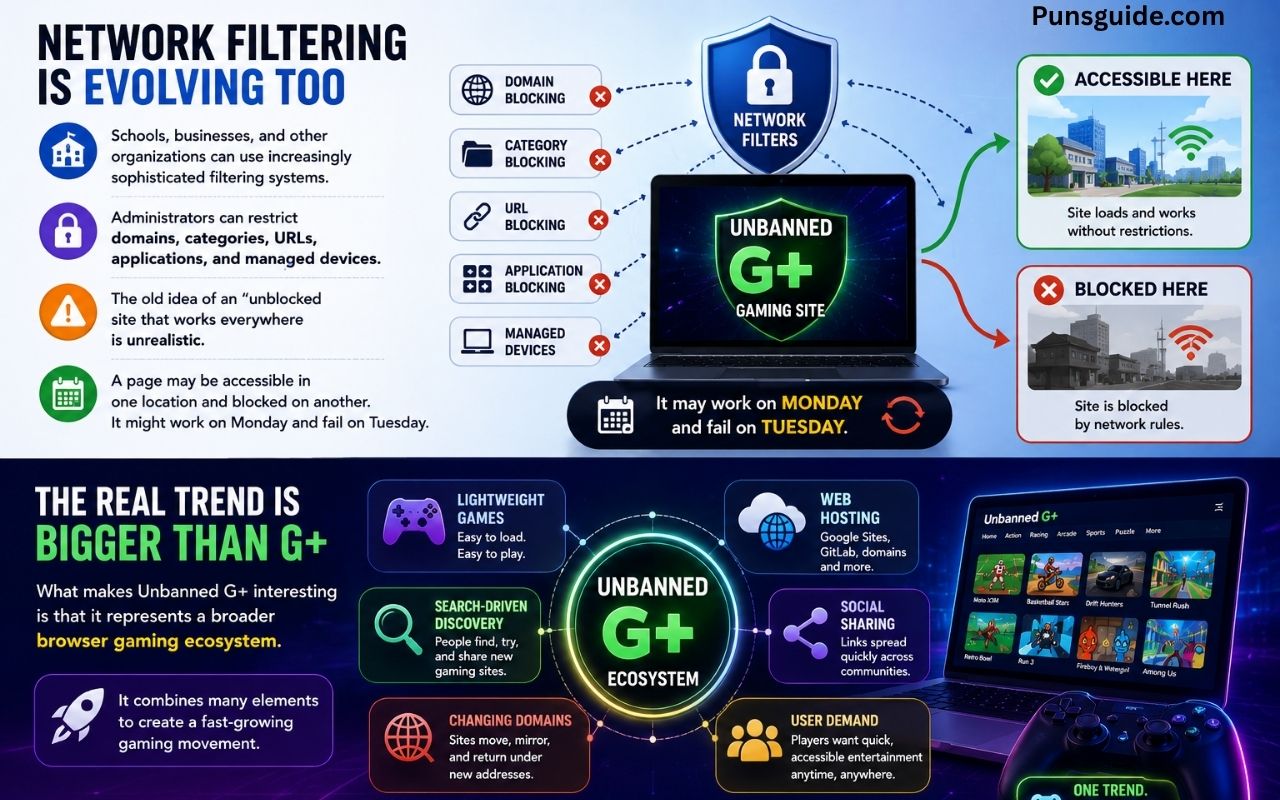
Schools, businesses, and other organizations can use increasingly sophisticated filtering systems. Administrators can restrict domains, categories, URLs, applications, and managed devices.
That means the old idea of an “unblocked” site that works everywhere is unrealistic.
A page may be accessible in one location and blocked on another. It might work on Monday and fail on Tuesday.
The Real Trend Is Bigger Than G+
What makes Unbanned G+ interesting is that it represents a broader browser gaming ecosystem.
It combines lightweight games, web hosting, search-driven discovery, social sharing, changing domains, and user demand for quick entertainment.
The name may change. The URL may change. The game library may change.
The underlying demand is much harder to eliminate.
Safer Alternatives to Unbanned G+
If your goal is simply to find enjoyable browser entertainment, you don’t necessarily need to chase constantly changing “unblocked” domains.
Official game websites and established browser-game platforms can offer a more predictable experience. Educational gaming sites can also be a better fit for school environments because they’re designed around learning rather than circumventing network restrictions.
For managed devices, the safest option is always to follow the network’s rules.
If a school or workplace blocks gaming sites, that restriction is usually there for a reason. Trying random mirrors, proxy services, or unfamiliar downloads can create far more trouble than a five-minute game is worth.
Choose the Game Source Carefully
When you have a choice, look for:
A clear publisher or developer, a recognizable domain, transparent privacy information, reasonable advertising, and no unexplained downloads.
Those signals don’t guarantee perfection. They do give you a much better starting point than an anonymous page packed with pop-ups.
Don’t Treat “Unblocked” as a Safety Label
This distinction deserves repeating.
Unblocked means accessible. It doesn’t mean safe.
A website can remain accessible while containing intrusive advertisements or questionable third-party content. Conversely, a perfectly legitimate site can be blocked simply because a network administrator categorizes gaming as nonessential.
Accessibility and trust are two separate questions.
Frequently Asked Questions About Unbanned G+
What is Unbanned G+?
Unbanned G+ is a term used by multiple browser-game websites and collections. It isn’t one standardized gaming platform. Different sites use related names and offer different game libraries.
Is Unbanned G+ the same as Google+?
No. Google+ was Google’s former social network. Modern G+ gaming pages are separate websites or gaming collections. Some use Google Sites, but that doesn’t make them official Google products.
Does Unbanned G+ work on every Chromebook?
No.
A Chromebook may support the browser technology required by a game, yet the network can still block the site or an external game resource. Device management and local filtering policies also vary.
Does Unbanned G+ require downloads?
Many G+ gaming pages advertise no-download browser games. Current collections describe their games as browser-based and offer titles designed to run directly online.
However, don’t install anything simply because a page says a download is required. Unexpected downloads are a security warning sign.
Is Unbanned G+ safe?
There’s no universal answer because multiple unrelated websites use the name.
Treat each domain separately. Watch for deceptive advertising, suspicious redirects, fake update notices, unnecessary permissions, and requests for personal information.
Why does an Unbanned G+ link stop working?
Several things can cause it: network filtering, domain changes, deleted pages, broken game files, hosting problems, or content removal.
That’s why a working URL today isn’t necessarily a reliable destination tomorrow.
What games are available on Unbanned G+?
The selection varies by site. Common categories include racing, arcade, platform, puzzle, sports, idle, simulation, action, and multiplayer games.
Current collections list titles such as Slope, Moto X3M, 1v1.LOL, Retro Bowl, Basketball Stars, Level Devil, Cookie Clicker, and many others.
Can schools block Unbanned G+?
Yes.
There is no permanent “unblock” status. Schools can restrict domains, Google Sites, categories, external game servers, or specific URLs.
What Unbanned G+ Really Represents in 2026
The easiest way to understand Unbanned G+ is to stop thinking of it as one website.
It’s a loose ecosystem of unblocked browser games, gaming hubs, mirrors, hosting pages, and search-driven communities. Some sites use Google Sites. Others use different hosts. Some stay online for months while others disappear much sooner.
Its popularity comes from a practical formula: quick access, lightweight games, familiar titles, minimal installation requirements, and easy sharing.
That formula fits modern browser habits surprisingly well.
At the same time, the “unbanned” label shouldn’t be taken literally. No gaming page is guaranteed to work on every restricted network. A site can be accessible in one location while being blocked somewhere else. A familiar name doesn’t guarantee security either.
The smarter way to approach the trend is to separate accessibility, technology, and safety.
Browser technology makes these games easy to deliver. Search behavior helps users discover them. Social sharing spreads working pages. Network filtering pushes users toward new destinations. That feedback loop keeps the ecosystem moving.
And that’s the real reason Unbanned G+ keeps appearing in 2026 searches.
It isn’t one site defeating the internet’s filters. It’s a constantly changing example of how browser gaming adapts to the way people use the web.

Jhon AJS, the creative mind behind Puns Guide, is an experienced blogger with a knack for wordplay and witty humor. Passionate about blending laughter with language, he crafts engaging pun filled content that entertains and inspires readers. With years of blogging expertise, Jhon continues to share clever insights, making every visit to Puns Guide a fun and refreshing experience.