A controller can have great buttons, comfortable grips, and precise sticks. None of that matters much if its connection keeps dropping during a match.
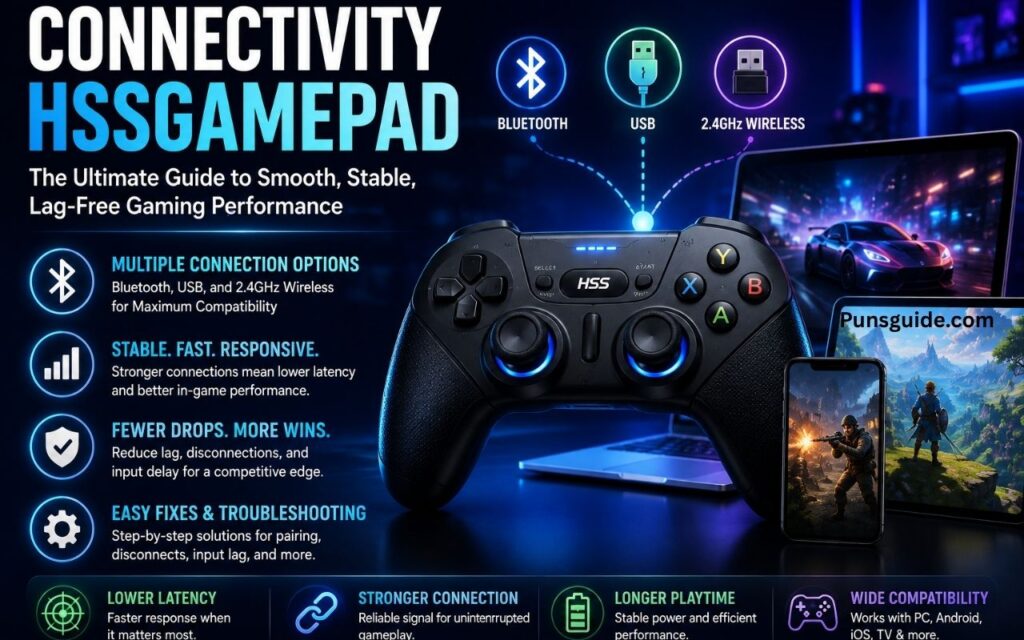
That’s where Connectivity HSSGamepad becomes important. The term essentially describes how an HSSGamepad controller communicates with a PC, phone, tablet, TV, console, or other compatible host. Depending on the model, that connection may use Bluetooth, USB, or a dedicated 2.4GHz wireless receiver. Public HSSGamepad pages describe several of these options, but the exact features can vary between models.
The good news is that most controller connection problems aren’t mysterious. A weak wireless signal, stale pairing data, low battery, unsuitable USB hardware, interference, or a compatibility problem can usually explain what’s happening.
This guide breaks down HSSGamepad connectivity, explains the difference between wired and wireless connections, and walks through practical fixes for pairing failures, input lag, random disconnects, and controller detection problems.
What Does Connectivity HSSGamepad Actually Mean?
Connectivity HSSGamepad isn’t a special wireless protocol. It describes the communication link between an HSSGamepad controller and the device receiving its inputs.
When you press a button or move an analog stick, the controller has to send that information to the host device. The host then passes the input to the operating system and ultimately to the game. Every part of that chain needs to work properly for you to get responsive gameplay.
Think of it like a conversation. The controller speaks first, the receiver listens, and the game reacts. If the message arrives late, gets interrupted, or never arrives, you feel the problem immediately.
The Connection Methods Used by HSSGamepad Controllers
Public HSSGamepad material describes controllers that can use Bluetooth connectivity, USB connections, and 2.4GHz wireless dongles. However, those features shouldn’t automatically be treated as universal across every HSSGamepad model.
That distinction matters. A controller that includes a 2.4GHz receiver can use that receiver for wireless communication. A Bluetooth-only model can’t magically gain the same capability with a generic dongle.
Before troubleshooting, check the exact controller model and its documentation. That one step can save a surprising amount of wasted time.
Why Your Exact HSSGamepad Model Matters
Many online guides describe HSSGamepad controllers as though every model has identical buttons, pairing combinations, wireless modes, and platform support. That’s risky.
For example, one public guide describes Bluetooth and USB support while another describes a 2.4GHz receiver as part of the setup. Because those instructions aren’t consistent enough to establish one universal procedure, model-specific instructions should take priority.
This also applies to HSSGamepad firmware, reset procedures, pairing shortcuts, and compatibility. Don’t force a button combination from a different model just because it appears in a search result.
Why HSSGamepad Connectivity Matters for Gaming Performance
A stable connection does more than keep your controller powered and visible. It determines whether your inputs reach the game consistently.
Imagine playing a racing game and tapping the brake just before a corner. If that input arrives late, your mistake may look like poor driving. In reality, the controller may have missed or delayed the command.
Controller Connectivity and Input Response
Input response describes how quickly and consistently the game reacts after you interact with the controller.
Several things can contribute to the final response you feel. Controller electronics, the connection method, operating-system processing, game-engine behavior, display latency, and network conditions can all play a role.
That’s why it’s misleading to blame every delay on Bluetooth or every slow reaction on the controller. The entire input path matters.
Connection Stability Matters More Than a Big Latency Number
A controller with a predictable connection can feel better than one that occasionally produces severe delays.
For example, suppose a wireless controller responds normally for ten minutes and then briefly stops registering inputs. That tiny interruption can be much more disruptive than a connection that consistently adds a small amount of latency.
For competitive gaming, consistency is the real prize. You want the same button press to produce the same result every time.
FPS, Racing, Fighting, and Sports Games
Different genres expose connectivity problems in different ways.
In FPS gaming, unstable controller connectivity can affect aiming, movement, weapon switching, and split-second reactions. In racing games, inconsistent input can make steering and throttle control feel unpredictable. Fighting games can expose missed or delayed commands particularly quickly because timing matters so much.
Casual adventure games may hide minor connection problems for longer. That doesn’t mean the connection is better. The gameplay simply gives you more room for error.
Controller Lag Isn’t the Same as Internet Lag
This distinction causes a lot of confusion.
Controller latency happens between the controller and the gaming device. Network latency happens when information travels between your device and an online game server or other players.
You can have a perfect internet connection and still experience controller input delay. Conversely, your controller can respond instantly while an online match suffers from network lag.
If an offline game feels sluggish, investigate the controller and system first. If offline play feels normal but online matches feel delayed, the network deserves closer attention.
HSSGamepad Connectivity: Bluetooth vs. 2.4GHz vs. USB
Choosing the right connection method can make troubleshooting much easier. Each approach has a different balance of convenience, hardware requirements, and reliability.
There isn’t one universal winner. Your device and the specific HSSGamepad model matter.
Bluetooth Connectivity
Bluetooth connectivity is convenient because you don’t need a dedicated receiver. If the controller and host device support the appropriate Bluetooth profile, pairing can be straightforward.
It’s particularly useful for phones, tablets, laptops, and other devices where a USB dongle would be inconvenient. You also avoid occupying a USB port.
The tradeoff is that Bluetooth operates in a busy wireless environment. Nearby Bluetooth devices, Wi-Fi activity, physical obstacles, and USB-related interference can contribute to connection problems.
2.4GHz Wireless Connectivity
A supported 2.4GHz wireless receiver creates a dedicated wireless link between the controller and its receiver.
This can be a useful option for desktop gaming because the receiver stays attached to the PC or another compatible host. It also avoids relying on the host’s built-in Bluetooth system.
However, 2.4GHz does not mean “immune to interference.” The 2.4GHz range is shared by several wireless technologies, so placement still matters.
More importantly, don’t assume a generic 2.4GHz receiver will replace a missing controller dongle. Many wireless gamepads use proprietary communication between a controller and its paired receiver.
USB Wired Connectivity
A wired connection is the simplest baseline for troubleshooting.
Plugging the controller directly into a compatible USB port removes the wireless link from the equation. There is no Bluetooth pairing to manage and no wireless signal to maintain.
That makes USB especially useful when diagnosing input lag, random disconnects, and wireless instability. If the controller works perfectly over USB but struggles wirelessly, you’ve narrowed the problem considerably.
Wired vs. Wireless HSSGamepad Performance
| Connection | Main advantage | Common concern | Best use |
|---|---|---|---|
| USB wired | Direct and predictable connection | Cable limits movement | Competitive or diagnostic testing |
| Bluetooth | Convenient and cable-free | Pairing and wireless interference | Mobile and general gaming |
| 2.4GHz receiver | Dedicated wireless link | Requires compatible receiver | PC or supported console setups |
The practical lesson is simple: use wired mode as your baseline when something feels wrong. Once the controller works correctly through USB, you can troubleshoot wireless connectivity with much more confidence.
What Causes HSSGamepad Connectivity Problems?
Connection failures rarely come from one dramatic hardware defect. More often, several ordinary factors line up in an unfortunate way.
A controller may be low on battery, sitting several meters away, competing with other wireless devices, and carrying old pairing information. Each factor alone might seem harmless. Together, they can produce a miserable gaming session.
Wireless Interference
Wireless interference can disrupt communication between a controller and its host.
Bluetooth and many 2.4GHz wireless systems operate around the same general frequency range used by Wi-Fi equipment and other devices. That means a crowded wireless environment can sometimes affect connection quality.
You don’t need to turn your gaming room into a radio laboratory. Start with simple changes. Move the controller closer, reposition a wireless receiver, and temporarily reduce unnecessary nearby wireless activity.
Low Battery Levels
A low controller battery is one of the easiest things to overlook.
When troubleshooting a wireless controller, charge it fully before drawing conclusions. If the controller works reliably after charging, you may have found the cause. If the same problem returns despite a healthy charge, continue testing rather than repeatedly blaming the battery.
Old Pairing Data
Bluetooth devices remember previous connections. Sometimes that information stops matching the state of the controller or host.
The result can look confusing: the controller appears in Bluetooth settings but refuses to connect. In that situation, removing the old pairing and starting again can clear the problem.
Distance and Physical Obstacles
Wireless range isn’t a magic number that stays identical in every room.
Walls, furniture, metal objects, computer cases, and other electronics can change the quality of the wireless path. The farther the controller moves from its receiver, the more important the surrounding environment becomes.
When diagnosing weak signal or signal drops, place the controller close to the host. If the connection suddenly becomes reliable, distance or the wireless environment deserves further investigation.
How to Connect HSSGamepad Correctly
The safest setup method starts with the controller’s own documentation. Public HSSGamepad guides describe several connection methods, but they don’t provide enough consistent model-specific information to justify one universal pairing sequence.
Still, the basic process remains straightforward.
How to Connect HSSGamepad Through Bluetooth
First, charge the controller and enable Bluetooth on the host device. Put the HSSGamepad into its documented Bluetooth pairing mode, then open the host’s Bluetooth settings.
Wait for the controller to appear in the available-device list. Select it and complete the pairing process if the host asks for confirmation.
If it doesn’t appear, don’t immediately assume the controller is broken. Make sure it isn’t already connected to another device, move it closer to the host, restart Bluetooth, and try again.
How to Connect HSSGamepad Through USB
For a wired connection, use a compatible USB cable and connect the controller directly to the host.
If the operating system recognizes the controller, test its buttons and sticks before launching a game. This establishes whether the hardware communication itself works.
If nothing happens, try another USB port. Then test another known-good cable if the controller uses a detachable cable. A bad cable can imitate a much more complicated driver or firmware problem.
How to Connect a Supported 2.4GHz Receiver
If your HSSGamepad came with a 2.4GHz wireless receiver, connect that receiver to the compatible host and follow the controller’s documented pairing procedure.
Avoid substituting an unrelated dongle. The fact that both devices operate in the 2.4GHz range doesn’t mean they speak the same communication protocol.
Once connected, test the controller close to the receiver first. After confirming stability, move back to your normal gaming position.
HSSGamepad Troubleshooting: A Logical Step-by-Step Process
Randomly changing settings can make troubleshooting harder. Instead, remove one possible cause at a time.
The following process works because it starts with simple variables and gradually moves toward software and hardware diagnosis.
Step 1: Identify the Exact Problem
Start by describing what actually happens.
Does HSSGamepad keep disconnecting? Does it refuse to pair? Does Windows recognize it while the game ignores it? Does the controller connect but feel delayed?
These are different problems. Treating them as one giant “connectivity issue” often leads to unnecessary fixes.
Step 2: Charge the Controller
Give the controller a full charge.
Then reconnect it and test again. If the problem disappears, monitor the battery over the next few sessions. If it returns with a healthy battery, continue.
Step 3: Restart the Controller and Host
Turn the controller off and restart the PC, phone, tablet, or other host.
This sounds almost too simple. It isn’t. A restart can clear temporary device states, stalled Bluetooth services, or communication processes that didn’t recover properly.
Step 4: Remove and Re-Pair the Controller
For Bluetooth problems, remove the existing device entry and pair the controller again.
A fresh pairing can eliminate pairing conflicts and stale connection information.
Step 5: Test Another Connection Method
This is one of the most useful tests available.
If Bluetooth is unreliable, test USB. If USB works flawlessly while Bluetooth repeatedly fails, you have strong evidence that the problem lies somewhere in the wireless connection path rather than the controller’s basic input hardware.
If the same problem appears through multiple connection methods, investigate the controller, host device, compatibility, or software more closely.
Step 6: Test Another Compatible Host
Connect the controller to another supported device.
For example, if HSSGamepad works normally with a phone but won’t connect to your Windows PC, the controller is less likely to be the sole problem.
That doesn’t prove the PC is faulty. It simply gives you a valuable comparison point.
Step 7: Check Drivers and Operating-System Support
Windows handles many standard controller connections automatically. However, Bluetooth and USB problems can still involve drivers, device configuration, or operating-system updates.
Don’t install random third-party driver packages just because a search result recommends them. Start with Windows Update, the device manufacturer’s documentation, and the normal Device Manager tools.
Step 8: Investigate Firmware Carefully
HSSGamepad firmware deserves a cautious approach.
Firmware can affect device behavior, but an update should come from a trustworthy source for the exact model. Don’t install firmware intended for another controller simply because the name looks similar.
A failed firmware process can create a bigger problem than the original connectivity issue.
How to Reduce HSSGamepad Input Lag
The phrase lag-free gaming sounds attractive, but no wireless connection can honestly guarantee zero latency under every condition.
The realistic goal is lower unnecessary delay and, more importantly, consistent input behavior.
Test Wired Mode First
Connect the HSSGamepad by USB if the model supports it.
Play the same game using the same system settings. If the response immediately feels more consistent, wireless connectivity becomes the obvious area to investigate.
This simple A/B test is far more useful than guessing whether Bluetooth “should” be fast enough.
Improve Wireless Signal Conditions
Move closer to the host and reduce physical obstacles.
If you’re using a 2.4GHz receiver, experiment with its placement. A receiver buried behind a desktop tower can have a worse wireless path than one positioned more openly.
Reduce Wireless Congestion
You don’t need to shut down every device in the house.
Instead, look for obvious sources of congestion. Multiple Bluetooth accessories, busy Wi-Fi equipment, wireless headsets, and poorly positioned USB devices can create a difficult environment for a small controller signal.
Start by changing one thing. If the connection improves, you’ve learned something useful.
Check Game and System Settings
Sometimes the controller connection is fine while the game introduces the delay.
Check the game’s controller configuration, input mode, frame rate, and display settings. A game running with inconsistent frame delivery can make controls feel sluggish even when the controller is communicating correctly.
This is why controller latency should never be diagnosed in isolation.
HSSGamepad Bluetooth Problems and Their Fixes
Bluetooth problems usually fall into a few recognizable categories.
Once you identify which category you’re dealing with, the fix becomes much less mysterious.
HSSGamepad Bluetooth Is Not Showing Up
Start by confirming that the controller is actually in pairing mode.
Then check its battery, move it close to the host, and make sure another device hasn’t already connected to it.
If it still doesn’t appear, restart Bluetooth on the host. Make sure the host supports the required Bluetooth controller profile and check that the controller remains within a reasonable range.
HSSGamepad Bluetooth Won’t Pair
If the controller appears but won’t connect, remove its old Bluetooth entry.
Then restart the host and initiate a fresh pairing process. This clears many pairing problems without touching firmware or drivers.
If the controller pairs successfully with another compatible device, focus your attention on the original host.
HSSGamepad Bluetooth Keeps Disconnecting
Start with battery level and distance.
Next, reduce possible wireless interference and test the controller near the host. If the problem disappears at close range, the wireless environment is likely contributing to the issue.
If disconnects continue even when the controller is close and fully charged, test USB or another supported connection method.
Bluetooth Connects but the Game Doesn’t Respond
This problem is different from a pairing failure.
If the operating system says the controller is connected but the game doesn’t react, check gamepad compatibility, input settings, and whether another controller or input layer is taking control.
Some games support certain controller standards more reliably than others. A successful Bluetooth connection only proves that the host can communicate with the controller. It doesn’t guarantee that every game will interpret those inputs correctly.
HSSGamepad USB and Wireless Receiver Problems
Wireless problems get most of the attention. USB issues deserve equal consideration because they can affect both wired play and wireless receivers.
HSSGamepad Is Not Detected Over USB
Try another USB port first.
If that fails, try another compatible cable. Also test the controller on another computer if possible.
Windows may expose the device through Device Manager even when a particular game doesn’t recognize it. That distinction helps determine whether you’re dealing with hardware communication or game-level compatibility.
The 2.4GHz Receiver Isn’t Working
First, reconnect the receiver.
Then try another USB port and confirm that you’re using the receiver supplied for that controller. Don’t assume any 2.4GHz dongle can communicate with any 2.4GHz gamepad.
If the receiver works on one host but not another, investigate the second host’s USB support and compatibility.
The Receiver Works but the Connection Drops
Try moving the receiver.
USB placement can matter because the receiver needs a clean enough wireless path to communicate with the controller. Testing a different port can also help identify interference or hardware-specific problems.
If wireless still behaves badly, use USB as a comparison. A stable wired connection gives you a useful baseline.
HSSGamepad Compatibility Across PC and Mobile Devices
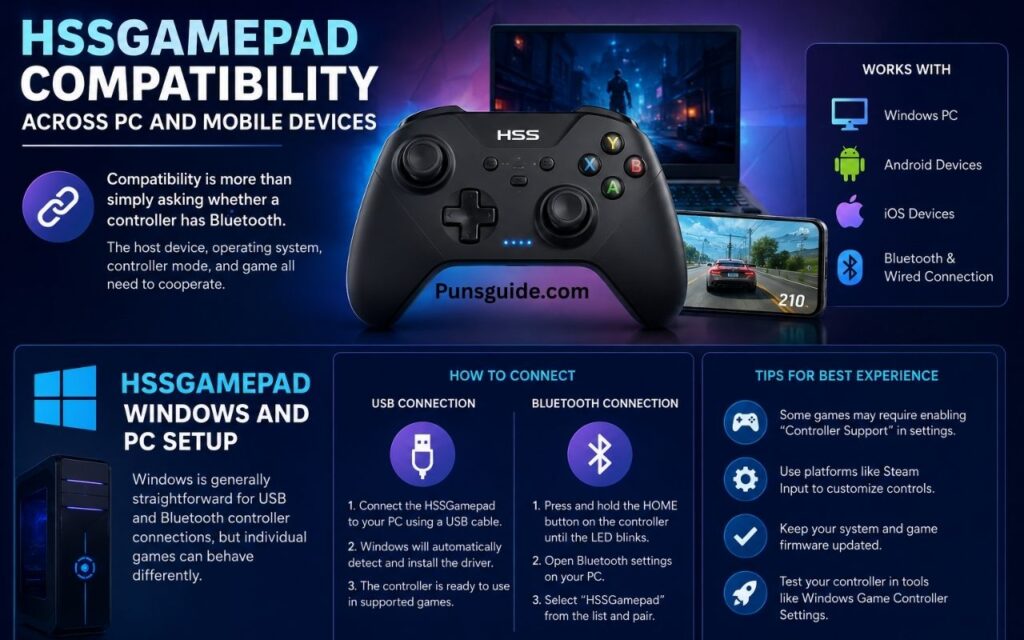
Compatibility is more than simply asking whether a controller has Bluetooth.
The host device, operating system, controller mode, and game all need to cooperate.
HSSGamepad Windows and PC Setup
Windows is generally straightforward for USB and Bluetooth controller connections, but individual games can behave differently.
If Windows recognizes the controller yet the game doesn’t, check the game’s input support and configuration. On PC, controller layers can also influence how games interpret a connected device.
HSSGamepad Android Setup
Android devices can pair with compatible Bluetooth controllers, but game support remains important.
A phone may successfully connect to the controller while a particular game ignores physical gamepad input. That’s a software compatibility issue, not necessarily a connectivity failure.
For mobile gaming, keep the controller reasonably close to the phone and avoid unnecessary wireless interference.
HSSGamepad iOS and iPadOS
The same principle applies to Apple devices.
Bluetooth pairing does not automatically mean every game will support the controller. Check the individual game’s controller support and the controller’s documented compatibility.
If the controller pairs but doesn’t work inside one particular title, test another controller-supported game before changing system settings.
Smart TVs and Gaming Consoles
Console and smart-TV support should always be treated as model-specific.
Broad compatibility claims don’t establish universal support across every PlayStation, Xbox, Nintendo, or smart-TV model.
That is especially important with USB receivers. A console may recognize the receiver as a device yet still fail to accept the controller’s inputs correctly.
How to Build a Stable HSSGamepad Gaming Setup
A good setup doesn’t require expensive accessories. It requires fewer weak points.
Start with the connection method that behaves most predictably on your particular device. For competitive PC gaming, that may mean USB. For convenient mobile gaming, Bluetooth may be the better fit. A supported 2.4GHz receiver can make sense when you want wireless play without relying on Bluetooth.
Keep the Controller Charged
Don’t wait until the battery is nearly empty before charging.
A healthy battery level removes one variable from your troubleshooting process and gives wireless communication the power it needs.
If the controller repeatedly disconnects near the end of a charge, pay attention to that pattern. It can tell you more than a one-time connection failure.
Position the Controller and Receiver Sensibly
Don’t hide a wireless receiver behind a dense stack of electronics if you can avoid it.
Keep the controller within a practical range and reduce unnecessary physical obstacles. Small changes in controller placement can sometimes make a surprisingly noticeable difference.
Keep the Wireless Environment Reasonable
A gaming setup may contain a PC, Wi-Fi router, Bluetooth headset, phone, smartwatch, keyboard, mouse, and several other wireless accessories.
You don’t need to eliminate all of them. Just avoid creating an unnecessarily crowded wireless environment around the controller and receiver.
Use Wired Mode When Reliability Matters Most
For tournament-style play, competitive FPS sessions, or situations where a dropped input could ruin the experience, wired mode remains an excellent fallback when supported.
It’s not glamorous. That’s part of its appeal.
A cable removes an entire category of wireless problems.
A Practical HSSGamepad Connectivity Troubleshooting Table
| Problem | Likely cause | Best first move |
|---|---|---|
| HSSGamepad won’t pair | Pairing mode, battery, stale pairing data | Charge it, remove old pairing, then pair again |
| HSSGamepad isn’t detected | USB port, cable, driver, compatibility | Try another port and cable |
| Controller keeps disconnecting | Interference, distance, battery | Move closer and charge fully |
| Bluetooth connection feels unstable | Wireless congestion or host Bluetooth issue | Test close to the host |
| Controller connects but game ignores it | Game compatibility or input configuration | Test another supported game |
| 2.4GHz receiver fails | Wrong receiver, USB issue, pairing problem | Use the original receiver and another USB port |
| Wireless feels delayed | Wireless environment or system/game latency | Compare against wired mode |
| Controller works on phone but not PC | PC Bluetooth, drivers, or compatibility | Troubleshoot the PC connection |
| Controller works through USB only | Wireless-side issue | Focus on Bluetooth or receiver setup |
| Problem persists everywhere | Controller hardware or firmware | Check model documentation and support |
Signs Your HSSGamepad Connectivity Is Properly Optimized
A stable controller connection is easy to recognize during normal play.
Buttons register when you expect them to. Analog movement doesn’t randomly stop. The controller doesn’t disappear halfway through a match. Most importantly, the behavior remains consistent over a long session.
Consistent Input Registration
The best sign of controller stability is predictability.
You shouldn’t need to press a button twice because the first input disappeared. You also shouldn’t see random movement freezes or unexplained trigger delays.
Stable Long Gaming Sessions
Test the controller for more than five minutes.
A connection that survives a short setup test isn’t necessarily reliable. Long sessions reveal problems caused by battery level, wireless congestion, or gradual connection instability.
Fast and Predictable Reconnection
A well-behaved controller should reconnect according to its normal documented behavior.
If you constantly have to remove and re-add the controller, restart Bluetooth, or unplug the receiver, something isn’t right.
Minimal Unexplained Input Delay
Don’t chase theoretical perfection.
Instead, look for a responsive, repeatable experience. If wired and wireless modes feel practically identical during your normal games, your wireless setup is probably doing its job well.
Frequently Asked Questions About HSSGamepad Connectivity
Why Does My HSSGamepad Keep Disconnecting?
Start with the simplest possibilities: low battery, excessive distance, wireless interference, stale pairing data, and host-device compatibility.
Charge the controller, move it close to the host, remove and re-pair it, then test again. If the problem continues, compare the connection against USB or another supported wireless method.
How Do I Reduce HSSGamepad Input Lag?
First, test the controller through a direct USB connection if supported.
If wired play feels noticeably better, investigate wireless interference, receiver placement, Bluetooth conditions, battery level, and system or game settings. Don’t assume that every delay comes from the controller itself.
Is Wired Better Than Wireless for Gaming?
For connection stability, wired has a major advantage because it removes the wireless link.
Wireless offers freedom of movement and cleaner setups. A well-configured Bluetooth or 2.4GHz connection can work very well for everyday gaming. The best option depends on your priorities and the capabilities of your exact HSSGamepad model.
Should I Update HSSGamepad Firmware?
Only when a firmware update is documented for your exact controller.
Use a trustworthy manufacturer or product-support source. Avoid unofficial firmware files and instructions that don’t clearly identify your model.
Can Other Devices Cause HSSGamepad Connectivity Problems?
Yes.
Bluetooth devices, Wi-Fi equipment, USB hardware, and other wireless equipment can contribute to a difficult RF environment. The simplest test is to reduce nearby wireless activity temporarily and see whether the controller becomes more stable.
Why Is HSSGamepad Connected but Not Working in My Game?
The operating system recognizing a controller and a game supporting that controller are two different things.
Check the game’s controller settings and compatibility. If possible, test another controller-supported game. This quickly reveals whether the problem belongs to the controller connection or the individual game’s input system.
Is a 2.4GHz HSSGamepad Connection the Same as Wi-Fi?
Not necessarily.
A controller can use the 2.4GHz radio band without using Wi-Fi networking. Many third-party wireless controllers use proprietary radio communication with a dedicated receiver. The frequency band alone doesn’t tell you which wireless protocol the device uses.
Final Verdict: Reliable Connectivity Beats Marketing Claims
The best HSSGamepad performance doesn’t come from blindly choosing one connection mode or chasing a promised latency figure. It comes from building a stable communication path between the controller and your gaming device.
For the most predictable baseline, USB is hard to beat when your controller supports it. Bluetooth connectivity makes more sense when convenience and mobile compatibility matter. A supported 2.4GHz wireless receiver can be an excellent middle ground for compatible PC and console setups.
When problems appear, resist the urge to change ten settings at once. Charge the controller. Check pairing. Move closer. Reduce interference. Test USB. Try another host. Then investigate drivers, software, or firmware.
That method turns HSSGamepad troubleshooting from guesswork into a process.
And that’s ultimately what good gamepad connectivity should provide: not flashy promises, but consistent input, stable communication, responsive controls, and fewer interruptions between you and the game.

Jhon AJS, the creative mind behind Puns Guide, is an experienced blogger with a knack for wordplay and witty humor. Passionate about blending laughter with language, he crafts engaging pun filled content that entertains and inspires readers. With years of blogging expertise, Jhon continues to share clever insights, making every visit to Puns Guide a fun and refreshing experience.