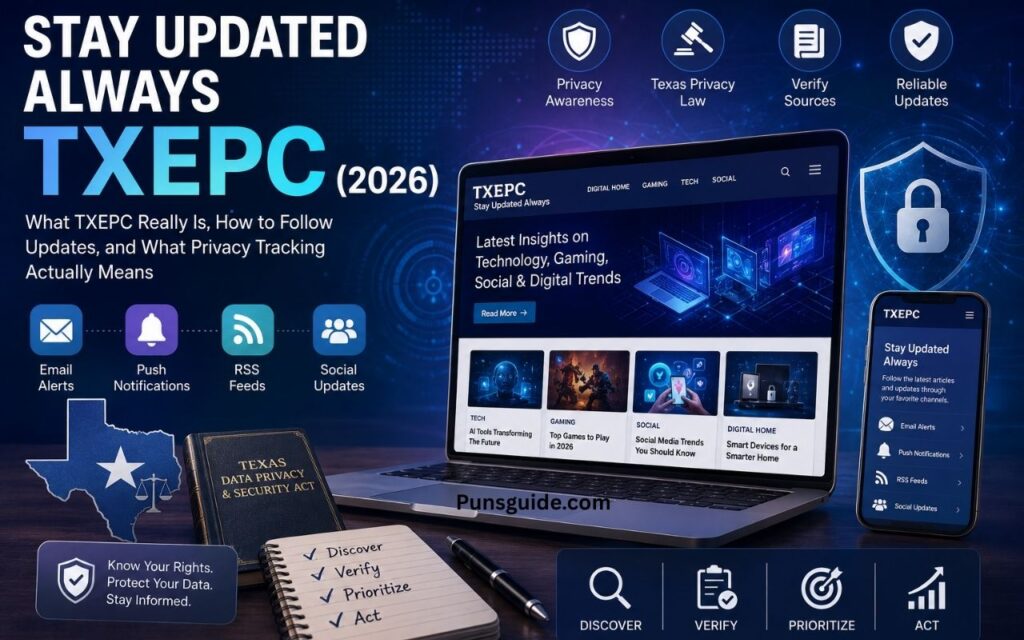
If you’ve searched for Stay Updated Always TXEPC, you’ve probably noticed something unusual. Some pages describe TXEPC as though it were a sophisticated privacy tracking system, a compliance dashboard, or an automated regulatory alert platform.
That’s where things get confusing.
The current TXEPC website presents itself primarily as a publishing site with sections for Digital Home, Gaming, Tech, and Social. Its homepage also uses the “Stay Updated Always” tagline and features articles about technology, digital topics, gaming, and related subjects. TXEPC official website
That distinction matters. A website can publish articles about privacy, tracking, security, technology, or compliance without being a dedicated TXEPC tracking system itself.
So what does “Stay Updated Always TXEPC” actually mean in 2026? More importantly, how can you follow useful TXEPC content without getting buried under alerts, questionable claims, or unnecessary notifications?
Let’s separate the signal from the noise.
What Is TXEPC in 2026?
At its core, TXEPC currently appears to be an online publishing platform rather than a standalone privacy-monitoring product. Its public navigation includes Digital Home, Gaming, Tech, and Social, while its homepage features a mixture of guides, commentary, and technology-related content.
The site has also published material specifically about staying updated with TXEPC. One article discusses options such as email alerts, browser push notifications, social channels, and RSS for following new content. TXEPC update guide
That makes “Stay Updated Always” easier to understand. It works primarily as a content-following concept, not proof of a proprietary surveillance or compliance engine.
What “Stay Updated Always TXEPC” Means
The phrase can be read quite literally: stay informed about newly published TXEPC material.
That could mean checking the website regularly, following available notification channels, using an RSS reader where a feed is available, or watching the site’s social activity. The exact options can change, so it’s sensible to verify what TXEPC currently offers instead of assuming every notification method mentioned online remains active.
There’s another important distinction here. TXEPC updates aren’t automatically the same thing as legal updates, government announcements, security advisories, or regulatory changes.
For example, an article discussing Texas privacy law isn’t itself a change to Texas law. The law’s official text and government publications remain the authoritative sources.
Why the TXEPC Name Creates Confusion
The acronym can create another layer of confusion because similar terminology can refer to different organizations, websites, or subjects.
Search results can blur the distinction between TXEPC, Texas privacy regulation, and the Texas Electronic Privacy Coalition. Those references shouldn’t be treated as interchangeable simply because their names contain similar terms.
Whenever an article makes a strong claim about TXEPC, check the domain, organization, publication context, and original source. A familiar acronym isn’t enough evidence.
Why “Stay Updated Always TXEPC” Matters for Readers
Keeping up with a website sounds simple until information starts arriving from five different directions.
You might see an article through search, encounter a social post later, receive an email, save an RSS item, and then find another site repeating the same claim. Suddenly, “staying updated” becomes an exercise in sorting rather than reading.
That’s why a useful TXEPC update tracking routine should focus on relevance rather than volume.
The goal isn’t to know about every new article within thirty seconds. The goal is to notice material that actually matters to you, understand what it says, and verify important claims before acting on them.
Staying Informed Without Creating Notification Fatigue
More notifications don’t necessarily make you better informed.
Imagine receiving twenty alerts in a morning. The tenth alert may contain something genuinely useful, but by then you’ve already developed the instinct to swipe everything away. That’s the hidden cost of aggressive notification management.
A better TXEPC monitoring approach uses a small number of reliable channels. For casual readers, one regular website check may be enough. For someone researching technology or digital privacy, an RSS reader or email-based workflow may make more sense.
The right system should feel like a clean desk, not an inbox after a three-day vacation.
Is TXEPC Actually a Privacy Tracking System?
This is the biggest point to clarify.
Current public evidence does not establish TXEPC as a dedicated privacy tracking system, consumer surveillance platform, or proprietary compliance-monitoring product. The public website presents content categories and articles rather than technical documentation for such a system. TXEPC official website
That doesn’t mean privacy is irrelevant to TXEPC readers. The site publishes technology and privacy-related material, and any website can raise legitimate questions about cookies, personal information, notifications, and data handling.
But those are different questions.
A digital privacy monitoring tool might scan accounts for exposed information. A regulatory monitoring service might watch government publications for legal changes. A content website publishes information. Treating all three as the same thing creates a misleading picture.
TXEPC Tracking vs. Website Tracking
The word “tracking” itself causes much of the confusion.
Website tracking can refer to ordinary technologies such as cookies, analytics, advertising systems, referral measurements, or session-related functionality. A tracking system in an enterprise context can mean something completely different, such as GPS monitoring, employee location tracking, or automated compliance alerts.
TXEPC has published material about GPS employee tracking systems, including features such as geofencing, reporting, mobile alerts, and employee privacy controls. However, that article discusses what businesses should look for in GPS tracking software. It doesn’t establish that TXEPC operates such a system. TXEPC GPS tracking article
That distinction is worth remembering whenever you encounter a page claiming that TXEPC itself provides a particular tracking technology.
How to Stay Updated With TXEPC
The simplest approach is still the most reliable: start with the source itself.
TXEPC’s homepage currently displays recent content across its categories. You can use that as the first stop for discovering new articles instead of relying entirely on third-party summaries. TXEPC official website
For readers who want more automation, TXEPC has published guidance describing several update channels, including email alerts, browser push, mobile notifications, social posts, and RSS feeds. Because website features can change, check the current site before building a workflow around a specific option. TXEPC update guide
Email Alerts
Email is useful when you want a searchable record of what you’ve received.
It also gives you more control than a constant stream of browser pop-ups. You can create a dedicated folder, apply an email filter, or simply review new messages at a convenient time.
If you’re using email for TXEPC update tracking, keep the setup lean. One useful alert stream beats several overlapping subscriptions.
RSS Feeds
RSS remains one of the cleaner ways to follow websites because it separates content discovery from social media algorithms.
An RSS reader can gather new posts from multiple sites in one place. You can then scan titles, save useful articles, and ignore topics that don’t matter to you.
TXEPC has specifically discussed RSS as one way readers can follow its content. TXEPC update guide If you rely on RSS for a serious workflow, verify the current feed URL and make sure the feed still updates as expected.
Social Notifications
Social channels can be useful for quick discovery, especially when you don’t want to check a website manually.
There’s a catch, though. Social posts are usually summaries or links rather than the complete source. Treat them as an early signal. Open the original article before relying on a claim.
That simple habit can prevent a surprising number of misunderstandings.
The TXEPC Content Categories Worth Watching
Not every TXEPC article deserves equal attention. Your best information tracking workflow depends on what you’re actually trying to learn.
The site’s current structure gives readers several broad areas to work with.
Technology Content
The technology section is the obvious place to start if your interest involves software, digital tools, artificial intelligence, online platforms, or emerging technology.
Technology changes quickly. A useful article can still become outdated when a product changes its interface, pricing, privacy settings, or technical capabilities.
For that reason, treat technology articles as useful context rather than permanent documentation.
Gaming Content
TXEPC currently publishes substantial gaming material alongside its other categories. Its homepage features gaming guides and related articles. TXEPC official website
For gamers, following the gaming category directly can be more useful than subscribing to everything on the site.
This is a basic principle of information prioritization: follow the stream that matches your actual interests.
Social and Digital Topics
Social content can cover online behavior, content creation, platforms, digital communication, and related subjects.
This category becomes particularly useful when an article discusses a changing platform feature or online practice. Still, always check whether the article is explaining a trend or reporting an official platform change.
Those are two very different things.
How to Verify a TXEPC Update Before You Act
This is where a smart TXEPC update monitoring system becomes genuinely useful.
You don’t need an elaborate dashboard. You need a repeatable verification habit.
Start by asking a basic question: What exactly is the source claiming?
If an article says a Texas privacy requirement has changed, don’t stop at the article. Find the relevant government source, legislation, agency publication, or official guidance. If an article says a technology company changed its privacy policy, look for the company’s actual policy or announcement.
The article can point you toward the issue. The primary source should settle the important details.
The Five-Question Verification Test
Before treating an important update as fact, ask:
- Who published the original information?
- When was it published or updated?
- Does the source provide supporting documentation?
- Is the claim about TXEPC itself or another organization?
- Does an authoritative primary source confirm it?
This small checklist is more valuable than a complicated compliance tracking system when you’re simply trying to avoid misinformation.
Why Repeated Claims Can Still Be Wrong
The web has a peculiar habit: one unsupported statement can become ten apparently independent statements.
A blog copies another blog. A third site rewrites the second. Search engines then surface all three. Eventually, the claim looks established because you’ve seen it everywhere.
That’s not verification. It’s repetition.
This is especially important when researching phrases such as TXEPC tracking system, TXEPC notification system, or TXEPC compliance updates. Search volume doesn’t prove that a technical product exists.
The source does.
Texas Privacy Law Is a Separate Issue
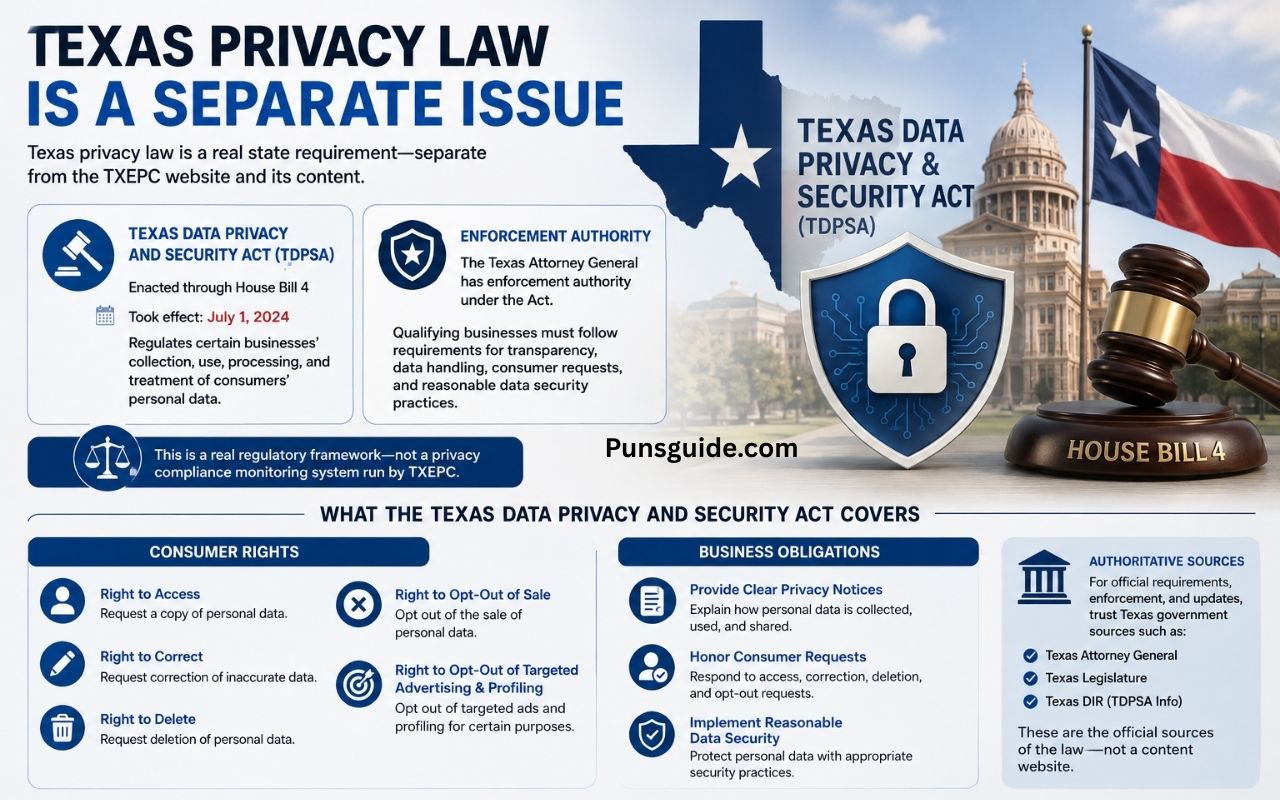
If your interest in TXEPC comes from Texas privacy law, it’s important to separate the website from actual state requirements.
Texas enacted the Texas Data Privacy and Security Act (TDPSA) through House Bill 4. The law took effect July 1, 2024, and regulates certain businesses’ collection, use, processing, and treatment of consumers’ personal data. Texas DIR — Texas Data Privacy and Security Act
The Texas Attorney General has enforcement authority under the Act. Texas government guidance explains that qualifying businesses face obligations involving transparency, data handling, consumer requests, and reasonable data security practices. Texas DIR — TDPSA information
That’s a real regulatory framework. It shouldn’t be presented as evidence that TXEPC itself is a privacy compliance monitoring system.
What the Texas Data Privacy and Security Act Covers
The TDPSA gives Texas consumers several rights concerning their personal data. Texas government guidance identifies rights involving access, correction, deletion, and certain opt-outs related to targeted advertising, data sales, and profiling. Texas State Law Library — TDPSA overview
The law also places requirements on qualifying businesses, including privacy notices, limits on data collection, methods for consumer requests, and reasonable data security practices. Texas State Law Library — TDPSA overview
For businesses operating in Texas, privacy law updates, consumer data rights, and regulatory compliance deserve monitoring through authoritative government sources.
A blog can help you understand the subject. It shouldn’t replace the statute or official regulatory guidance.
What Businesses Should Actually Monitor
Businesses sometimes need a more structured legal update tracking workflow. That doesn’t mean they need to turn TXEPC into something it isn’t.
If Texas privacy obligations affect your organization, monitor the sources that actually have authority over those obligations. The Texas Attorney General, Texas Legislature, and relevant state agencies are far more important for legal decisions than a secondary article.
The Texas Department of Information Resources explains that the Attorney General has enforcement authority under the TDPSA. Texas DIR — TDPSA information
A Practical Compliance Workflow
A useful workflow can be simple:
Discover → Verify → Assess → Assign → Document → Review
First, discover a potentially relevant change. Then verify it against the primary source. Next, determine whether it affects your organization.
If it does, assign responsibility, document the decision, and review the change later.
That is a real compliance tracking workflow. It doesn’t require pretending that a publishing website is an automated legal-monitoring platform.
Critical vs. Non-Critical Updates
Not every update deserves an emergency response.
A useful classification might look like this:
| Update type | Typical response |
|---|---|
| Official legal requirement with a deadline | Immediate review |
| Confirmed security vulnerability affecting your systems | Rapid technical assessment |
| Major privacy-policy change affecting your operations | Review and document |
| New explanatory article | Read when relevant |
| General technology commentary | Optional |
| Duplicate or low-value notification | Ignore or filter |
The point isn’t to create artificial urgency. It’s to reserve attention for changes that can actually affect your decisions.
How Information Overload Breaks Update Tracking
Information overload doesn’t always look dramatic.
Sometimes it simply means opening an email, thinking “I’ll read that later,” and then forgetting it existed. Other times, it means subscribing to so many alerts that important messages disappear among minor ones.
A good notification management strategy therefore starts with subtraction.
Remove redundant channels. Filter broad keywords. Create separate folders for high-priority sources. Review subscriptions every few months.
You don’t need a fire alarm for every toaster.
How to Build a Simple TXEPC Update Routine
A sustainable routine should take minutes rather than hours.
For casual readers, checking TXEPC once or twice a week may be plenty. If you follow a specific topic closely, a feed reader or email alert can make the process faster.
The important part is consistency.
A Five-Minute Daily Check
If you need frequent awareness, scan the newest material and look for articles that match your interests.
Don’t open everything.
Instead, identify the few pieces that deserve a closer look. Save those for later and move on.
This creates noise reduction without sacrificing useful information.
A Weekly Review
Once a week, review anything you’ve saved.
Ask whether the information is still relevant. Check publication dates. Follow important source links. Delete material that no longer matters.
If you manage updates for a team, add a short note explaining why a particular item matters. Future readers will appreciate that context.
A Monthly Cleanup
Once a month, review your entire notification setup.
Turn off channels you no longer use. Remove unnecessary subscriptions. Check browser and mobile permissions. Clean up old RSS feeds.
This kind of routine provides more long-term value than chasing the latest “smart” tracking tool.
Privacy and Security While Following Updates
Following a website shouldn’t require surrendering more personal information than necessary.
When you subscribe to an email alert, you’re providing an email address. When you enable browser push notifications, you’re granting notification permission. When you use an external RSS or automation service, you’re introducing another service into the information chain.
Those aren’t automatically dangerous. They simply deserve awareness.
Keep Permissions Minimal
Only enable notifications you actually want.
Review browser and mobile permissions occasionally. If a service no longer provides value, remove its access rather than leaving it active indefinitely.
The same principle applies to email. If a newsletter stops being useful, unsubscribe.
Be Careful With Third-Party Automation
Automation can reduce manual effort, but every additional service adds another point of dependency.
If you connect an RSS reader, automation platform, email service, or team workspace, understand what information that service receives.
For ordinary public content, the privacy risk may be relatively small. For sensitive internal information, the stakes can be much higher.
How to Recognize a Dubious “TXEPC Tracking” Claim
Some claims should immediately make you slow down.
Be cautious when a page describes a supposedly sophisticated TXEPC tracking system but provides no official product page, technical documentation, terms of service, or first-party explanation.
The same applies to claims about proprietary dashboards, automated compliance engines, real-time legal enforcement alerts, or advanced privacy surveillance features.
If a system genuinely performs those functions, there should normally be some evidence of how the system works.
Red Flags to Watch
Watch for:
- Vague technical language with no documentation
- Claims that TXEPC automatically monitors laws without identifying the underlying sources
- Screenshots that can’t be traced to an official product
- Statements about proprietary features without first-party evidence
- Confusion between TXEPC and the Texas Electronic Privacy Coalition
- Articles that repeat one another without citing original documentation
- Claims that a website’s content automatically constitutes legal advice
None of these signs proves that a claim is false. They do tell you that the claim needs verification.
TXEPC vs. a Dedicated Monitoring Platform
The distinction becomes clearer when you put the concepts side by side.
| Feature | TXEPC website | Dedicated monitoring platform |
|---|---|---|
| Publishes articles | Yes | Depends on the product |
| Organizes content by topic | Yes | Sometimes |
| Content discovery | Yes | Often |
| Automated regulatory monitoring | Not established by current public evidence | Common in some products |
| Compliance dashboard | Not established | Common in enterprise tools |
| Personal-data monitoring | Not established as a core function | Common in privacy products |
| Automated workflow management | Not established as a core TXEPC feature | Common in workflow platforms |
| Primary purpose | Information and publishing | Monitoring, alerting, or management |
This table gets to the heart of the matter.
TXEPC can be useful for discovering information without being the technology that monitors the underlying issue.
That’s a crucial distinction for anyone researching digital monitoring systems, privacy awareness systems, or automated update tracking tools.
How Professionals Can Use TXEPC More Effectively
Professionals can still get genuine value from TXEPC.
Use relevant articles for discovery, background reading, ideas, and context. Then follow the trail to the strongest available source.
For example, suppose you read an article about privacy regulation. The smart move isn’t to immediately update your compliance policy. First, identify the legislation or official agency material behind the claim.
Then ask whether it applies to your organization.
That approach combines situational awareness with disciplined source verification.
When TXEPC Is a Useful Secondary Source
TXEPC can help you discover subjects you may want to investigate further.
It can also make unfamiliar technology or digital topics easier to understand. That explanatory layer has value, particularly when primary documentation is dense or written for specialists.
But when a decision carries legal, financial, security, or operational consequences, move upstream toward the authoritative source.
That’s where responsible research begins.
A Better “Stay Updated Always TXEPC” Framework
The strongest approach isn’t complicated.
Think of the workflow as four stages:
Discover → Verify → Prioritize → Act
Discover relevant TXEPC content through the website or available update channels.
Verify important claims against original documentation.
Prioritize the information according to its actual impact.
Act only when the evidence and circumstances justify a response.
This framework works because it separates information consumption from decision-making.
You can read an article without treating it as an instruction.
Common Mistakes to Avoid
One common mistake is assuming that every article mentioning TXEPC describes an official TXEPC capability.
Another is treating the phrase Stay Updated Always TXEPC as the name of a technical product simply because several pages use the wording.
A third mistake involves confusing Texas privacy regulation with TXEPC itself.
The Texas Data Privacy and Security Act is an actual state law with defined consumer rights and business obligations. Its official requirements come from Texas law and government guidance, not from a content website. Texas DIR — Texas Data Privacy and Security Act
Finally, don’t confuse keyword research with factual research. Search terms can reveal what people are asking about, but they cannot establish whether a product, feature, law, or organization actually exists.
That’s an important distinction for anyone doing SEO research, text analysis, or content optimization around TXEPC.
What the Search Terms Reveal
The search language around TXEPC contains an interesting mix of concepts.
People may search for TXEPC updates, TXEPC tracking, TXEPC monitoring, TXEPC notification system, Texas privacy updates, or Texas privacy law. Those phrases don’t necessarily describe one unified product.
They’re search terms representing different information needs.
That’s why good keyword analysis should distinguish between closely related subjects rather than forcing every phrase into one definition.
Primary Terms and Semantic Context
The core search phrases include TXEPC, Stay Updated Always TXEPC, TXEPC updates, and TXEPC tracking.
Related semantic terms include privacy updates, data protection, consumer data rights, source verification, notification management, regulatory awareness, and information prioritization.
Those terms belong in the same topical neighborhood, but they shouldn’t be treated as synonyms.
A content strategy that understands that difference will usually read better and provide more useful answers than one built around aggressive keyword density.
Why Keyword Density Isn’t the Goal
There is no useful reason to force a target phrase into every paragraph.
Readers notice it immediately. Search engines can understand related concepts without seeing the same phrase repeated dozens of times.
A stronger keyword strategy uses natural variations, accurate terminology, supporting entities, and clear explanations. The result is better for humans and more useful for search engines.
In practical terms, write about what the reader actually wants to know.
That’s the best form of content optimization.
Frequently Asked Questions About Stay Updated Always TXEPC
What does Stay Updated Always TXEPC mean?
It refers to the idea of staying current with TXEPC’s published content and available update channels.
TXEPC’s current website uses “Stay Updated Always” as its tagline and has published articles explaining ways readers can follow new material. TXEPC official website
Is TXEPC a privacy tracking system?
Current public evidence does not establish TXEPC as a dedicated privacy tracking platform.
The website is publicly presented as a publishing platform covering technology, gaming, social topics, and other digital subjects. TXEPC official website
How can I stay updated with TXEPC?
Start with the TXEPC website. Depending on the current features available, you can also use channels such as email, RSS, browser notifications, or social updates. TXEPC has itself described several of these options in its published guidance. TXEPC update guide
Is TXEPC the same as the Texas Electronic Privacy Coalition?
You shouldn’t assume they are the same organization.
The acronym can appear in different contexts, so always check the domain, organization name, and source before treating two references as connected.
Does TXEPC provide Texas privacy law updates?
TXEPC may publish material discussing privacy and technology, but official Texas privacy requirements should be verified through government sources.
The Texas Data Privacy and Security Act is a separate legal framework enacted by the Texas Legislature, with enforcement authority assigned to the Texas Attorney General. Texas DIR — Texas Data Privacy and Security Act
What is the best TXEPC tracking system?
If by “tracking system” you mean a way to follow new TXEPC articles, you don’t necessarily need specialized software.
The website itself, email, RSS, browser notifications, and social channels can serve different information-discovery needs. If you mean legal or privacy compliance tracking, choose a system based on the actual regulatory requirements you need to monitor rather than assuming TXEPC provides that functionality.
Conclusion: Stay Updated Without Falling for the Hype
The smartest way to approach Stay Updated Always TXEPC in 2026 is to start with what can actually be verified.
TXEPC’s public website currently presents a content platform with sections covering Gaming, Tech, Social, and Digital Home. Its published guidance also discusses ways readers can follow new content through channels such as email, push notifications, social media, and RSS. TXEPC official website
What the available evidence does not establish is a proprietary TXEPC privacy-tracking engine, automated regulatory compliance dashboard, or universal real-time surveillance platform. Those descriptions should therefore be treated cautiously unless first-party documentation establishes them.
That doesn’t make TXEPC irrelevant to privacy, technology, or regulatory research. It simply puts the website in the right category.
Use TXEPC to discover and understand information. Use official government sources to verify laws and regulatory requirements. Use dedicated monitoring software when you genuinely need automated tracking. Most importantly, don’t mistake a repeated online claim for documented fact.
A good update workflow doesn’t need hundreds of alerts or a complicated dashboard. It needs reliable sources, sensible filtering, and a habit of checking the original evidence.
The best system isn’t the one that tells you everything.
It’s the one that helps you notice what matters, verify it quickly, and act when the information genuinely calls for action.

Jhon AJS, the creative mind behind Puns Guide, is an experienced blogger with a knack for wordplay and witty humor. Passionate about blending laughter with language, he crafts engaging pun filled content that entertains and inspires readers. With years of blogging expertise, Jhon continues to share clever insights, making every visit to Puns Guide a fun and refreshing experience.