If your team constantly asks, “Who’s handling this?” or “What’s the priority?” the problem probably isn’t effort. It’s the way work moves through the organization.
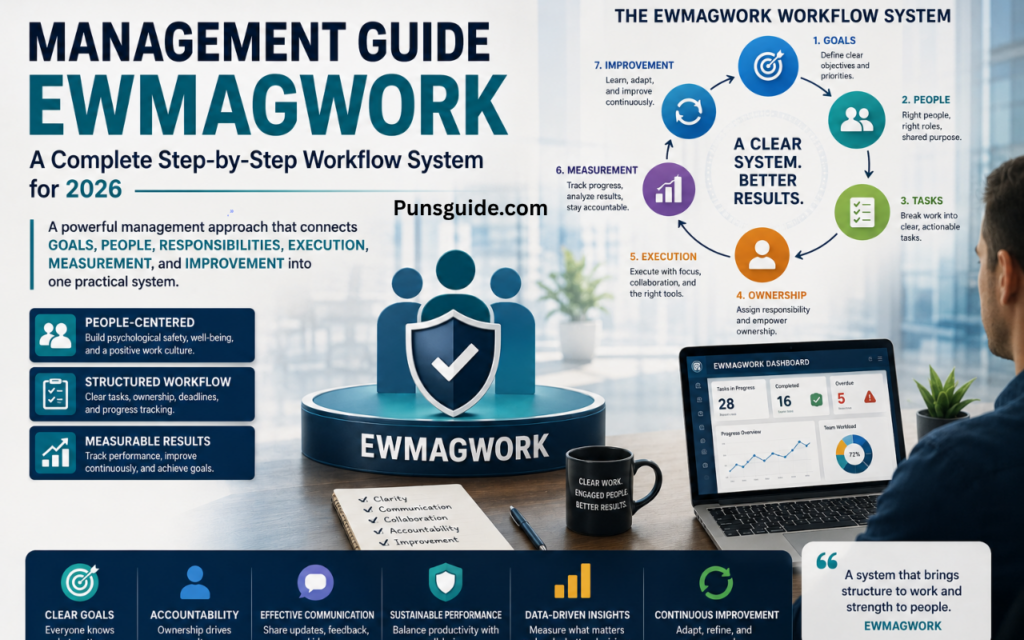
A useful Ewmagwork Management Guide should therefore go beyond task lists and productivity slogans. It needs to connect goals, people, responsibilities, execution, measurement, and improvement into one practical system.
There is an important caveat, though. Ewmagwork isn’t described consistently across the web. Some current sources present it as a people-centered management approach focused on psychological safety, employee well-being, energy, and communication. Others describe it as a structured workflow or work-management system built around tasks, ownership, deadlines, and progress tracking.
That distinction matters. Rather than pretending there is one universally standardized Ewmagwork methodology, this guide focuses on the common management and workflow principles appearing across current 2026 material. The result is a practical Ewmagwork Workflow System you can adapt to a small business, startup, remote team, department, or larger organization.
What Is the Ewmagwork Management System?
At its most practical, an Ewmagwork Management System is a structured way to organize goals, tasks, ownership, communication, execution, performance, and improvement. It treats workflow as more than a sequence of boxes on a project board. The people doing the work matter just as much as the process itself.
Current sources use Ewmagwork in several ways. One describes a management approach centered on sustainable performance and employee well-being, while others frame it around strategic alignment, workflow efficiency, accountability, and measurable outcomes.
That means the safest definition is broad but concrete: Ewmagwork is a management-oriented approach that combines structured work coordination with human-centered leadership. It gives managers a way to make work clearer without turning the workplace into a maze of dashboards and status meetings.
How Ewmagwork Differs From Traditional Workflow Management
Traditional workflow management often concentrates on the movement of work. A request enters the system, someone receives it, the task moves through several stages, and eventually it reaches completion.
That’s useful, but it leaves out an important question: Can people realistically sustain the way this system operates? A workflow can be technically efficient while creating overloaded employees, unclear communication, constant interruptions, or unnecessary pressure.
The Ewmagwork approach adds that human layer. Current Ewmagwork material emphasizes psychological safety, energy management, clear communication, autonomy, feedback, and sustainable performance alongside organizational execution.
A Simple Way to Think About Ewmagwork
Picture your business as a busy kitchen.
A traditional workflow system tells you which order comes first, who prepares each dish, and when it should leave the kitchen. A stronger management system also checks whether the kitchen has enough staff, whether responsibilities are clear, whether one station is causing delays, and whether the team can keep operating that way tomorrow.
That’s the practical value of a structured workflow. It creates order without confusing order with control.
Why Teams Lose Control of Work
Most workflow problems don’t begin with a broken software platform. They begin with unclear decisions.
A manager might say, “Can you take care of the new campaign?” The employee says yes. Two days later, questions appear. What does “take care” mean? Is the employee writing the copy, managing the designer, approving the budget, or delivering the entire campaign?
This is where task clarity, role clarity, and clear ownership become essential. Without them, even talented people spend valuable time interpreting instructions instead of completing work.
The Hidden Cost of Ambiguous Work
Unclear work creates a chain reaction. People ask more questions, managers hold more meetings, tasks wait for approvals, and employees start making assumptions.
Over time, those small delays become operational drag. You might see missed deadlines, duplicated effort, excessive meetings, uneven workload distribution, and repeated mistakes.
The answer isn’t necessarily more monitoring. Often, the better answer is better process design.
Why Another Tool Usually Isn’t the Answer
A new task board can’t fix conflicting priorities. Automation can’t decide who should own a strategic decision. A dashboard won’t make vague instructions clearer.
Technology becomes useful after the underlying workflow makes sense. That’s why a good Ewmagwork implementation starts with goals, responsibilities, and process rules before anyone starts configuring software.
Core Principles of the Ewmagwork Management Approach
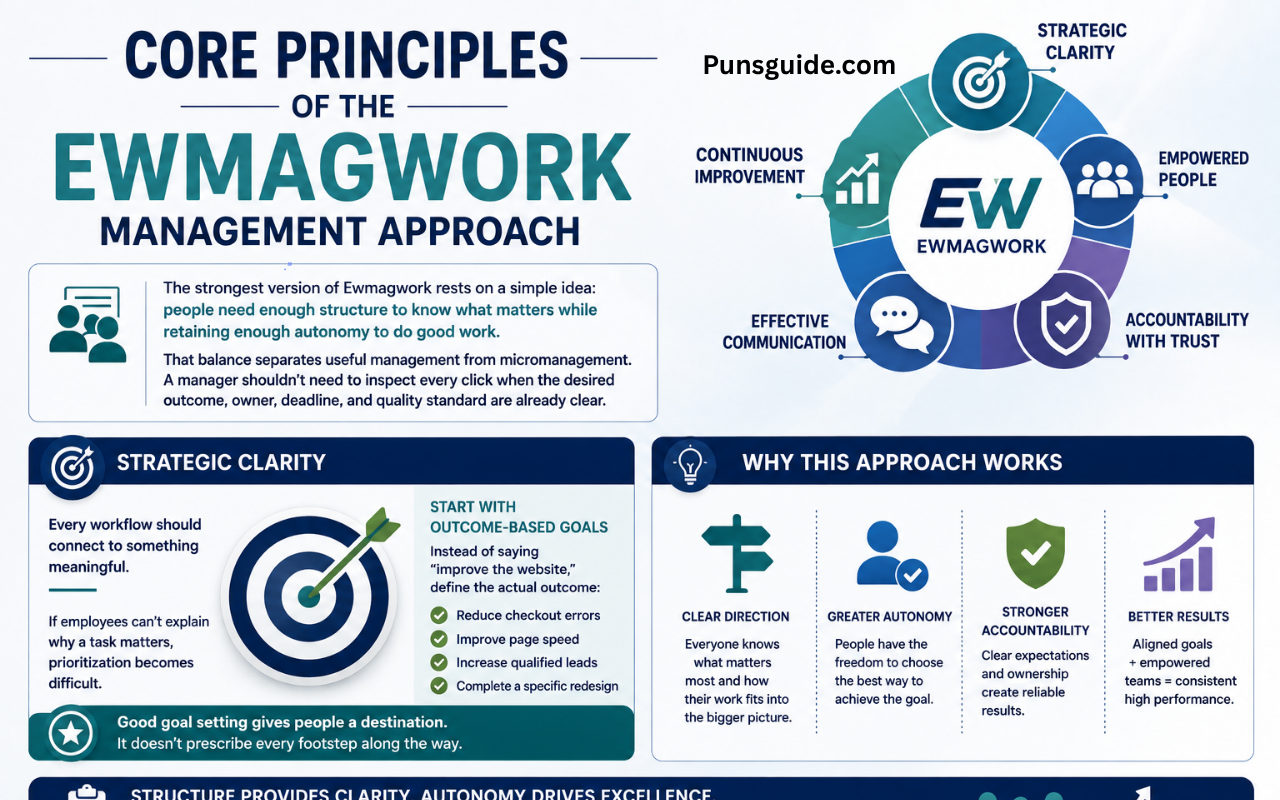
The strongest version of Ewmagwork rests on a simple idea: people need enough structure to know what matters while retaining enough autonomy to do good work.
That balance separates useful management from micromanagement. A manager shouldn’t need to inspect every click when the desired outcome, owner, deadline, and quality standard are already clear.
Strategic Clarity
Every workflow should connect to something meaningful. If employees can’t explain why a task matters, prioritization becomes difficult.
Start with outcome-based goals. Instead of saying “improve the website,” define the actual outcome: reduce checkout errors, improve page speed, increase qualified leads, or complete a specific redesign.
Good goal setting gives people a destination. It doesn’t prescribe every footstep along the way.
Clear Ownership
A task can involve five people while still having one accountable owner.
That distinction matters. Collaboration describes who contributes. Task ownership identifies who makes sure the work actually reaches completion.
For example, a product launch might involve marketing, design, sales, engineering, and customer support. Each group contributes, but one project owner should coordinate the overall deliverable.
Workflow Visibility
People work better when they can see what matters now, what’s waiting, and what’s blocked.
A simple workflow might use:
Backlog → Ready → In Progress → Review → Done
The exact labels don’t matter nearly as much as their meaning. Every team member should understand what each stage represents and what must happen before work moves forward.
Human-Centered Management
A workflow system shouldn’t treat people as processing units.
Current Ewmagwork sources place considerable emphasis on psychological safety, employee well-being, energy management, communication, and sustainable performance.
That doesn’t mean lowering standards. It means recognizing that performance depends partly on the conditions under which people work. A team that consistently operates at maximum capacity has little room for unexpected problems.
Continuous Feedback
Feedback works best when it arrives while someone can still use it.
Instead of waiting for a quarterly review to discuss a recurring problem, address it when the evidence is fresh. Focus on the behavior, result, or process rather than making the conversation personal.
A healthy feedback loop also works upward. Employees should be able to tell managers when a process creates unnecessary work.
The Ewmagwork Workflow Structure
A practical Ewmagwork Workflow System can be understood as a repeating cycle:
Goal → Request → Task → Owner → Execution → Review → Outcome → Feedback → Improvement
This isn’t a claim that Ewmagwork has one official technical architecture. Current sources don’t establish such a standardized specification. Instead, this cycle turns the recurring management principles into an operational model that teams can actually use.
The important part is the loop. Work shouldn’t simply end at “Done.” Teams should learn from completed work and use those lessons to improve the next cycle.
Goal: Define the Outcome
Start by deciding what success looks like.
A useful goal answers three questions: What needs to change? Why does it matter? How will the team know it succeeded?
For example, “create a marketing report” describes an activity. “Deliver a monthly marketing report that gives leadership accurate acquisition and conversion data by the third business day” describes an outcome with clearer expectations.
Task: Break the Outcome Into Work
Large goals often fail because nobody converts them into manageable actions.
Task decomposition turns a broad deliverable into actionable tasks. Each task should be small enough to understand and large enough to matter.
Don’t break work into dozens of microscopic steps just because your software allows it. Excessive task fragmentation creates administrative work without necessarily improving execution.
Owner: Assign Responsibility
Every meaningful task needs an accountable person.
If three people share responsibility equally, accountability can become fuzzy. Instead, identify one owner and list other contributors separately.
This simple practice strengthens accountability mapping and reduces the familiar situation where everyone assumed somebody else was handling the issue.
Execution: Move Work Through Stages
Once tasks have owners, work needs a predictable path.
The team should know what qualifies as ready, what happens during execution, who reviews the result, and what “done” means.
This creates workflow discipline without requiring a complicated operating manual.
Review: Check More Than Completion
A completed task isn’t automatically a successful task.
Review output quality, timeliness, customer impact, errors, and whether the original goal was achieved. If a report arrived on time but contained incorrect figures, the workflow did not succeed merely because someone moved the card to “Done.”
This is where performance monitoring becomes more useful than simple activity tracking.
Improvement: Close the Loop
The final stage asks what should change next time.
Maybe approval took too long. Perhaps one person handled too many tasks. Maybe the instructions were vague. Or perhaps the workflow worked perfectly and shouldn’t be changed.
That last possibility matters too. Continuous improvement doesn’t mean constantly changing everything. It means changing what evidence shows needs attention.
How to Implement the Ewmagwork Management System Step by Step
Implementation works best when you resist the urge to rebuild everything at once.
Choose one important workflow. Map it. Improve it. Measure the result. Then expand what works.
Step 1: Audit Your Current Workflow
Before designing a new system, understand the old one.
Follow one real piece of work from its initial request to final delivery. Record where the request originated, who touched it, where decisions happened, and where delays appeared.
You may discover that the biggest bottleneck isn’t task execution at all. It could be approval, unclear requirements, missing information, or constant priority changes.
Step 2: Define Measurable Goals
Turn broad ambitions into outcomes the team can recognize.
For example, “improve customer support” is too broad for operational use. A more useful goal might involve reducing first-response time, improving resolution quality, or reducing repeat contacts.
Measurable goals don’t need to turn everything into a number. Some work requires qualitative judgment. The point is to establish a clear definition of success.
Step 3: Convert Goals Into Actionable Tasks
Now perform structured task breakdown.
Suppose a small company wants to launch a new service page. The work might include research, copywriting, design, development, quality assurance, analytics setup, and final approval.
Each task should have enough context to begin without forcing the owner to chase basic information.
Step 4: Assign Ownership With Zero Ambiguity
Assign one owner to each significant deliverable.
Then clarify who contributes, who approves, and who needs to be informed. This creates responsibility assignment without requiring every person to participate in every decision.
A useful rule is simple: if a task is important enough to track, it should be obvious who is accountable for moving it forward.
Step 5: Build a Structured Workflow Pipeline
Create a small number of workflow stages.
A team might start with:
| Stage | Meaning |
|---|---|
| Backlog | Work exists but isn’t ready to start |
| Ready | Requirements and priority are clear |
| In Progress | Someone is actively working on it |
| Review | The deliverable needs checking or approval |
| Done | The agreed completion criteria are satisfied |
| Blocked | Progress can’t continue without intervention |
The workflow structure should reflect reality. If your team needs eight stages, use eight. If five are enough, don’t create three more just to make the system look sophisticated.
Step 6: Establish Communication Rules
Every communication channel should have a job.
Use the workflow system for task status and decisions tied to specific work. Use chat for quick coordination. Use meetings for discussions that genuinely benefit from real-time conversation.
This approach improves workflow visibility because important information doesn’t disappear inside unrelated conversations.
Step 7: Introduce Practical Task Tracking
Task tracking should answer useful questions quickly:
- What needs attention?
- Who owns it?
- What’s late?
- What’s blocked?
- What requires a decision?
- What changed?
Don’t turn tracking into surveillance. The purpose is to help the team coordinate work and help managers remove obstacles.
Step 8: Measure Performance
Choose a handful of useful performance metrics.
Depending on the work, these might include cycle time, completion rate, overdue tasks, rework, blocked work, quality results, or customer outcomes.
Task completion rate can be useful, but don’t treat it as the ultimate measure of productivity. A person can close twenty low-value tasks while another completes one difficult project that produces far greater business value.
Step 9: Review the Human Side
Numbers tell only part of the story.
Ask whether employees understand priorities, whether workloads are realistic, whether people feel comfortable raising concerns, and whether managers create unnecessary interruptions.
This aligns with the people-centered side of current Ewmagwork guidance, which emphasizes psychological safety, sustainable performance, energy management, and clear communication.
Step 10: Improve One Bottleneck at a Time
Don’t launch a massive workflow optimization project because one approval takes too long.
Fix the approval problem first. Measure the change. Then look for the next meaningful constraint.
That approach keeps process improvement grounded in evidence instead of turning improvement into an endless stream of new procedures.
Ewmagwork Example: A Five-Person Marketing Team
Imagine a five-person marketing team preparing a product launch. The team includes a marketing manager, content writer, designer, SEO specialist, and paid-media specialist.
Previously, requests arrived through email, chat, and meetings. Everyone stayed busy, but nobody had a reliable view of priorities. The designer often waited for copy. The SEO specialist discovered missing product information late. The manager spent much of the week asking for updates.
The team then creates one workflow pipeline for the launch. Each deliverable receives an owner, deadline, dependencies, and acceptance criteria.
Before the Workflow
The team might have described its process as “we’re working on the launch.”
That’s not enough information to manage execution.
After introducing clearer task sequencing, the team can see that product messaging must finish before several downstream tasks can proceed. The dependency becomes visible instead of remaining buried in someone’s memory.
After the Workflow
The marketing manager can now see which work is active, which items are awaiting review, and which tasks are blocked.
The system doesn’t eliminate problems. That’s not its job. Instead, it exposes problems early enough for the team to address them.
That distinction is important. Good workflow management doesn’t make work magically frictionless. It makes friction easier to see and manage.
How to Measure Workflow Performance
A useful measurement system combines activity, flow, quality, and outcomes.
Cycle time tells you how long work takes once execution begins. Lead time captures the broader period between a request entering the system and its completion. Both can reveal delays that ordinary task counts miss.
You can also monitor blocked-task frequency, overdue work, rework, and workload distribution. For customer-facing operations, add measures such as satisfaction, resolution time, or quality scores where appropriate.
Activity Metrics vs. Outcome Metrics
Activity metrics tell you what people did. Outcome metrics tell you what changed.
For example, a sales team might report 500 outreach messages. That’s useful operational information, but it doesn’t tell you whether those messages generated qualified opportunities.
A strong results-oriented workflow connects activity to impact wherever the work allows it. This prevents teams from optimizing numbers that don’t actually matter.
Human Performance Metrics
People-related indicators require more care.
Employee feedback, role clarity, workload concerns, absenteeism, retention, and engagement can reveal problems that operational dashboards overlook. However, managers should avoid reducing employee well-being to one simplistic score.
The goal is performance improvement, not turning every human experience into a spreadsheet.
Tools That Support an Ewmagwork Workflow
Ewmagwork principles don’t require one specific software platform.
A small team might use a spreadsheet or lightweight task board. A larger organization may need workflow software with permissions, reporting, automation, integrations, and analytics.
The important thing is to choose tools after defining the process. Otherwise, the software starts dictating the workflow instead of supporting it.
Task Management Tools
Look for features that support task ownership, due dates, dependencies, workflow stages, comments, and reporting.
A tool becomes useful when the team can answer basic coordination questions without holding another meeting.
Communication Platforms
Chat and collaboration platforms work well for quick coordination, but they shouldn’t become the permanent storage location for critical workflow decisions.
When important information remains buried in fast-moving conversations, workflow control deteriorates. People start asking the same questions because the answer technically exists somewhere but nobody can find it.
Automation and AI
Workflow automation can handle repetitive work such as notifications, reminders, routing, data entry, summaries, and recurring reports.
AI can also help draft documentation, summarize project updates, identify patterns, or prepare management reports. Yet automation should support judgment rather than replace it.
A workflow that automatically moves the wrong task to the wrong person is still a broken workflow. It’s simply broken faster.
Common Ewmagwork Implementation Mistakes
The biggest mistake is confusing complexity with sophistication.
A workflow containing twenty statuses, dozens of required fields, and constant reporting may look impressive. In practice, employees may stop updating it because maintaining the system becomes another job.
Treating Activity as Productivity
Counting tasks can encourage the wrong behavior.
If employees believe closing more tickets is always better, they may prioritize easy work while difficult, valuable projects sit untouched.
Use output measurement alongside quality and outcome indicators. Numbers need context.
Giving Everyone Responsibility
“Everyone is responsible” sounds collaborative but often creates ambiguity.
A better model combines team collaboration with individual accountability. Everyone can contribute while one person remains clearly responsible for moving a deliverable forward.
Building the Workflow Without the People
Managers shouldn’t design every process from a conference room.
Ask the people who actually perform the work where delays occur. They know which approval takes three days, which form nobody uses, and which recurring meeting could probably disappear.
That information is invaluable for workflow improvement.
Ignoring Workload
A system can distribute tasks evenly on paper while creating completely different experiences for the people involved.
Consider task difficulty, deadlines, interruptions, meetings, and specialized responsibilities when reviewing workload management. A balanced task count isn’t necessarily a balanced workload.
Measuring Everything
More metrics don’t automatically produce better decisions.
A useful dashboard might need only five or six indicators. If a metric doesn’t influence a decision, question why you’re collecting it.
Ewmagwork vs. Traditional Workflow Systems
Ewmagwork overlaps with established approaches such as Agile, Kanban, Lean, and traditional project management. It shouldn’t be presented as a magical replacement for all of them.
The clearest distinction is emphasis. Traditional systems often focus heavily on project control, process flow, delivery, or work-in-progress. Ewmagwork material gives additional attention to the human conditions surrounding performance.
| Approach | Main emphasis | Where it helps |
|---|---|---|
| Traditional project management | Scope, schedule, resources | Planned projects |
| Kanban | Flow and work-in-progress | Continuous work |
| Agile | Iteration and adaptability | Changing requirements |
| Lean | Waste reduction and value | Process efficiency |
| Ewmagwork approach | People, clarity, workflow, feedback | Human-centered management |
These approaches can complement one another. A team could use Kanban for its workflow stages while applying Ewmagwork principles to communication, workload, accountability, and feedback.
Who Should Use an Ewmagwork-Style Workflow System?
Small businesses often benefit because informal coordination eventually stops working as the team grows.
A founder might once have known every customer request, deadline, and employee responsibility. At twenty or thirty employees, that knowledge can’t remain inside one person’s head.
Startups face a similar challenge. Speed matters, but speed without clarity quickly becomes chaos.
Remote and Hybrid Teams
Remote teams have fewer opportunities for accidental coordination.
In an office, someone might overhear a conversation and discover that a deadline changed. Remote employees may never receive that context.
A clear workflow management system for remote teams creates shared visibility without forcing everyone into constant meetings.
Growing Organizations
Growth creates handoffs.
Sales hands work to implementation. Marketing coordinates with design. Product works with engineering. Customer support reports issues to operations.
As those connections multiply, team coordination becomes increasingly important. A structured workflow gives those handoffs a place to live.
When You Don’t Need a Complex System
Not every team needs an elaborate workflow platform.
If three people perform simple, predictable work and communicate effectively, a complicated enterprise system could make their lives worse.
Good workflow simplicity means using exactly enough structure to solve the coordination problem.
A 30-Day Ewmagwork Implementation Plan
You don’t need to redesign the entire company on Monday morning.
A practical first month can focus on one workflow and use it as a controlled experiment.
Week One: Diagnose
Map one real process from beginning to end.
Talk to the people involved. Identify delays, unclear responsibilities, repeated work, missing information, and unnecessary approvals.
Don’t fix everything yet. First understand what is actually happening.
Week Two: Design
Define the desired outcome. Create workflow stages. Assign owners. Establish communication rules and completion criteria.
Keep the system lightweight. If people need a training course just to understand the board, you’ve probably made it too complicated.
Week Three: Pilot
Run the workflow with one team or project.
Watch for bottlenecks, blocked tasks, unclear instructions, and unnecessary steps. Ask team members what feels useful and what feels like administrative overhead.
Their feedback is part of the implementation rather than an afterthought.
Week Four: Review
Compare the new workflow with your baseline.
Did work move faster? Did fewer tasks become blocked? Did ownership become clearer? Did the team spend less time chasing status updates?
Keep what works. Change what doesn’t. Then decide whether the approach deserves expansion.
Ewmagwork Management Checklist
Before rolling the system across your organization, make sure the basics are in place.
- Goals: Can the team explain the desired outcomes?
- Tasks: Are goals translated into actionable work?
- Ownership: Does every important deliverable have one accountable owner?
- Workflow: Are stages clearly defined?
- Communication: Does everyone know where important information belongs?
- Tracking: Can managers see blocked and overdue work?
- Metrics: Do measurements support real decisions?
- Feedback: Can employees raise problems safely?
- Workload: Does the system account for human capacity?
- Improvement: Does the team regularly review recurring bottlenecks?
If most answers are yes, you have the foundations of a workable structured workflow management system.
Frequently Asked Questions About the Ewmagwork Management Guide
What is Ewmagwork?
Ewmagwork is currently used online to describe several related management ideas rather than one universally standardized methodology. Current material connects the term with structured management, workflow organization, accountability, communication, employee well-being, and sustainable performance.
For practical purposes, an Ewmagwork Management Guide can be treated as a framework for connecting people, work, performance, and continuous improvement.
Is Ewmagwork a software platform?
Some online sources describe Ewmagwork as a digital work and task-management platform with projects, assignments, due dates, and progress visibility. Other sources clearly use the term for a broader management philosophy.
Because the terminology varies, check the specific product or source before assuming every reference to Ewmagwork means the same thing.
Is Ewmagwork a formally recognized management methodology?
There is no clear evidence in the current sources reviewed here of a single formal standard governing Ewmagwork in the way established methodologies have defined bodies of practice.
That’s why responsible Ewmagwork workflow implementation should focus on the practical principles rather than inventing official terminology, mandatory stages, or guaranteed results.
Can small businesses use an Ewmagwork workflow?
Yes. In fact, small businesses can usually start with a very simple system.
You might need only clear goals, an owner for each important task, five workflow stages, a weekly review, and a few meaningful performance metrics.
Do you need special software?
No.
A task board, spreadsheet, project-management application, or workflow platform can support the approach. The technology matters less than whether your process gives people clarity, ownership, visibility, and useful feedback.
How quickly can you see results?
Basic organizational improvements can appear quickly when the problem is obvious, such as unclear ownership or scattered task information. Meaningful performance improvements require measurement over time.
Avoid promises of guaranteed six-week or six-month results. Current Ewmagwork sources make claims about benefits, but they don’t establish a universal timeline that applies to every organization.
Can Ewmagwork work with Agile or Kanban?
Yes, conceptually.
You can use Kanban for visual workflow management, Agile practices for iterative delivery, Lean techniques for waste reduction, and Ewmagwork principles for people-centered management, accountability, communication, and sustainable performance.
The methods don’t have to compete. The best system is usually the one that solves the actual problem without creating unnecessary process.
Final Takeaway: Structured Execution Works When People Can Sustain It
A useful Ewmagwork Management System isn’t about creating another layer of corporate machinery. It’s about making work easier to understand and easier to manage.
Start with the basics: define the outcome, break it into actionable tasks, assign clear ownership, establish a simple workflow, monitor meaningful performance metrics, and create a feedback loop. Then pay attention to the people inside that system. Workload, communication, autonomy, psychological safety, and energy all influence whether the process can survive real-world pressure.
The most valuable part of workflow optimization isn’t a clever dashboard or an impressive automation rule. It’s knowing where work gets stuck and having enough visibility to do something about it.
If one principle deserves to survive everything else, make it this: make the work visible, make ownership clear, measure meaningful results, support the people doing the work, and improve the process when the evidence says it needs changing.
That is a far more durable approach to structured execution, operational efficiency, and continuous improvement than simply adding another tool to an already crowded workplace.

Jhon AJS, the creative mind behind Puns Guide, is an experienced blogger with a knack for wordplay and witty humor. Passionate about blending laughter with language, he crafts engaging pun filled content that entertains and inspires readers. With years of blogging expertise, Jhon continues to share clever insights, making every visit to Puns Guide a fun and refreshing experience.