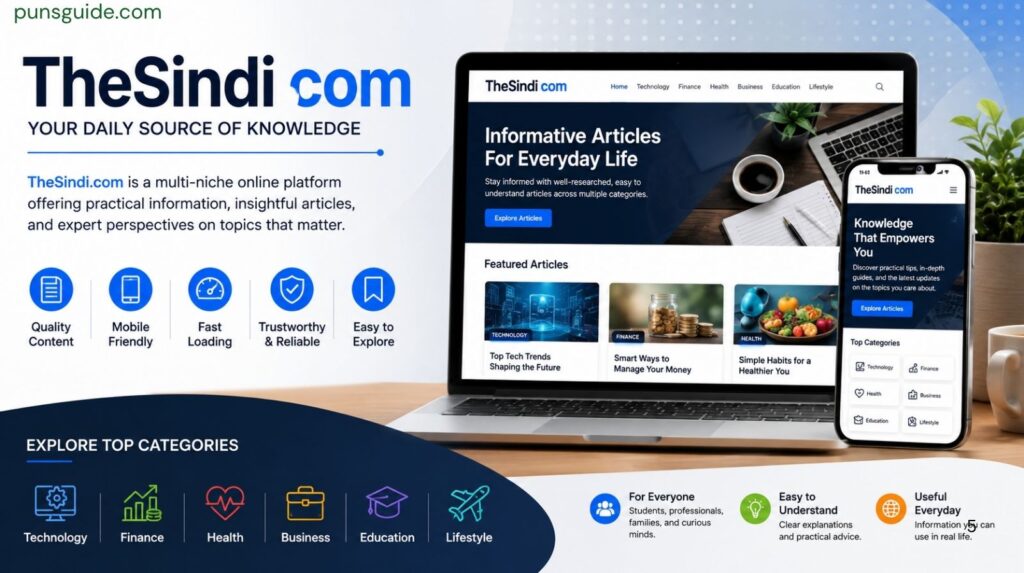
If you’ve searched for TheSindi.com recently, you may have noticed that information about the site is surprisingly inconsistent. Several websites use similar names, while third-party pages describe the domain in different ways. That makes it important to separate what can actually be verified from assumptions.
The exact domain matters here. Publicly available domain information identifies thesindi.com as “The Sindi,” with HTTPS enabled and Cloudflare infrastructure. A current third-party website profile describes it as a news-oriented website with a broad range of content.
This guide looks at TheSindi.com from that practical angle. It covers its identity, content direction, website experience, mobile access, discoverability, and the things readers should consider before relying on any information published there.
What Is TheSindi.com?
TheSindi.com is a web publishing destination associated with the name “The Sindi.” Available domain records show that the domain has been registered since March 18, 2023, while the current website profile describes it as a news-oriented website intended to provide timely content across subjects that interest its audience.
That distinction is useful because similarly named websites appear in search results. For example, other domains use “TheSindi” branding while presenting themselves as multi-niche information platforms. Those sites shouldn’t automatically be treated as the same property. The safest approach is to check the exact domain before drawing conclusions about its content or ownership.
From a reader’s perspective, TheSindi.com fits into the wider online media and digital publishing landscape. Like other general-interest publishing websites, its value depends on the quality, relevance, freshness, and accuracy of the individual articles rather than the domain name alone.
What Can You Find on TheSindi.com?
The available third-party profile characterizes TheSindi.com as a site focused on news and content that reflects topics of interest to its audience. It also describes the website as having a broad readership rather than serving one tightly defined specialist niche.
That broad positioning gives the site room to cover different subjects. However, readers shouldn’t assume that every category mentioned by similarly branded websites belongs to thesindi.com. Search results currently surface several unrelated or similarly named properties, which makes domain-level verification especially important.
For someone visiting the site for the first time, the practical question is simple: Does the specific article answer the question you came to solve? A useful informational website should make that answer easy to find without forcing readers through unnecessary pages or vague claims.
Also Read: Erikkapost.com: Your Daily Hub for Fresh Content in 2026
TheSindi.com’s Multi-Topic Content Strategy
A broad publishing model can work well when an editorial team understands what its audience actually wants. Instead of restricting every article to one narrow subject, a general-interest content platform can address different interests and capture readers at different stages of their online research.
There is a trade-off, though. A multi-niche website needs strong organization. If technology, business, lifestyle, news, and other subjects sit together without a clear structure, visitors can struggle to understand what the publication stands for. Good content categories, descriptive titles, and logical navigation therefore become more than design features. They become part of the editorial experience.
TheSindi.com’s broad positioning makes that organization particularly important. Readers should be able to tell what a page covers before spending several minutes reading it.
How TheSindi.com Organizes Its Articles
Website organization plays a surprisingly large role in whether people actually consume online content. A useful content hub should help visitors move from one relevant article to another without making them restart their search every time.
For a general publishing site, that usually means clear menus, recognizable categories, descriptive headings, and useful links between related stories. Internal linking can also help readers discover background information when an article introduces a topic they don’t know well.
The available information confirms that TheSindi.com has a website structure intended for broad article discovery. However, because the main domain currently restricts automated access, some page-level details can’t be independently verified from the live homepage.
That limitation matters. Claims about exact article counts, publishing frequency, individual categories, or specific interface elements should be checked directly on the site rather than repeated simply because another website says they exist.
TheSindi.com User Experience
A good user experience begins before someone reads the first paragraph. Visitors need to know where they are, what the page covers, and how to find something else if the current article isn’t relevant.
The available website profile describes TheSindi.com’s layout as user-friendly and says the site is designed to make articles accessible across its broader content offering.
Still, usability isn’t just about having a clean-looking homepage. Website usability also includes readable typography, sensible spacing, predictable navigation, accessible links, and pages that work properly on different screen sizes. Those details determine whether a visitor stays to read or quietly closes the tab.
Readability and Interface Design
Online readers rarely approach an article the way they approach a printed book. They scan first. They look at the title, headings, opening paragraph, images, and highlighted information before deciding whether the page deserves their attention.
That’s why readability matters so much. Short paragraphs, meaningful subheadings, descriptive titles, and a clean visual hierarchy make complicated information easier to process.
The strongest interface design doesn’t demand attention. It gets out of the way. When navigation feels obvious and the text remains comfortable to read, visitors can focus on the information itself rather than figuring out how the website works.
Desktop and Mobile Experience
Mobile access has become a basic expectation for modern publishing. A mobile friendly website should adapt its layout to smaller screens without making readers pinch, zoom, or fight with oversized menus.
Responsive layouts also support people who switch between devices throughout the day. Someone might discover an article on a phone, continue reading on a tablet, then return to it from a laptop.
Third-party information associated with TheSindi.com indicates that the domain uses HTTPS and Cloudflare infrastructure. However, technical infrastructure alone doesn’t prove that every page delivers excellent mobile optimization, so individual pages should still be evaluated on the device being used.
Is TheSindi.com Free to Use?
Public information currently available about the exact domain doesn’t provide enough evidence to make a blanket claim that every part of TheSindi.com offers free access or operates with no paywall.
That’s an important distinction because similarly named websites make stronger claims about free access. Those statements belong to those particular sites and shouldn’t automatically be transferred to thesindi.com.
If you’re checking whether a specific article is freely accessible, the simplest method is to visit the exact page. Look for subscription prompts, registration requirements, premium labels, or content restrictions. A genuinely open article should make its access conditions obvious.
Who Is TheSindi.com For?
The site’s broad news-oriented positioning suggests that it is aimed at a general online audience rather than a narrowly defined professional group. That makes it potentially useful for everyday readers who want to browse current topics without committing to a specialist publication.
It may also appeal to casual researchers who arrive through organic search. These readers usually have a specific question rather than a strong attachment to a publication. They want an understandable answer, useful context, and a clear path to additional information.
However, audience suitability depends on the individual article. A beginner may appreciate a straightforward explainer, while an experienced professional might need primary sources, technical documentation, or specialist reporting.
Key Benefits of Using TheSindi.com
One practical benefit of a broad publishing website is convenience. Instead of visiting a highly specialized publication for every question, readers can encounter different subjects within one general online environment.
The broader reader experience can also benefit from straightforward article presentation. When pages use clear explanations and avoid unnecessary complexity, readers can move through unfamiliar subjects more comfortably.
That doesn’t mean every article should be treated as an authority. For important decisions involving health information, financial choices, legal matters, or safety, general-interest articles should be considered a starting point. Primary sources and qualified professionals remain important.
What Could Be Improved on TheSindi.com?
The biggest challenge for any broad publishing platform is consistency. A website can cover many subjects, but readers still expect the same basic standards for accuracy, clarity, sourcing, and presentation.
Content depth is another consideration. General-interest publishing can introduce readers to a subject quickly, but specialized questions often require deeper research. A short article may explain the basics while leaving important technical details unanswered.
There’s also a broader issue worth mentioning: brand clarity. Several websites currently use variations of “TheSindi” or “thesindi com” in their branding. Searchers can therefore encounter pages that appear related even when they sit on different domains. Checking the URL before trusting a claim is a small step that can prevent a lot of confusion.
How Fresh Is TheSindi.com Content in 2026?
Freshness matters most when the subject itself changes. News, technology, financial rules, digital services, and other fast-moving topics can become outdated quickly.
A current article should ideally show a publication or update date when timing affects the information. Readers can then judge whether the material still reflects the situation they’re researching.
Available third-party data confirms that thesindi.com remains an active registered domain in 2026 and identifies its current positioning as news-oriented. However, there isn’t enough independently verified information available to responsibly state an exact publishing frequency for the site.
That is worth keeping in mind when evaluating claims about fresh content. “Active domain” and “publishes multiple times per week” are not the same thing.
TheSindi.com and Search Visibility
Search engines connect readers with pages based on relevance, usefulness, technical accessibility, and many other signals. Simply placing thesindi com repeatedly throughout an article doesn’t create strong search visibility.
For a publisher, useful SEO starts with satisfying search intent. If someone searches for a definition, they should find a definition. If they want current news, they need timely reporting. If they’re comparing options, they need meaningful differences rather than vague descriptions.
A strong content strategy can also build topical authority over time. Publishing several genuinely useful articles around related subjects gives readers more opportunities to discover the publication through organic search.
Internal Linking and Topical Coverage
Internal linking helps connect related information. Imagine an article explaining a technology trend that mentions cybersecurity. A useful link could take the reader to a deeper cybersecurity explanation instead of leaving them to search elsewhere.
This approach creates a stronger content journey. It can also help search engines understand how pages relate to one another.
However, links should serve readers first. Adding links simply to manipulate search rankings usually creates a cluttered experience. A relevant link at the right moment is far more useful than five unrelated links stuffed into a paragraph.
Why Quality Online Content Matters
The web is full of information. The harder problem isn’t finding something to read. It’s finding something worth trusting.
Quality online content should give readers a clear reason to keep going. It should explain the subject accurately, distinguish facts from opinions, provide enough context, and avoid making claims that the evidence doesn’t support.
That standard becomes even more important for broad informational articles. When a website covers many topics, readers can’t assume that expertise in one category automatically means expertise in another.
A reader-friendly article doesn’t need to sound academic. In fact, conversational writing can make complex ideas easier to understand. What matters is that simplicity doesn’t come at the expense of accuracy.
E-E-A-T and Trustworthiness
Google’s E-E-A-T concept centers on experience, expertise, authoritativeness, and trustworthiness. These ideas are especially relevant when readers use online information to make meaningful decisions.
For publishers, that means being transparent about who created content, where important information comes from, and when facts may have changed. Clear author information and appropriate sources can strengthen the reader’s confidence.
The same principle applies to TheSindi.com. A useful content platform should help readers understand what they’re reading and how much confidence they should place in it. For medical, legal, or financial subjects, that standard should be especially high.
The Role of AI, Voice Search, and Modern Search
Search behavior continues to change. People increasingly ask complete questions rather than typing a few disconnected keywords.
Voice search reinforces that behavior. Someone might ask, “What does this financial term mean?” rather than searching for a short phrase. Content that answers questions naturally can therefore be easier for both users and modern search systems to understand.
AI-powered search adds another layer. AI powered summaries and answer engines increasingly extract information from web pages and present direct responses to users. That makes factual clarity more important, not less.
The best response isn’t to fill an article with artificial keyword variations. It is to provide clear answers, useful context, and well-organized information that can stand on its own.
How TheSindi.com Compares With Single-Niche Websites
A specialist website usually has one obvious advantage: depth. A technology publication can spend most of its editorial effort on technology. A finance publication can build expertise around financial subjects.
A general-interest publication offers a different benefit: breadth. Readers can explore multiple subjects without staying inside one narrow editorial lane.
| Factor | TheSindi.com-style General Publishing | Single-Niche Website |
|---|---|---|
| Topic range | Broad | Focused |
| Audience | General readers | Specialized readers |
| Content discovery | Multiple subjects | One main subject |
| Depth | Varies by topic | Often deeper |
| Best for | General exploration | Specialist research |
| Editorial challenge | Maintaining consistency | Maintaining depth |
Neither model automatically wins. The better choice depends on what you’re trying to learn.
Also Read: Glossywise Com Review 2026: Is It Worth It? An Honest Look at the Website, Content, and Credibility
What Makes an Article Useful on TheSindi.com?
A strong article should answer its main question early. Readers shouldn’t have to wade through several paragraphs before discovering what the page is actually about.
From there, good informational content adds context. It explains unfamiliar terms, uses realistic examples, acknowledges limitations, and points readers toward useful next steps when necessary.
A few characteristics consistently improve the reader-friendly quality of an article:
- A clear title that matches the subject
- A useful opening answer
- Descriptive H2 and H3 headings
- Short, readable paragraphs
- Accurate and current information
- Relevant internal links
- Appropriate sources for important claims
- A natural writing style
- A layout that works on mobile devices
The goal isn’t to make every article longer. It’s to make every section earn its place.
FAQs
What is TheSindi.com?
TheSindi.com is a website associated with the “The Sindi” name. Current third-party domain information describes it as a news-oriented website designed to deliver content around subjects relevant to its audience.
Because several similarly named websites appear online, always confirm that you’re looking at thesindi.com rather than another domain using similar branding.
Is TheSindi.com free to access?
There isn’t enough independently verified information to make a universal claim about free access or the absence of a paywall across the exact domain.
Check the specific page you’re interested in for subscription prompts, registration requirements, or access restrictions.
Do you need an account to read TheSindi.com articles?
A reliable public source currently available doesn’t establish a site-wide account requirement. If an article asks you to register, follow the instructions shown on that specific page.
Don’t assume that registration policies from similarly named TheSindi websites apply to thesindi.com.
What topics does TheSindi.com cover?
The exact domain is currently described by third-party website information as a news-oriented website serving a broad audience.
Specific subject coverage can change over time. For the most accurate picture, check the categories and latest articles directly on the domain.
Is TheSindi.com mobile friendly?
The domain is identified as an active HTTPS website, but available third-party information doesn’t provide enough evidence to guarantee the quality of every page’s mobile experience.
A proper test should look at actual article pages on a smartphone. Check text size, menu behavior, scrolling, image scaling, and loading performance.
Who is TheSindi.com best suited for?
Based on its described news-oriented positioning, TheSindi.com appears most relevant to general readers interested in following a range of online topics.
Specialist readers may still need dedicated publications or primary sources when they require expert-level depth.
How often does TheSindi.com publish new content?
A precise publishing schedule isn’t independently established by the sources available for this review.
Rather than assuming a fixed schedule, check the site’s latest article dates. That gives you a more reliable picture of current publishing activity.
Is TheSindi.com the same as other websites called TheSindi?
Not necessarily. Search results currently show several different domains using “TheSindi” branding. For example, the-sindi.com, thethesindi.com, and thesindicom.com appear as separate websites with different descriptions.
If you’re researching a specific site, always compare the exact domain name before relying on information about it.
Final Verdict: Is TheSindi.com Worth Visiting in 2026?
TheSindi.com is best understood as a general web publishing and news-oriented destination rather than assuming it belongs to one specific niche. Current public domain information confirms the site’s existence and HTTPS configuration, while third-party descriptions position it as a broad-interest news website.
Its biggest practical consideration isn’t simply whether it covers a lot of subjects. It’s whether each individual article provides accurate, current, and useful information. That’s the standard worth applying to any online platform, regardless of how polished its branding looks.
There is also a naming issue that readers shouldn’t overlook. Several similarly branded websites exist, and some make claims about technology, finance, health, education, lifestyle, or other categories that may belong to different domains.
So if you’re exploring thesindi com in 2026, start with the exact URL. Check the article date, evaluate the sources, look for transparent information about the publisher, and consider whether the article actually answers your question.
That’s a much better test of an informational website than a long list of promises.
In the end, useful digital publishing isn’t about covering every possible topic. It is about giving readers information they can understand, evaluate, and use. For TheSindi.com, the same rule applies: judge the individual content, not just the name at the top of the page.

Jhon AJS, the creative mind behind Puns Guide, is an experienced blogger with a knack for wordplay and witty humor. Passionate about blending laughter with language, he crafts engaging pun filled content that entertains and inspires readers. With years of blogging expertise, Jhon continues to share clever insights, making every visit to Puns Guide a fun and refreshing experience.